
The card spends from your own keys, but half of it is still coming soon
 Available in US
If you keep your crypto in a self-custody wallet and want to pay for ordinary things with it without handing your coins to a company, ELLIPAL Pay is the card to look at. The idea is clean: stablecoins sit in your own wallet, and each payment settles on-chain at the moment of the purchase, through the Gnosis Pay card programme. The official fee story is good — no transaction fee, no ELLIPAL markup on currency conversion, no gas on the card payment itself.
Conditions are current as of October 28, 2026.
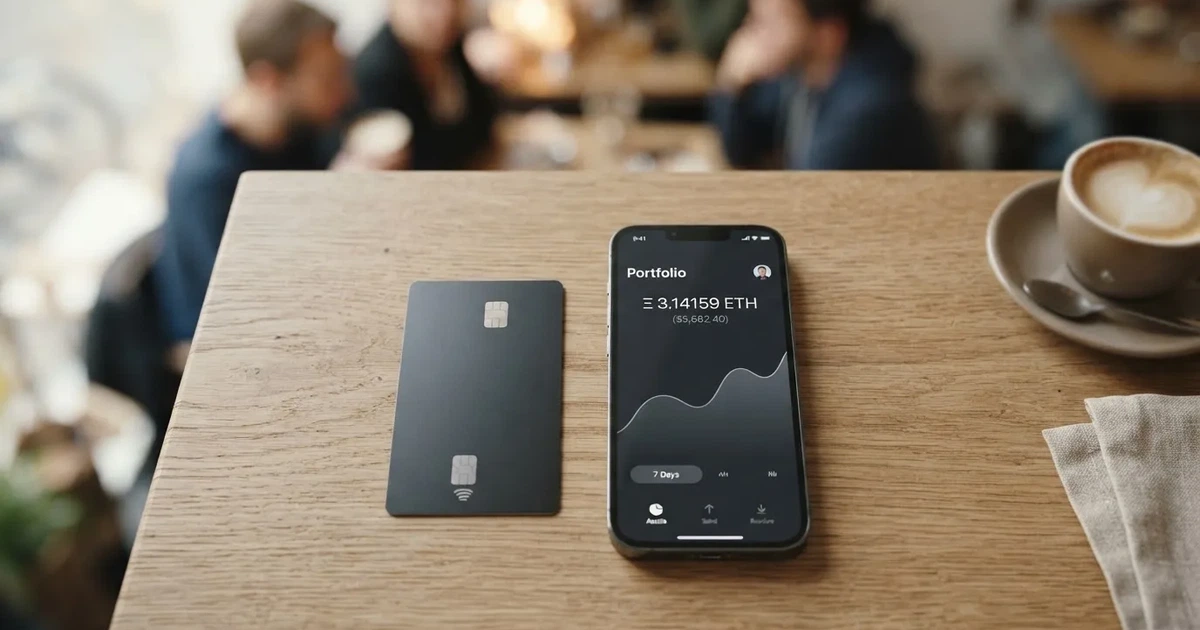
The catch is that this is still a card that is arriving rather than a card that has settled into daily life. The product page carried a “coming soon” label, the physical card is not described, Apple Pay and Google Pay are not described, and the company does not name the bank that issues the card. I gave it 5.8 out of 10. That is not a bad score for an honest self-custody design; it is a middling score for a product you would have to plan around rather than reach for without thinking.
The conditions described below are current as of October 2026.
Verdict: 5.8 out of 10, and the gap is about readiness, not principle
ELLIPAL Pay suits one reader in particular: someone who already trusts the ELLIPAL hardware wallet, already holds stablecoins in their own keys, and wants to spend them at shops. It is built for that flow and it does that flow without asking you to deposit funds with a provider first. If that is you, the design is sound and the fees read better than most of what is in this category.
It suits nobody who needs a card tomorrow. A new account starts as a virtual card, a physical card is not confirmed, mobile wallets are not confirmed, and the issuer behind the programme is not named on ELLIPAL’s own pages. If your rent goes through a card, or your bank needs a card for recurring payments, this is not something to depend on yet. Treat it as something to test with small amounts and see whether it survives your actual spending, not as infrastructure.
| Criterion | Mark | Why |
|---|---|---|
| Who can get it | 6 / 10 | Legal residents of selected countries in Europe and Latin America; everyone else is on a waiting list |
| Cost | 7 / 10 | Officially no transaction fees, no ELLIPAL conversion markup, no gas on payments, card described as free — an unofficial source charges for the card and for cash withdrawals |
| Top-up options | 5 / 10 | Stablecoins from your own wallet, settling on Gnosis Chain at the point of payment; balances in EURe, GBPe and USDCe |
| Reliability and complaints | 6 / 10 | Runs on the Gnosis Pay programme with KYC by SumSub; issuer unnamed, unofficial sources name Monavate; the product page still says “coming soon” |
| Everyday use | 4 / 10 | Virtual card on activation; physical card and Apple Pay / Google Pay not described |
| Total | 5.8 / 10 | A good principle, a product still in rollout |
Read those six rows as one sentence: the card’s economics are its strongest suit and its everyday practicality is its weakest. Everything between those two ends follows from where in the rollout it is.
Will they give you the card?
Yes, if you are a legal resident of one of the countries they open first. Everywhere else, you wait.
The list as published covers European and Latin American countries. On the European side: Austria, Belgium, Bulgaria, Croatia, Cyprus, Czech Rep., Denmark, Estonia, Finland, France, Germany, Greece, Hungary, Iceland, Ireland, Italy, Latvia, Liechtenstein and Luxembourg. On the Latin American side: Argentina, Brazil and Colombia. That is the starting list. It is a residence list, not a citizenship list, and it is not the whole world — Mexico appears in some descriptions of the programme but not in the published starting set I checked, so if Mexico is where you live, ask rather than assume.
Two things this list does not tell you. It does not say what happens if you move, and it does not say whether it is expanding or fixed. Both are the sort of thing that changes quietly and gets noticed only when you try.
The page I checked had itself redirected to the help-centre landing when fetched, which tells you something in its own way: the information about who qualifies is currently sitting in a help centre rather than on a product page. If you are outside the list, the honest answer is that you cannot find out your position from the public pages, and the wait is the thing you are signing up for.
How to get it
The route runs through the ELLIPAL app, and the identity check is the part most people will feel most.
In the app, the path is ELLIPAL App > Assets > Pay > ELLIPAL Pay > Apply. From there you complete identity verification: an email address, a government ID, and a proof of address — a utility bill from the last three months. Then you wait while Gnosis Pay runs the verification. After it clears, you activate a virtual card with a phone number and a source-of-funds confirmation.
So yes, this card requires KYC, and it is not the light kind. Document checks, an address document dated within a three-month window, and a source-of-funds question are all on the list before you hold anything. What is not stated is the minimum age, and what is not stated is how long the verification takes — the process is described as “wait for Gnosis Pay to verify” with no duration attached. Plan for it not being instant.
What you end up holding at the end of this is a Visa card usable wherever Visa is accepted. Balances run in EURe, GBPe and USDCe. A virtual card is what appears at activation; whether a physical or metal card exists, and what delivery looks like, are both things the public pages do not say. I have not assumed either way, because the difference matters if you want a card in a wallet.
Fees: what a payment actually costs you
This is where the card looks best and where the sources disagree most, so read both halves.

Officially, ELLIPAL’s own ordering guide calls the card free. The same guide says no transaction fees, no added fee from ELLIPAL Pay for currency conversion, and no gas fees on card transactions. That is a genuinely strong set of promises: most of what people complain about in crypto cards is either a conversion markup or gas charged at the moment of payment, and both are absent here.
Unofficially, and this is where I would not take the marketing at face value, Gnosis Pay’s own ordering guide for its partner programme says the card costs 30.23 EURe, paid from a Gnosis Chain wallet, plus a little xDai for gas. The same Gnosis Pay help pages describe withdrawals at 250 per withdrawal, 500 daily, with fair use of five free withdrawals or 200 per month and then a 2% fee. These figures come from the partner programme documentation, not from ELLIPAL, and ELLIPAL has not confirmed them for this card. The conflict with “free” is unresolved — I am reporting it rather than picking a winner.
Limits are stated and they are ordinary: a 24-hour rolling daily cap of 8,000 in EURe, GBPe or USDCe, and 5,000 per transaction. ATM fees are not stated on the ELLIPAL pages I read.
| Item | What is stated |
|---|---|
| Card issuance | Called free by ELLIPAL’s ordering guide; unofficial partner documentation says 30.23 EURe plus gas |
| Monthly or annual fee | Not stated |
| Transaction fee | None |
| Conversion fee | No ELLIPAL markup on currency conversion |
| Gas on card payments | None |
| ATM fee | Not stated on ELLIPAL pages; unofficial: 2% after five free withdrawals or 200 per month |
| ATM withdrawal limit | Unofficial: 250 per withdrawal, 500 daily |
| Daily cap | 8,000 (EURe/GBPe/USDCe), 24-hour rolling |
| Per-transaction cap | 5,000 |
| Tiers | Not stated |
Two ordinary payments, so you can see what this looks like in practice. A lunch in a euro-area city spends EURe directly: no transaction fee, no conversion at all, nothing added. A lunch in a city that bills in dollars spends USDC converted at the rate your balance gives you, with no ELLIPAL markup on top — the card’s honest number here is that you carry whatever your stablecoin is actually worth that day, and the network’s rate, not a rate the card company chose.
Top up: there is no deposit step, and that is the point
The funding story is the strongest idea in the product, and it is the reason to look at it at all.
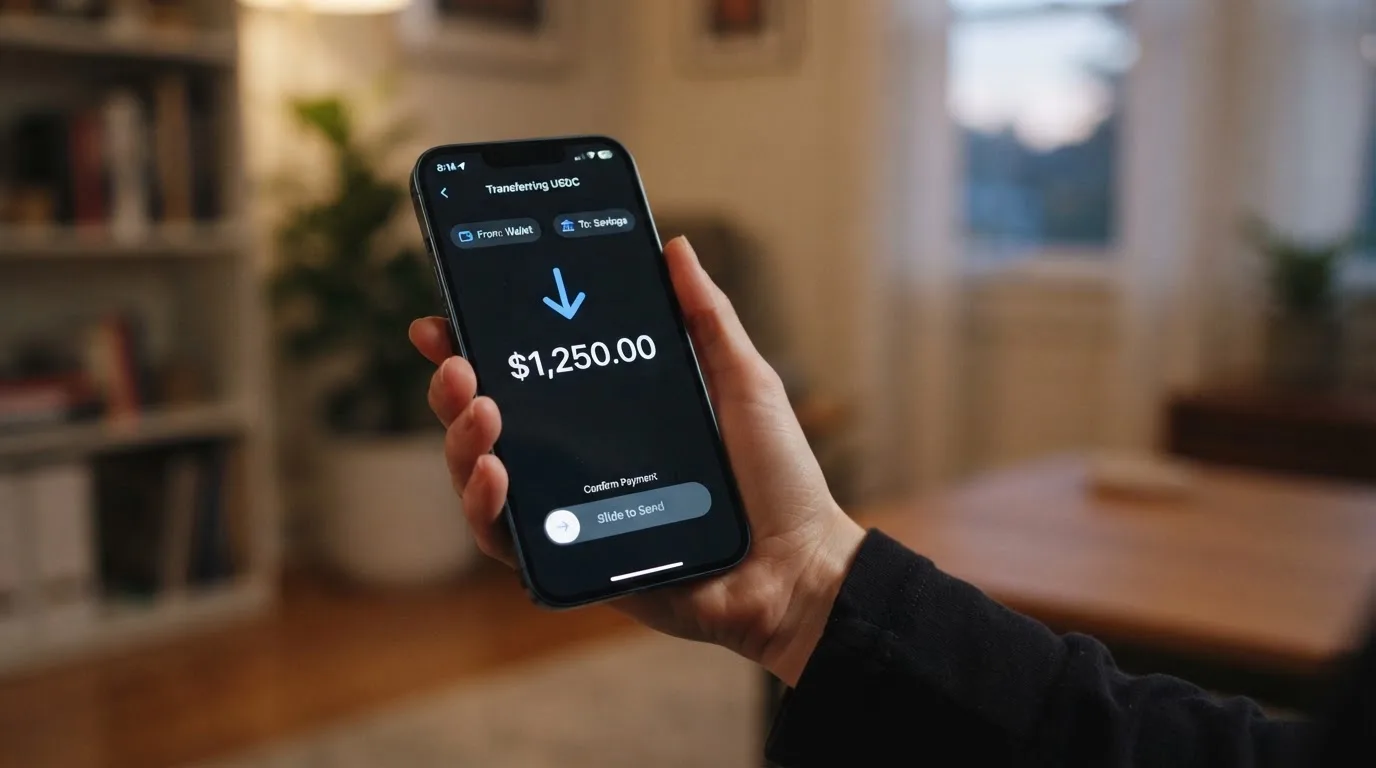
Topping up does not involve topping up. Funds stay in your own wallet. You spend stablecoins from your self-custody wallet, and settlement happens on-chain through the Gnosis Pay smart contract on Gnosis Chain at the moment of payment. There is no deposit step described, and no withdrawal step described — because there is no account balance to deposit into or withdraw from. On-chain fees apply only where an on-chain movement is part of the flow, which is the generic statement ELLIPAL’s own FAQ makes.
Practically this means one thing you should internalise: you need the stablecoin in your own wallet, on a network the flow supports, before you can spend. There is no rescue path described where the card front-end goes and fetches it for you. That is a feature if you like self-custody and a wall if you were hoping for something that feels like an ordinary prepaid card.
The balances you spend from are EURe, GBPe and USDCe — euro-, pound- and dollar-referenced tokens, not the dollar-pegged USDT or USDC most people hold. That is a real difference between this and several alternatives, and it means the question “what exactly do I have in the wallet” deserves a careful answer before you apply rather than after.
Paying with it every day
The honest summary is: you get a virtual card, and the details of everything else are unwritten.
A virtual card is what activates. Whether there is a physical card, whether it is metal, whether you can add it to Apple Wallet or Google Pay — none of this is stated. Same for blocked merchant categories and for the dispute process if a payment goes wrong. If your phone wallet is how you pay for coffee, that is currently an open question.
Rewards are not stated for ELLIPAL Pay. There is an unofficial claim circulating that Gnosis Pay pays 1% to 5% cashback in GNO depending on how much GNO is staked — that comes from a third-party review of Gnosis Pay, not from ELLIPAL, and it is not confirmed for this card. I would not plan around it.
Applying happens inside the ELLIPAL App. I did not read the App Store or Google Play ratings, so I have no view on how people rate the app itself, which is worth checking yourself if the app is your front door to this.
What can go wrong
The failure modes here are not mostly scams or collapses. They are the boring ones: the card not existing yet, the issuer not being named, and the wallet being yours to lose.
- The product is still in rollout. The product page still says “coming soon” and the company describes a gradual release. No dated news about the Pay card was found. That is the single biggest risk: you depend on something that has not fully switched on.
- The issuing institution is not named. ELLIPAL does not state the issuer, its country or its licences on the pages read. Unofficially, DeFiLlama lists the Gnosis Pay card issuer as Monavate. That is a third-party data listing, not a confirmation from ELLIPAL, and if it matters to you, ask who stands behind the card rather than assuming.
- Self-custody means self-loss. No bank and no third party holds, freezes or manages your funds — that is the design and the point. But it also means a lost seed phrase or a copied-and-swapped address is unrecoverable. Blockchain transfers are irreversible, and a deposit sent on an unsupported network or to an address belonging to another network can be lost or need manual support recovery with no guarantee.
- Stablecoins can and do move. USDC temporarily lost its peg in March 2023 during the US banking crisis, and TerraUSD collapsed in May 2022. A card that spends your balance at whatever your stablecoin is worth that day is a card that spends a moving value.
- Not censorship-proof. Tether says it disables tokens in wallets on the OFAC sanctions list and has frozen funds tied to illicit activity. Not anonymity — a stablecoin issuer can act.
- A declined payment can leave a hold on funds for several days, typically up to seven.
- Support is help-centre only. Support is at support.ellipal.com and ELLIPAL says it does not offer phone support — that came from a company reply on Trustpilot dated 25 August 2026. For a card where your money sits in your own wallet, this is less painful than it sounds, but for anything urgent it is a limit.
- Two-factor authentication, instant freeze and spending controls are not stated. The usual safeguards for this kind of card exist in the category; whether they are here is unwritten.
- Complaints exist about the company, not this card. On Trustpilot, ellipal.com — the whole company, hardware wallets, not the Pay card — sits at 4.1 out of 5 from 303 reviews, read 21 October 2026. Recurring themes there are delivery delays, device battery and defect problems, and wallet and app issues, reported between August and October 2026. No official incidents involving the Pay card were found. I would not read the Trustpilot number as a verdict on the card; I would read it as a signal about hardware and logistics, which is a different thing.
What to take instead
If ELLIPAL Pay is not the right fit, the honest comparison is against other cards in the same category — and against being early on a product that is still arriving. All three alternatives below come with their own gaps, which is the point: none of them solves everything.
| Alternative | Score | Strong point | Weak point |
|---|---|---|---|
| ELLIPAL Pay | 5.8 / 10 | No conversion markup, no gas on payments, funds stay in your own keys | Still rolling out, issuer unnamed, virtual card only |
| BloFin Wallet Card | 6.9 / 10 | Four zero-dollar fees: activation, annual, issuance, dormancy; spend fee drops from 1.00% at VIP 0 to 0.00% at VIP 5 | Country list not published on the card page; no cashback, a reduced spend rate instead; FX fee not stated |
| Decaf | 6.2 / 10 | No fee added to the Visa exchange rate; virtual card $5, physical $10 in the US or $90 elsewhere | A long restricted-country list including Russia, Belarus and Ukraine; which coins and networks top up the card is not stated |
| SafePal | 6.2 / 10 | Top-up from 40+ blockchains converted to USDC; 0% standard top-up fee | 1% FX fee on Mastercard non-USD settlement; swaps carry an unquantified spread; region page was empty when checked |
BloFin Wallet Card is the strongest of the alternatives on paper, at 6.9. Its Visa Platinum card charges $0.00 for activation, annual, issuance and dormancy, and its spend fee is 1% or lower depending on VIP tier — VIP 0 at 1.00% down to VIP 5 at 0.00% — charged at payment. You top up with USDT and USDC on Arbitrum and Base. What gives me pause: the country list is not published on the card page (you get “select your country or region” in the app), the starting data lists 35 countries including the US, Australia, Japan, the UAE, Brazil, Mexico, Malaysia and New Zealand without saying whether the test is citizenship or residence, and there is no cashback at all — you get a lower spend rate instead.
Decaf makes a clean FX promise: it adds no fee, and “the FX is the one Visa offers.” Activation is $5 for a virtual card worldwide, $10 for a physical card in the US, $90 elsewhere, with no annual or monthly fee. You can pay a Decaf payment link or account details by card, bank transfer or USDC, the sample balance is in USDC, and the app runs on Solana and Stellar. What I do not like: the restricted-country list is long and includes Belarus, China, North Korea, India, Iran, Iraq, Israel, Myanmar, Nepal, Russia, Syria, Turkey, Cuba, Ukraine, Venezuela, Vietnam, Nicaragua, Puerto Rico and Nigeria, plus a set of US states, and whether the rule follows citizenship or residence is not stated. Which coins and networks actually top up the card is also not stated.
SafePal is the one with the widest top-up reach: crypto from 40+ blockchains, converted to USDC by default or to fiat, with transactions on Arbitrum. No account creation or management fees, and a standard top-up fee of 0%. Against that: a 1% FX fee when Mastercard settles anything non-USD, a refund processing fee of 1 USD/EUR/CHF or 7 CNH, swaps that include a spread nobody quantifies, and — the detail that would stop me — the region list at its own bank page was empty when checked, so who is actually eligible is unclear.
Who I would recommend it to
I would recommend ELLIPAL Pay to someone who already keeps stablecoins in an ELLIPAL wallet, already believes in holding your own keys, and wants to test the self-custody spend model with amounts they can afford to lose. Under those conditions the design is good: funds never leave your wallet, there is no conversion markup to argue with, and no gas at the moment of payment.
I would not recommend it to someone who needs a working card this week, who lives outside the published country list, or whose budgeting depends on a physical card, a phone wallet, or a dispute process. All three of those are unstated, not excluded — but unstated is not the same as available, and a card that might not exist yet is not a card to move a salary onto.
The gap between those two answers is small, and it closes when the product page stops saying “coming soon.” Check that first, then check whether the issuer is named and whether a physical card exists. Those three answers would move my score more than anything else on this page.
Frequently asked questions
What is the ELLIPAL Pay card?
It is a Visa payment card that spends stablecoins straight from your own self-custody wallet. Instead of depositing money with a provider, the payment settles on-chain through the Gnosis Pay smart contract on Gnosis Chain at the moment of purchase. Balances run in EURe, GBPe and USDCe, and it applies inside the ELLIPAL App. It is a Visa card, so it works wherever Visa is accepted.
How does ELLIPAL Pay work in practice?
You apply in the app under Assets > Pay > ELLIPAL Pay, complete identity verification, and activate a virtual card. When you pay, the stablecoins in your own wallet are used to settle the transaction on Gnosis Chain at that moment. Funds stay in your wallet — there is no deposit step and no withdrawal step, because there is no account balance to hold them in. That is the whole idea in three sentences.
Is ELLIPAL Pay a bank?
No — ELLIPAL is not described as a bank, and the issuing institution behind the card is not named on ELLIPAL’s public pages. An unofficial third-party listing names Monavate as the Gnosis Pay card issuer, but ELLIPAL has not confirmed that. In practice the card runs through the Gnosis Pay partner programme, with KYC handled by SumSub. Ask who actually stands behind the card before you rely on it.
Which countries is the ELLIPAL Pay card available in?
Legal residents of a starting list of European and Latin American countries, including Austria, Belgium, France, Germany, Ireland and Italy in Europe, and Argentina, Brazil and Colombia in Latin America. Outside those, the list is described as a waiting list. The published set is a residence list, not a citizenship list, and the page I checked had redirected to the help centre, so eligibility details are thin. If your country is not named, the position is worth asking about rather than assuming.
What do I need to apply, and does it need KYC?
Yes, it needs KYC. You need a government ID, a utility bill from the last three months as proof of address, an email address, and a source-of-funds confirmation, plus a phone number when you activate the card. The verification is run by Gnosis Pay rather than ELLIPAL. Minimum age is not stated, and neither is how long verification takes, so plan for it not being instant.
Is the ELLIPAL Pay card free, and what are the fees?
ELLIPAL’s own ordering guide calls the card free, with no transaction fees, no ELLIPAL markup on currency conversion and no gas on card transactions. Unofficially, Gnosis Pay’s partner documentation says the card costs 30.23 EURe plus a little xDai, and that withdrawals cost 2% after five free or 200 per month. ELLIPAL has not confirmed those figures for this card, and the conflict is unresolved. Limits are 8,000 daily and 5,000 per transaction.
How do I top up the card?
You don’t, in the usual sense. The card spends stablecoins already sitting in your self-custody wallet, and settlement happens on Gnosis Chain at the moment of payment. There is no deposit step described, so what you need is the right token — EURe, GBPe or USDCe — in your own wallet, on a supported network, before you pay. Blockchain fees apply only where an on-chain movement is part of the flow.
Can I add the ELLIPAL Pay card to Apple Wallet or Google Pay?
That is not stated anywhere. What is confirmed is a virtual card at activation; whether a physical or metal card exists, and whether mobile wallets are supported, are both unwritten. This is worth asking before you apply if phone-wallet payment is how you normally spend, because it is central to daily use.
Is the ELLIPAL Pay card safe?
The self-custody part is a real strength: no bank or third party holds, freezes or manages your funds. But that also means a lost seed phrase or a hijacked clipboard address is unrecoverable, and blockchain transfers are irreversible. Two-factor authentication, instant freeze and spending controls are not stated. The issuer behind the card is not named, and the product page still says “coming soon”, so this is not a card to move large sums through yet.
Is the ELLIPAL Pay card worth it?
For someone already holding stablecoins in an ELLIPAL wallet, the fee structure is genuinely good: no conversion markup, no gas on payments, and no third party holding the coins. Against that, the product is still rolling out, the issuer is unnamed, and a physical card, mobile wallets and the dispute process are all unstated. I would call it worth testing with small amounts, not worth reorganising your money around.
Highest-scored wallet cards – cryptocardbest.com
Content created by the «cryptocardbest.com» team