
A self-custody USDC card with a $39 physical card and 1.99% FX — worth it if you already hold the stablecoin
 Available in US
If you have read this page, you are probably in an awkward spot. Ordinary bank cards are hard to get where you live, or your bank will not open an account for you, or you have one but it does not work where you actually spend. The Banqa card exists for that gap: it is a Visa Infinite card that spends a stablecoin balance, and it comes from a brand of Codego Group rather than from a bank named on the card. That last detail matters more than the marketing does, so I will come back to it.
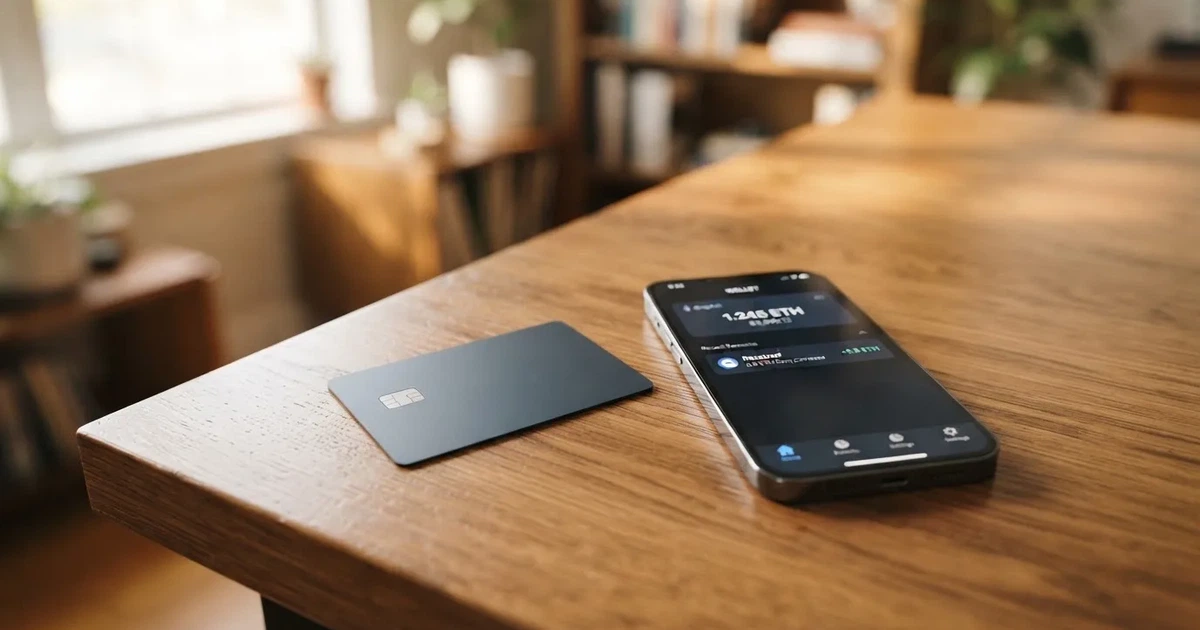
My verdict up front: the card scores 7.1 out of 10. It is a genuinely capable everyday card — virtual and physical Visa Infinite, Apple Pay and Google Pay, ATM access, no annual fee on the Standard tier — wrapped around a self-custody wallet that you hold the keys to. That last part is unusual and, for the right person, a real advantage over custodial crypto cards. But the card’s public pages leave several things unsaid that you would want to know before you rely on it: no published country list, no published daily or monthly limits, no stated minimum top-up, no blocked-merchant list, and no named issuer.
So who is it for? In plain terms: someone who already holds USDC, keeps it in their own wallet, and wants to spend it through an ordinary Visa card without giving a third party control of the coins. If you do not hold USDC yet, or you want a card that quietly handles everything for you, this is not the card to start with.
One more thing before we begin. The details below reflect what Banqa’s own public pages said when I checked them. The terms and conditions are current as of October 28, 2026.
Who will they give you the card to
The honest answer is: I could not find a published list, and that is not a small gap.
Banqa’s own wording is that “eligibility depends on residence and applicable rules,” and that eligibility is confirmed during the application and the identity checks. A supported-countries page is linked from the site, but its contents are not described on the pages I checked. So I cannot tell you whether your country is on the list, and neither, as far as I can see, can you without applying.
Here is why that matters more than it sounds. Country eligibility in this category is rarely about nationality alone. It is usually a mix of where you live, where you are a citizen, and what the issuer’s own risk policy allows. The card’s pages do not distinguish between the two for you. If you are a citizen of one country and resident in another, expect the answer to depend on which one the issuer applies — and expect the application to be the place you find out.
If your country is restricted or your application is declined, the realistic fallback is not another card on the same provider but a different provider. That is why the alternatives later in this review have a whole section each.
The card itself, for reference: it is a Visa Infinite, available in virtual and physical form, in USD. Business customers also get a virtual and a physical card. Any transaction not in USD carries a currency conversion fee — we get to the numbers in the costs section.
How to get it
The path is short and mostly document-driven.
You will need government ID — a passport, national ID or driving licence — plus proof of address dated within the three months before you apply. Higher verification tiers may also ask for source-of-funds documents, which usually means showing where the money you are depositing came from.
The checks themselves run in two speeds:
- Automated checks usually finish within minutes.
- Manual reviews take 24 to 48 hours.
- If a check fails, you can retry from the dashboard.
That is the whole documented flow. There are no instructions on the public pages about an in-person step, a video call, or a branch appointment, and none would be expected for a product of this type.
Two things the pages do not tell you, and I would want to know before applying:
- Age requirement. Not stated. In this category prepaid and debit cards are generally for adults, but that is the general rule for the category, not something Banqa has published.
- Which verification tiers exist and what they unlock. Tier names and amounts are not stated. What is stated is that daily, weekly and monthly limits depend on your verification tier — so the tier you land in will decide how much you can actually spend per day or per month. You cannot look that up in advance; you find out after you are verified.
If you want the physical card in the post, the card’s issuance and shipping for the physical card is priced separately — it appears in the costs table below. Countries served and delivery time are not stated, which for someone outside the mainstream crypto-card markets is the question that actually decides whether the physical card is worth ordering at all.
Fees: what it really costs
The headline is good and the details are mixed. Banqa states no annual fee on the Standard tier, and no conversion fee when you spend USDC directly against your collateral. But there is a $39.00 charge for issuing and shipping a physical card, a 1.99% fee on every non-USD transaction, and an ATM charge that has more moving parts than most people expect.
Here is the documented list:
| Fee or limit | What Banqa states |
|---|---|
| Annual fee | None on the Standard tier; a “Standard tier” is named, other tiers and their benefits are not stated |
| Monthly fee | Not stated |
| Physical card issuance and shipping | $39.00 |
| Account residency (Visa Corporate) | $3.00 |
| Corporate card issuing | $5.00 |
| Account closure | $10.00, one-time |
| Conversion | No fee — USDC is spent against collateral, “no manual conversion” |
| FX on non-USD transactions | 1.99% |
| ATM | Fixed fee $1.50 per withdrawal; percentage fee 1% of the amount plus $1 for end users; balance/decline/authorisation check $0.60 |
| ATM limits | Follow Visa partner standards; free allowance not stated |
| Daily, weekly and monthly limits | Depend on verification tier; amounts not published; per-transaction limits can be set by you |
| Card currency | USD-based |
Read that table twice, because two rows are doing the heavy lifting. The ATM row is unusual: there is a fixed $1.50 fee *and* a percentage charge of 1% plus $1 for end users *and* a $0.60 charge for balance, decline or authorisation checks. Whether those stack on the same withdrawal or apply in different situations is not spelled out. If you take money out of ATMs often, ask before you rely on it.
The FX row is the one that quietly decides whether this card is cheap for you. At 1.99% on every non-USD purchase, a holiday in a euro country costs you 1.99 euros per hundred spent, before anything else. That is not a scandal in this category, but it is a real, ongoing number, and it is the one most likely to be the deciding factor for you if you travel or buy in non-USD currencies routinely.
Now, three everyday payments and which fees apply to each.
A coffee in your home currency, say in the euro zone. This is an FX transaction. Banqa adds 1.99%. There is no conversion fee on top, because you are spending USDC directly against your collateral rather than swapping anything first. So the total overhead on a small purchase is the 1.99% and nothing else. If the coffee costs €4, the currency fee is what 1.99% of €4 comes to — there is no minimum spend published, and no small-purchase exemption stated.
An online subscription billed in USD, say $9.99. This is the case the card is cheapest in. The card currency is USD, so there is no FX fee and no conversion fee. The only risk is a decline, and if the authorisation is declined a hold can sit on the balance for several days — that is a general property of card payments, not something specific to Banqa, and there is no published policy on how holds are released here.
Withdrawing cash at an ATM abroad. This is where several fees meet. The fixed fee is $1.50, the percentage fee is 1% of the amount plus $1 for end users, and if the ATM also charges its own surcharge on top of that, it is outside Banqa’s control and outside this table. A balance or authorisation check adds $0.60 if it applies. This is the payment type to use least.
One number is missing that you may want: monthly fee — not stated. The absence of an annual fee on Standard is the good news, but I could not find a published recurring monthly charge to rule out. Check the fee page yourself before you commit.
How to Top up the card
The mechanism is the thing to understand here, because it is the opposite of how most crypto cards work.
Banqa is tied to a self-custody smart-contract wallet. Your USDC sits in a wallet you control, and spending it against the card moves it on-chain under your authorisation. That is a genuine structural difference from the common model, where a provider holds your balance and you trust them.
The networks named on the card’s pages are Base, Arbitrum and Ethereum. The site says to “hold USDC on Base and Arbitrum” and to “send only USDC on Base.”
The costs:
- Topping up with USDC carries zero deposit fees — “zero deposit fees” and no fee on USDC top-ups.
- Other assets and other networks cost from free to 1% depending on the route, per the fee page.
- Minimum top-up: not stated.
Three practical points follow from that, and all three are ordinary on-chain facts rather than Banqa-specific rules.
- The network you send on must be one the card supports. A transfer sent on a network the provider does not support, or to an address belonging to a different network, can be lost or need manual support recovery with no guarantee. Blockchain transfers are irreversible.
- Native support is narrower than the token. Circle lists USDC as natively supported on 38 networks, Ethereum, Solana, Base, Polygon PoS, Avalanche, Arbitrum and Stellar among them. Circle also stopped supporting USDC on Tron in February 2024, so “USDC over TRC20” is not a native option. Which networks Banqa will actually credit is a narrower question than which networks exist, and the pages name Base, Arbitrum and Ethereum.
- You may need a little of the network’s own token to pay for the transfer. On Ethereum, fees are paid only in ETH, so a wallet holding a stablecoin but no ETH cannot send. Network fees are charged by the blockchain, not by Banqa.
Withdrawing is the reverse trip. The withdraw page moves USDC from the card collateral back to your own wallet via an on-chain authorisation. The home page shows an off-ramp example fee of “1% + $3.00”. Closing the account costs $10.00.
Paying with it every day
This is where the card is strongest, and the reason it scores well on everyday use.
The range of what you can actually do with it is normal-card normal:
- Virtual and physical Visa Infinite, USD.
- Apple Pay and Google Pay are supported on the official page. Adding the card to your phone wallet gives you tokenised payments where the device holds a device-specific number and each payment carries a one-time dynamic code — which is a better shape than handing over a plastic number, not merely a convenience.
- ATM withdrawals, with the fee structure above.
- Per-transaction spending limits you can set yourself, on top of whatever tier limit applies.
What the pages do not say is which merchant categories are blocked. That list exists internally somewhere, and this is one of the most common reasons a crypto card gets declined at a specific shop — a merchant category code classifies a business, gambling is one of the categories issuers often restrict, and blocked lists vary by issuer and are not published here. If you travel or buy from unfamiliar merchants, that is the reason to keep a second card.
On rewards: no cashback is stated. What is stated is a referral programme — 0.15% of friends’ spend, and a $10 bonus per friend who reaches $500 of spend. That is not a rewards scheme, it is a distribution scheme. Judge it as one.
The dashboard is a web/app dashboard. Platforms and store ratings are not stated, so there is no public rating to weigh in with.
One more everyday item that matters more than it sounds: chargebacks. Chargeback handling appears as a disclosed fee in the fee schedule, but the process and the time frames are not described. If a payment goes wrong — goods not received, duplicate billing, fraud — you are reading a fee line rather than a procedure. Treat that as a real limitation on consumer protection.
What can go wrong
This section is where the gaps I mentioned start to cost something.
You may not be eligible, and you find out late. No published country list, eligibility confirmed at application. If you are outside the covered markets, the application is the first and only test.
Your limits are unknown until you are verified. Daily, weekly and monthly limits depend on the verification tier, and the tier names and amounts are not published. If you need to move a known sum on a known day, this card gives you no advance visibility.
The issuer is not named. Banqa is a brand of Codego Group. The cards are issued by a Visa Principal Member pursuant to a licence from Visa — but the card does not name which member. Banqa states it is not a bank. Three consequences follow. You do not have a bank here, so deposit-guarantee thinking does not apply and you should not apply it. The issuer’s own risk policy, and the network’s relationship with it, sit behind the card in ways the marketing pages do not describe. And as a general rule in this category, a network can suspend a programme: Visa terminated its global agreements with FTX on 13 November 2022 and the FTX US debit card was wound down by its issuer; WaveCrest, which supplied crypto card brands, was suspended by Visa in Europe in 2018, closing all WaveCrest-issued Visa programmes. Closures typically mean a notice period, then spending and loading stop, then you are asked to withdraw what is left. One 2026 closure reported by a secondary source had new loads ending 8 July 2026 and spending stopping 8 August 2026 — a single unconfirmed source, but the shape of it is what you would be exposed to.
Complaints cannot be judged from the outside. Trustpilot shows 3.7 from 1 review — a five-star review dated July 2026, with Trustpilot noting the company has not invited reviews. One review is not a sample. I found no complaint themes because there is nothing there yet, and no independent complaint record to tell you whether card freezes get resolved quickly, whether withdrawals get paid, or how support behaves when something goes wrong. Treat 3.7 from one review as an absence of data, not as a score.
If you lose your keys, nobody can help. This is the price of self-custody and it is worth stating plainly. Control of crypto belongs to whoever holds the private key or seed phrase; a seed phrase, typically 12 to 24 words, is an unencrypted form of the private key, and anyone who obtains it can restore the wallet and spend the funds. Blockchain transfers are irreversible and a stolen key has no built-in recovery — the network cannot freeze or return funds. Banqa’s own security design reflects this: the recovery phrase is shown once and is not recoverable by Banqa. In exchange you get a self-custody smart-contract wallet rather than a custodial balance, which is a real reduction in counterparty risk compared with platforms that hold the coins. The history of custodial failures is not theoretical: Mt. Gox (about US$350 million reported stolen, 2011–2014), Coincheck (about US$400 million, 2018), Ronin Network (US$625 million, 2022).
Support is email, usually within 24 hours. That is a reasonable commitment, and 24 hours is a long time when a card is frozen and a hotel is waiting.
What the company does state about security is reassuring, within its limits: instant card freeze in the app, card details shown for 60 seconds, email one-time codes or Google 2FA, passkeys rolling out, Codego running penetration tests and operating under SOC 2 controls. None of that protects your seed phrase.
Two things I could not find at all: news or announcements, and any detail of the chargeback process. Take both as open items.
The regulatory frame, briefly. Identity checks are not a formality: regulated businesses must verify customers and assess risk as part of anti-money-lundering and counter-terrorism-financing law, with ongoing monitoring and suspicious-activity reporting. In the EU that due diligence covers name, address, date of birth, nationality, identity documents, a sanctions check, the purpose of the relationship, and whether you are a politically exposed person. If it cannot be completed, EU rules require the institution to refrain from the relationship and, where necessary, end it — which is why accounts get closed or frozen pending documents. In the US the customer identification programme requires name, date of birth, address and an identification number, and electronic systems also validate proof-of-address documents. Nationality is screened separately from residence, because sanctions screening and issuer risk policy are usually applied to citizenship and country of birth as well as country of address.
Stablecoins are not what the name suggests. A stablecoin aims to hold a stable value against an asset such as a fiat currency, but stablecoins are not necessarily stable. TerraUSD collapsed in May 2022; USDC temporarily lost its peg in March 2023 during the US banking crisis. Tether also disables tokens in wallets on the OFAC sanctions list and has frozen funds tied to illicit activity, so stablecoins are not censorship-proof.
On taxes, one factual pointer and no advice: the IRS treats digital assets as property, so exchanging them for goods, services, dollars or other digital assets generally produces a taxable gain or loss, measured in local fiat currency at fair market value on the transaction date. Each card payment funded from crypto may therefore be a separate disposal. I am not qualified to tell you what applies to you, and I am not going to try.
One category detail that bites prepaid-style cards: Address Verification Service compares the numeric parts of a billing address with issuer records, is mainly offered in the US, Canada and the UK, and is generally unavailable for foreign-issued cards — which can cause declines. A card issued in one country can look foreign to a shop in another, because merchants can look up the BIN to see the issuing institution and country.
What to take instead
Three cards from the same category, and honestly each has one thing Banqa lacks.
BloFin Wallet Card — 6.9 / 10. Closest alternative on price. Activation, annual, issuance and dormancy fees are each $0.00, and cancellation is free — so no $39 to start and no 1.99% FX line stated. Its spend fee is “1% or lower” by tier, charged at payment: VIP 0 at 1.00% up to VIP 5 at 0.00%, so the effective rate falls as your tier rises. Top up with USDT and USDC on Arbitrum and Base. The card is a Visa Platinum. Two gaps: the country list is not published on the card page — you pick your country or region in the app — though starting data lists 35 countries including the US, Australia, Japan, the UAE, Brazil, Mexico, Malaysia and New Zealand, and whether the test is citizenship or residence is not stated. Card currency is not stated, and whether virtual or physical exists is not stated. There is no cashback; you get a reduced spend rate instead.
Decaf — 6.2 / 10. The one with the clearest published geography. It names the countries it is not issued in — Belarus, China, North Korea, India, Iran, Iraq, Israel, Myanmar, Nepal, Russia, Syria, Turkey, Cuba, Ukraine, Venezuela, Vietnam, Nicaragua, Puerto Rico, Nigeria — and the restricted US states: Arizona, Delaware, Georgia, Idaho, Louisiana, Maryland, Montana, Ohio, Oregon, Rhode Island, Washington, Wisconsin. Russia and Belarus are both on the list, and whether the rule runs on citizenship or residence is not stated. On cost it is cheap at the low end and expensive at the high end: a virtual card is $5 worldwide, a physical card is $10 in the US or $90 in the rest of the world, and there is no annual or monthly fee. Its FX position is the cleanest of the three — Decaf adds no fee of its own, “the FX is the one Visa offers.” It is a Visa card, virtual or physical, with tracked delivery on the physical one. Card currency is not stated, the crypto conversion fee is not stated, and which coins and networks top up the card is not stated. You can pay a Decaf payment link or account details by card, bank transfer or USDC, and the app runs on Solana and Stellar, with the sample balance shown in USDC. Rewards not stated.
SafePal — 6.2 / 10. The broadest on-chain reach, and the most explicit about being a custodial product. Eligibility is for “citizens of supported regions who live in supported areas” — and the regions list was empty when it was fetched, so I would not rely on it either way. It is a virtual Mastercard debit, physical not stated, with spending limits given in EUR against a Swiss Fiat24 account. No account creation or management fees; card issuance fee not stated. Top up from 40+ blockchains, converted to USDC by default or to fiat, with transactions on Arbitrum; the bank page elsewhere says crypto top-up “as low as 0.4%” on the top tier, standard top-up fee 0%, Mastercard non-USD settlement 1% FX, refund processing 1 USD/EUR/CHF/7 CNH, and swaps include a spread that is not quantified. No cashback; instead referral commissions of up to 40% of referred top-up fees and tier privileges tied to deposits, referrals and SFP staking.
| Banqa 7.1 | BloFin 6.9 | Decaf 6.2 | SafePal 6.2 | |
|---|---|---|---|---|
| Network and card | Visa Infinite, virtual + physical | Visa Platinum | Visa, virtual + physical | Virtual Mastercard debit |
| Card currency | USD, stated | Not stated | Not stated | Limits in EUR |
| Upfront card cost | $39.00 physical | $0.00 | $5 virtual / $10 US physical / $90 rest of world physical | Issuance not stated |
| Annual fee | None on Standard tier | $0.00 | None | No account fees |
| Spend or FX fee | 1.99% FX, no conversion fee | 1% or lower by tier | No added FX fee, Visa rate | 1% non-USD settlement |
| Top up | USDC, Base / Arbitrum / Ethereum | USDT and USDC, Arbitrum and Base | Not stated for the card; USDC by link | 40+ blockchains to USDC or fiat |
| Geography | Not published | Not published on card page | Restricted-country and US-state lists published | Regions page empty when fetched |
| Rewards | Referral only | Lower spend rate by tier | Not stated | Referral commissions, no cashback |
Where each loses: Banqa’s costs are the ones you can actually read in advance and they sit in the middle. BloFin is cheaper to start but tells you less about where it works and what currency the card holds. Decaf publishes its geography, which is worth more than it sounds, but its physical card costs $90 outside the US. SafePal is the broadest on chain and the weakest on disclosure.
Who I would recommend it to
I would recommend this card to three kinds of person, and I would not recommend it to most others.
Recommend it if you already hold USDC. That is the single condition. If the money is already in a self-custody wallet on Base, Arbitrum or Ethereum, Banqa turns it into a Visa Infinite with Apple Pay and Google Pay at no annual fee on the Standard tier, with no conversion fee when you spend. That is a good deal and there is not much else that does it.
Recommend it if you mind who holds the keys. This is the honest differentiator. Your USDC sits in your own wallet and moves under your authorisation, not in a provider’s balance. If you have watched custodial platforms fail — Mt. Gox, Coincheck, Ronin — that difference is worth something real. The cost of it is that a lost seed phrase is gone, and Banqa cannot recover it.
Recommend it if your spending is mostly in USD, or you are relaxed about 1.99% on non-USD purchases. If you buy in euros, pounds or anything else regularly, that fee is the number that decides it, and you should compare against BloFin’s tiered spend rate or SafePal’s 1% settlement fee before you commit.
I would not recommend it if you need to know your limits in advance — daily, weekly and monthly caps depend on an unpublished tier. Not if you rely on chargebacks — the handling is a fee line, not a procedure. Not if cash machines are your main cash source — the ATM fee structure has more parts than it should. Not if you are outside the mainstream crypto-card markets — with no published country list and no stated delivery countries for the physical card, this is a card to try only if you are comfortable discovering the answer by applying. And not as a first crypto card — if you do not hold USDC yet, you would be buying a stablecoin and a card in the same week, and there are simpler ways to start.
Frequently asked questions
What is the Banqa card?
Banqa is a Visa Infinite payment card that spends a stablecoin balance rather than a bank balance. It is available virtual and physical, denominated in USD, and works with Apple Pay and Google Pay. Banqa describes it as spending USDC held in a self-custody smart-contract wallet on Base, Arbitrum or Ethereum. The card comes from Codego Group, which states it is not a bank, and the issuing bank is a Visa Principal Member that the card’s pages do not name.
How does the Banqa card work?
You hold USDC in your own wallet, and the card spends it against the card’s collateral under your authorisation, with no manual conversion step. Payments go out as ordinary Visa transactions; Apple Pay and Google Pay tokenise the card on your device. The difference from a typical crypto card is custody — the coins never sit in a provider’s balance while you wait. In return, you are responsible for your seed phrase and for sending on a network the card supports.
Is Banqa a bank?
No, and Banqa says so itself. It is a brand of Codego Group, and the cards are issued by a Visa Principal Member under a licence from Visa, with the issuer’s name not published on the pages I checked. That distinction matters for how you think about your money: this is not a bank deposit, so deposit-guarantee schemes and the expectations that come with them do not apply. It is a payment card product with a crypto balance behind it.
Is the Banqa card safe?
Structurally, it removes the counterparty risk that custodial crypto cards carry, because your USDC stays in a wallet you control. Banqa also describes instant card freeze in the app, card details shown for 60 seconds, email one-time codes or Google 2FA, passkeys rolling out, and SOC 2 controls and penetration testing at Codego. What nobody protects you from is your own key loss — the recovery phrase is shown once and is not recoverable by Banqa.
What does the Banqa card cost?
There is no annual fee on the Standard tier, and no conversion fee when you spend USDC. The costs that bite are $39.00 to issue and ship a physical card, 1.99% on every non-USD transaction, an ATM fixed fee of $1.50 plus a percentage fee of 1% plus $1 for end users, a $0.60 balance or authorisation check, $3.00 for account residency under Visa Corporate, $5.00 for corporate card issuing, and $10.00 one-time to close the account. A monthly fee is not stated.
How do I top up the Banqa card?
You send USDC to the card’s smart-contract wallet on Base, Arbitrum or Ethereum, from a wallet you control. USDC top-ups carry zero deposit fees. Other assets and other networks cost from free to 1% depending on the route, and the minimum top-up is not stated. Check the network before you send: transfers are irreversible, a wrong network can mean lost funds, and on Ethereum you need a little ETH to pay the network fee. Circle stopped supporting USDC on Tron in February 2024, so TRC20 is not a native route.
Can I use Banqa card in my country?
I cannot tell you, and neither can you without applying. Banqa publishes no country list and states that eligibility depends on residence and applicable rules, confirmed during application and the identity checks. Country rules in this category often depend on citizenship as well as address, and Banqa does not say which one it applies. If travel is the point, also weigh that the card is USD with a 1.99% FX fee on anything else, and that the countries served for physical-card delivery are not stated.
Is Banqa card free?
Not quite. There is no annual fee on the Standard tier and no conversion fee on spending USDC, so the running cost can genuinely be zero if you stay in USD and never use an ATM. But the physical card costs $39.00 to issue and ship, non-USD purchases cost 1.99%, and cash withdrawals carry several separate charges. A monthly fee is not stated, so confirm that on the fee page before you treat “free” as settled.
How do I add Banqa card to Apple Wallet?
Apple Pay is supported on Banqa’s official page, so the card is added the normal way from the app or the dashboard rather than by typing in a card number. What is worth knowing is what happens afterwards: Apple Pay stores a device-specific number in the phone’s secure element, not on Apple’s servers, and each payment carries a one-time dynamic code. That is a meaningfully safer way to pay than handing over a plastic card number at a terminal. Google Pay works too.
Is Banqa card worth it?
For someone who already holds USDC in their own wallet and spends mainly in USD, yes — no annual fee on Standard, no conversion fee, and a real Visa Infinite with mobile wallets. For everyone else the arithmetic is less kind: 1.99% on non-USD spending, $39 for the physical card, a complicated ATM fee, and limits that depend on an unpublished verification tier. Compare BloFin for a cheaper start, Decaf if published country rules matter to you, or SafePal if on-chain reach matters more than fee transparency.
Highest-scored wallet cards – cryptocardbest.com
Content created by the «cryptocardbest.com» team