
What Agora really costs, who can get one, and whether the numbers add up
 Available in US
Agora is one of a new wave of crypto cards that turn a stablecoin balance into an ordinary payment card you can use in shops, online and at a cash machine. On paper it does the job well: broad country coverage, high limits, Apple Pay and Google Pay, and a virtual card you can hold within days of signing up. The arithmetic is less flattering. Issuing a virtual card costs $90, the page’s own total for a virtual card’s fees comes to 5.0%, the physical card is $500, and the card’s issuing bank and licences are not named on the pages I could read. That combination — excellent scores for reach and everyday use, poor scores for cost and reliability — is why the card lands at 5.4 out of 10 rather than higher or lower.
The conditions described here are current as of October 28, 2026.
Verdict: a strong reach with an expensive, thinly documented setup
Agora scores 5.4 / 10. That number is not a rounding of “fine” or “avoid” — it is a genuinely split card. On the two things most people care about when they cannot get a normal bank card, it scores near the top: 9 / 10 for who can get it and 9 / 10 for everyday use. On the two things that decide whether you should hand it money, it scores near the bottom: 1 / 10 for cost and 3 / 10 for reliability and complaints. Top-up options sit in the middle at 6 / 10.
If you are privacy-minded and want a no-KYC virtual card that spends almost anywhere, Agora is one of the more capable cards in this category. If what you want is a cheap everyday card, the $90 issuance fee and the 5.0% all-in figure are a poor deal, and the thin paper trail — no named issuer, no licences on the official page — is a poor foundation for trust.
Here is the score, criterion by criterion:
| Criterion | Score | Why |
|---|---|---|
| Who can get it | 9 / 10 | 26 countries and regions are closed, including Russia, Belarus, Ukraine, Iran, North Korea, Cuba and Venezuela; the rest of the world is open |
| Cost | 1 / 10 | Virtual Basic issuance $90, Plus $100, physical $500; top-up 2%, transaction $0.35 + 1.5%, FX 1.5%, page total 5.0%, ATM 2% |
| Top-up options | 6 / 10 | USDT and USDC supported; the networks behind them are not disclosed, no other coins named |
| Reliability and complaints | 3 / 10 | Issuer and licences not named; company founded April 2026 (unofficial); an unofficial review lists missing legal documents and terms and an anonymous structure; Trustpilot 4.4 from about 10 reviews (unofficial) |
| Everyday use | 9 / 10 | Virtual Basic and Plus cards plus a physical card; Apple Pay and Google Pay; ATM at 2% on the physical card |
| Total | 5.4 / 10 |
The audience note behind that score matters as much as the number: this card is aimed at people who value privacy and want a no-KYC virtual card. That goal is what the 9/10 for reach and everyday use are measuring. Whether you should trust it with your balance is what the 3/10 is measuring. Both are true at once.
Will they give you the card?
They will give it to almost anyone outside a list of excluded regions — but the list itself is where you need to look before you spend time on the rest. The official page names the places it cannot serve: “Due to regulatory requirements, we cannot currently serve the following regions” Somalia, Central African Republic, DR Congo, Guinea-Bissau, Libya, Mali, South Sudan, Sudan, Zimbabwe; Afghanistan, Iran, Iraq, Lebanon, Myanmar, North Korea, Syria, Yemen; Belarus, Russian Federation, Ukraine; Cuba, Haiti, Nicaragua; Venezuela. That is 26 countries and regions closed between them. Everyone else is open.
Two things to keep in mind. First, the page does not say whether the rule follows your citizenship or your residence, and that distinction matters a great deal if you live in one place and hold a passport from another. If you are, say, a citizen of an excluded country living in an open one, the page does not tell you which way the decision goes. Second, being outside the list does not guarantee the card will arrive at your address; delivery is a separate question, covered below.
Beyond geography, there is one more gate the official page leaves open. What verification is required to open an account is not stated on the official page. An unofficial summary (cryptocards.so, 2026) says “No KYC verification required (Level 0)”, with email, phone, ID, proof of address and selfie all listed as not required. That is not confirmed by the card’s own pages, and you should treat it as a claim from a third-party site rather than a promise. The card itself never names any KYC levels at all. If avoiding identity checks is a hard requirement for you, this is exactly the kind of point to test in a small amount before you commit a large balance.
How to get it
The application runs through the web, not a native app you download. The official entry points are app.agora.cards, where you log in and buy a card, and cards.agora.supplies, which handles the physical card side. There is no native mobile app named on the page, and store ratings are not stated, so you cannot read a rating to judge the software.
There are three cards to choose from: Virtual Card Basic, Virtual Card Plus and Physical Card. Whether they run on the Visa or Mastercard network is not stated, and neither is the currency the card is denominated in — both are things you would normally want to know before paying $90 or $500 for one. What the page does give you is the shape of the choice, and it is a real choice: Basic is the cheaper entry, Plus trades a slightly higher top-up fee for much higher limits and a longer validity, and the physical card is the expensive outlier with ATM access.
Delivery for the physical card is “48–72h priority delivery via EU and US warehouses”, which is fast for a physical card anywhere in the world. GoDarkEU is named as an official physical card distributor, and cards can be customized on request. The cost of a replacement card, if you lose it, is not stated — worth knowing before you commit to the $500 tier.
| Card | What it is | Issuance | Limits |
|---|---|---|---|
| Virtual Basic | Virtual card for online and everyday spending | $90 (includes $10 credit, valid 3 years / $1M) | $240,000 daily, $900,000 monthly, $20,000 per transaction |
| Virtual Plus | Virtual card with higher ceilings | $100 (includes $10 credit, valid 4 years) | $900,000 daily, unlimited monthly, $60,000 per transaction |
| Physical | Card you can hold and use at ATMs | $500 (valid 4 years) | $240,000 daily, $900,000 monthly, $20,000 per transaction; ATM $1,500 daily, $15,000 monthly |
An unofficial source (cryptocards.so, 2026) says the monthly fee is free and issuance is $90; the card’s own pages do not state a monthly fee either way.
Fees: what it really costs
The costs are the reason this card scored 1 / 10, so I want to give you the real numbers rather than the headline. Issuance is not a token amount: $90 for a Virtual Basic, $100 for a Virtual Plus, $500 for the physical card. On top of that, every top-up costs 2% (2.5% with Plus), every transaction costs $0.35 plus 1.5% on a virtual card or $0.10 plus 1.5% on the physical one, and the FX conversion fee is 1.5%. ATM withdrawals on the physical card are 2%. The card’s own page totals these for you, arriving at 5.0% all-in for a virtual card (5.5% with Plus) and 5.0% for the physical card (7.0% once ATM withdrawals are included).

| Fee or limit | Virtual Basic | Virtual Plus | Physical |
|---|---|---|---|
| One-time issuance | $90 (includes $10 credit) | $100 (includes $10 credit) | $500 |
| Validity | 3 years / $1M | 4 years | 4 years |
| Monthly fee | not stated | not stated | not stated |
| Top-up fee | 2% | 2.5% | 2% |
| Transaction fee | $0.35 + 1.5% | $0.35 + 1.5% | $0.10 + 1.5% |
| FX fee | 1.5% | 1.5% | 1.5% |
| ATM withdrawal | no ATM access | no ATM access | 2% |
| Page’s all-in total | 5.0% | 5.5% | 5.0% (7.0% with ATM) |
The free allowance, if any, is not stated. The card currency is not stated.
Let me run three everyday payments through those numbers so you can see how the percentages stack. A $40 grocery shop: top-up 2% is $0.80, the transaction fee $0.35 + 1.5% is $0.60 + $0.35 = $0.95, so the top-up fee and transaction fee together add about $1.75, before any FX conversion if your money is not already in dollars. A $15 coffee shop: top-up 2% is $0.30, transaction $0.35 + $0.225 = $0.575, so roughly $0.88 in fees on a $15 purchase. A $200 online purchase in a currency other than your own: transaction $0.10–$0.35 + $3.00 at 1.5% (physical), plus a further 1.5% on the FX conversion itself, and plus whatever spread sits in the conversion rate you are given — and if you had to top up first, another 2%. This is why the page’s own 5.0%–5.5% figure exists: the fees are real, they are charged at several points, and they land on small purchases hardest.
The takeaway for a buyer: this is not a card for someone who wants to spend a modest amount often. It is priced like a tool for moving larger sums, or for a buyer who values access more than the cost of access.
Top up: USDT and USDC, and the network question
Agora supports USDT and USDC — the card’s page lists exactly those two. The networks behind them are not stated, and no other coins are named, which is why this section scored 6 / 10 rather than higher. Two stablecoins sounds narrow until you try to use it, because which chain your tokens sit on decides whether a deposit works at all.
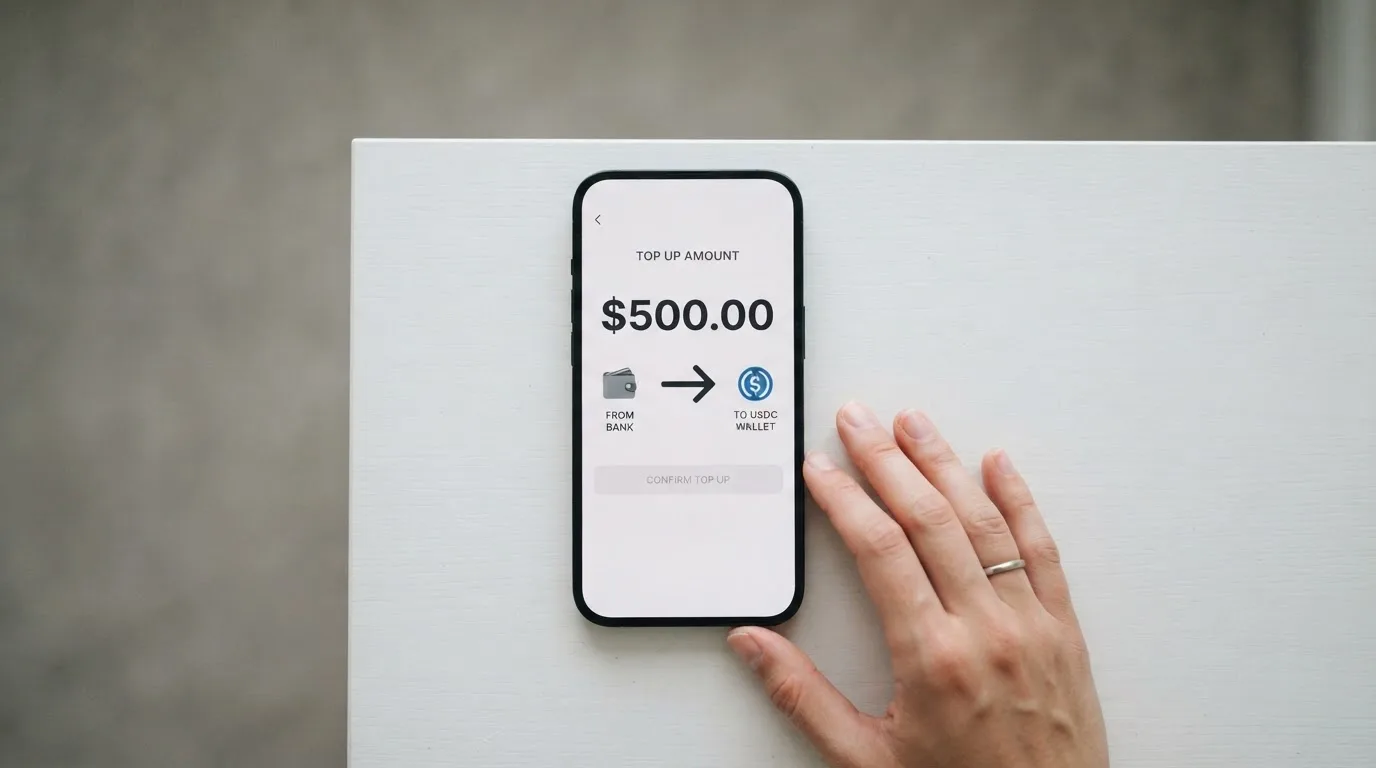
The fee for topping up is 2%, or 2.5% if you hold the Plus card. The minimum top-up, who pays the blockchain network fee, and any fiat top-up option are all not stated on the page. An unofficial source (cryptocards.so, 2026) lists “flat blockchain network fees on every top-up” among its cons, which matches how this category normally works: the on-chain gas is charged by the network, not by the card provider, and you pay it on top of the card’s own percentage.
This is the single most important thing to get right, and it is the part I would test first. Blockchain transfers are irreversible. If you send USDT on a network the provider does not support, or to an address belonging to a different network, the funds can be lost or need manual recovery through support with no guarantee of success. Before your first transfer of any size, send a small test amount and confirm it landed.
One oddity worth flagging, because it goes to the heart of who holds your money: the page calls the service “Self-Custodial” while also saying funds are held by “licensed and regulated custodian partners”. The page does not reconcile the two statements. In practice, that means you should not assume you hold the keys to your balance just because the word “self-custodial” appears. How to withdraw money from the card is not stated on the official page.
Paying with it every day
This is where Agora is at its best, and it is why the everyday-use score is 9 / 10. You get virtual and physical cards, Apple Pay and Google Pay on both, and — on the physical card — cash machine access at 2% per withdrawal. The daily limits are high enough that you are unlikely to hit them in normal life, even on the basic virtual card.
The services you add the card to work the way mobile wallets normally work: the card number is replaced by a device-specific number, and each payment uses a one-time code. If you add a virtual card to Apple Wallet or Google Wallet and then freeze or lose the physical card, your phone still works — a useful property for anyone whose goal is to avoid carrying a card with a visible brand.
Two constraints are worth knowing. First, there are prohibited uses: gambling, cryptocurrency purchases, sports betting, petrol, military supply, gaming credits, non-profit organizations and government agencies are all off-limits. That is a policy list, not a legal one, and it means a payment in those categories can be declined even where the network itself would allow it. Second, there is no cashback on the page. What the page does offer is referral bonuses: $5 per virtual card sale and $30 per physical card sale.
If you travel, one general fact applies to every card of this kind: merchants can look up the card’s issuing country from the card number and may apply extra scrutiny when it differs from the billing address. That is why a card issued in one country can look “foreign” to a shop in another, and it is not a defect particular to Agora. Address-verification checks, which compare the billing address a buyer types against the issuer’s records, are mainly available in the US, Canada and the UK and are generally unavailable for foreign-issued cards — another reason some checkouts decline. How to dispute a charge on Agora is not stated on the page, and that is a gap you would want closed before you keep a large balance.
What can go wrong
The reliability score here is 3 / 10, and the reason is not a scandal but a thin file. The official page does not name the issuer, the legal entity, or any licence. The brand is “Agora Cards”, said to be incorporated in Singapore in starting data, but that is not confirmed on a page I could read. An unofficial source (cryptocards.so, 2026) says it is operated by Agora Cards, established April 2026 — a company less than a year old at the time of writing.
Against that background, the complaint picture is thin but not damning. I found no official incidents. One vendor-opened thread on a forum (via an aggregator summary, 2026) reports the virtual card working almost everywhere except Uber. The same unofficial review lists as cons a “complete lack of legal documentation or Terms of Service” and “high counterparty risk due to anonymous company structure”. Trustpilot shows 4.4 / 5 from roughly 10 reviews as of mid-2026 — second-hand via an aggregator, since the Trustpilot page itself was not read, and a sample of ten is too small to lean on either way. Praise in those reviews goes to privacy, easy top-up and helpful support; there are no widespread reports of chargebacks or frozen funds. The aggregator notes much of the forum material is vendor-linked, which is worth holding in mind when reading any forum thread about a young card.
Security features are where the page goes quiet. Two-factor authentication, instant freeze and spending controls are all not stated. The practical safeguards people usually rely on — app-based 2FA, instant freeze, spending limits, 3-D Secure confirmation, tokenised mobile wallets — you should assume you need to ask about rather than expect. If none are offered, that is not disqualifying, but it is a real gap.
Support is the one place the card is reassuringly clear: “Real human agents available around the clock”, over Signal, SimpleX Chat, Telegram and X. Round-the-clock human support is genuinely useful with a card like this, because most of the things that go wrong — a deposit on the wrong network, a declined checkout — are support problems, not user errors. Still, support cannot substitute for a named issuer.
Let me put the counterparty risk in plain terms, because it is the thing that decides this card. Custodial platforms have a history of failure: Mt. Gox (about US$350 million reported stolen, 2011–2014), Coincheck (about US$400 million, 2018), Ronin Network (US$625 million, 2022). Holding funds with a custodian carries that kind of risk, and a self-custody-linked card avoids it at the price of making you responsible for key loss, phishing and clipboard malware. Whatever “self-custodial” means on this particular page — and the page contradicts itself — the real question is whether you can point to the licence of the institution holding your balance. On these pages, you cannot.
Alternatives worth comparing
Three other cards in this category scored higher overall, and each trades something away to get there. The comparison below uses each card’s published scores.
| Card | Score | Issuing cost | Transaction fee | Funding | Key trade-off |
|---|---|---|---|---|---|
| OkiCard | 6.0 / 10 | $0 issuance, $0 monthly, starting price $15 for the virtual card (pages disagree on the issuance fee); initial deposit 100 USDT | 0% on USD transactions; 3% load fee; “no hidden exchange spreads”; FX fee not stated | USDT on BSC (BEP-20), Ethereum (ERC-20), Tron (TRC-20) and Solana (SPL); USDC “soon”; BTC and altcoins “coming soon” | Cheapest to hold and cheapest to spend, but fewer coins and a narrower country story |
| Cardex | 5.6 / 10 | not stated | No percentage stated; real-time crypto-to-fiat conversion at the moment of payment, with an “AI-Powered Conversion Rate” | USDT, USDC and BTC wallets; networks not stated | No stated fee percentage at all, which cuts both ways — you cannot compare what is not disclosed |
| TakeCard | 5.5 / 10 | Virtual $5; physical (Bolivia) $20 issuance + $20 shipping (another article says $10 for physical in Bolivia — conflicting) | 1% commission per purchase; USD payments 1:1; other currencies at the official Visa rate of the day; crypto conversion fee not stated | Top up from the Takenos balance; coins not named in the article; starting data says USDC/USDT via Polygon, BNB Chain, Tron or Ethereum — not verified | Much cheaper to issue, but the physical card is “available only to Bolivian users for now” |
A few things stand out. OkiCard is the one to look at first if your priority is cost: $0 issuance, $0 monthly, and 0% transaction fees on dollar spending make its 6.0 / 10 the most economically sensible of the four. Its weakness is breadth — mostly USDT, USDC still pending. Cardex is the most opaque on fees, which makes it impossible to compare on price; it also runs on VERVE, Visa, Mastercard and UnionPay and is Naira-focused in its app listing. TakeCard is the cheapest to issue by a wide margin ($5 virtual) and charges a flat 1% per purchase, but its physical card is Bolivia-only.
The honest summary of the alternatives: none of them is dramatically safer than Agora. All of them share the same category weaknesses — an unnamed issuer here, a pending coin there, an unconfirmed licence somewhere. Choosing among them is a matter of which trade-off you can live with, not which one is beyond reproach.
Who I would recommend it to
I would recommend Agora to a person who has hit a wall with ordinary banking — no conventional card, or a country or situation where the mainstream options have closed up — and who values a virtual card with Apple Pay and Google Pay that spends almost anywhere, including the places where address verification and foreign-card rules would otherwise cause declines. If your requirement is a no-KYC virtual card and you have read that the verification level is “not stated” officially rather than confirmed, test the waters with a small balance before you rely on it.
I would not recommend it as a cheap everyday card. At $90 to issue and a page-total of 5.0% in fees, it is expensive by design, and the numbers only make sense if you are spending in larger amounts or the card’s access is the point rather than the price. I would also hesitate if you are putting a large balance on it, because the issuing bank and licences are not named on the official pages and the company is barely a year old. If that matters to you — and for many people it does — one of the alternatives, or an established exchange’s own card, is the safer place for the bulk of your money.
Before you commit, three checks in order: confirm your country is not on the excluded list and whether the rule follows citizenship or residence; send a small test top-up on the network the provider actually supports; and ask support directly which institution holds the balance and under what licence. The answers to those three will tell you more than the rest of this page can.
Frequently asked questions
What is Agora card?
Agora is a crypto payment card that turns a stablecoin balance into an ordinary card number you can spend in shops, online and at a cash machine. It comes as a virtual Basic card, a virtual Plus card and a physical card. You load it with USDT or USDC, and it behaves like a prepaid card — it spends only the balance you have put in. The brand is Agora Cards, said to be incorporated in Singapore, established April 2026 per an unofficial source.
How does Agora card work?
You log in on the web at app.agora.cards, buy a card, and top it up with USDT or USDC. The balance is converted and loaded as fiat value, and your card spends only that stored amount, so it cannot overdraw. The page calls the service “Self-Custodial” while also saying funds sit with “licensed and regulated custodian partners” — the page does not reconcile those two statements, which is worth asking about.
Does Agora card require KYC?
What verification is required is not stated on the official page. An unofficial source (cryptocards.so, 2026) says “No KYC verification required (Level 0)”, with email, phone, ID, proof of address and selfie all not required. That is a third-party claim, not something the card confirms, and no KYC levels are named officially at all. Test with a small amount first.
How much does the Agora card cost to get?
Issuance is the headline cost: $90 for a Virtual Basic (includes $10 credit, valid 3 years), $100 for a Virtual Plus (includes $10 credit, valid 4 years) and $500 for the physical card (valid 4 years). A monthly fee is not stated on the official page; an unofficial source says it is free. On top, top-up is 2% (2.5% with Plus), transactions are $0.35 + 1.5% virtual or $0.10 + 1.5% physical, FX is 1.5% and ATM 2%.
Can I use the Agora card in my country?
The official page says it cannot serve, “due to regulatory requirements”, Somalia, Central African Republic, DR Congo, Guinea-Bissau, Libya, Mali, South Sudan, Sudan, Zimbabwe; Afghanistan, Iran, Iraq, Lebanon, Myanmar, North Korea, Syria, Yemen; Belarus, Russian Federation, Ukraine; Cuba, Haiti, Nicaragua; and Venezuela. The rest of the world is open. Whether the rule applies to your citizenship or your residence is not stated, so check before you spend time on the rest.
Is Agora card free?
No. The cheapest tier, Virtual Basic, costs $90 to issue, though that includes $10 of credit. There is no stated free monthly fee, and even if there is none, you still pay the transaction fee of $0.35 + 1.5% on a virtual card or $0.10 + 1.5% on the physical one, plus 2% to top up. The card’s own page totals a virtual card at 5.0% all-in.
How do I top up the Agora card?
You load it with USDT or USDC — those are the only two the page names. The networks behind them are not stated, and no other coins are listed. The top-up fee is 2%, or 2.5% with the Plus card, and blockchain network fees are charged separately by the network. Send a small test amount first: transfers are irreversible, and a deposit on an unsupported network can be lost.
Where can I use the Agora card, and does it work in Apple Pay?
The virtual cards work online and in shops broadly, and both virtual and physical cards can be added to Apple Pay and Google Pay. One user report via an aggregator (2026) says the virtual card worked almost everywhere except Uber. Note that gambling, crypto purchases, sports betting, petrol, military supply, gaming credits, non-profits and government agencies are prohibited uses on this card.
Is Agora card safe?
There is no named issuer, licence or legal entity on the official pages, and an unofficial review lists a “complete lack of legal documentation or Terms of Service” among its cons. Trustpilot shows 4.4 / 5 from about 10 reviews (unofficial, via aggregator), with praise for privacy and support and no widespread reports of frozen funds. Treat a small test as the sensible starting position.
How do I withdraw money from Agora, and is it worth it?
How to withdraw is not stated on the official page, so confirm the process with support before you load a large balance. On whether it is worth it: for spending larger amounts, or for someone who needs a card that works where ordinary bank cards do not, the access may justify the 5.0% page total. For cheap everyday spending, the $90 issuance and 5.0% fees are hard to justify.
Highest-scored virtual cards – cryptocardbest.com
Content created by the «cryptocardbest.com» team