
A digital Visa you load with stablecoins, with fees worth reading twice
 Available in US
MaaarPay is a digital Visa card that you load with crypto, mainly USDT and USDC, and then spend like an ordinary payment card in shops, online or through Apple Pay and Google Pay. There is no physical card yet — the card’s own pages list it as “Coming soon” — and no ATM withdrawals today. That single fact shapes most of what follows, because it means the card is currently an online-spending instrument rather than a replacement for the plastic in your wallet.
I scored it 6.7 out of 10. It is a well-built product with sensible numbers attached to the wrong end of the scale: reach and funding are strong, cost is weak, and reliability is stronger than a brand-new name has any right to be. If your problem is “I cannot get a normal bank card where I live”, this is a real option. If your problem is “I want to earn cashback or spend crypto at the best rate”, the card’s public pages do not give me enough to say either way.
The conditions described here are current as of October 28, 2026.
Verdict: 6.7 / 10, good reach, thin cost disclosure
The card suits people who hold stablecoins, cannot open an ordinary bank account, and mainly pay online. It suits people who want a physical card and cash withdrawals less well, because neither exists yet. It does not suit anyone shopping on cashback, tiered rewards or published conversion rates, because none of that is stated anywhere I could read.
| Criterion | Mark | Why |
|---|---|---|
| Who can get it | 8 / 10 | “Available in 150+ countries” and the list is not published; US citizens are not accepted, and the terms lean on OFAC sanctions |
| Cost | 4 / 10 | FX fee up to 2%, cross-border fee up to 3%; issuance fee and crypto conversion fee not disclosed |
| Top-up options | 8 / 10 | USDT, USDC and other supported crypto, BTC also listed on the home page; card collateral in stablecoins on Ethereum, Polygon, Optimism, Arbitrum |
| Reliability and complaints | 8 / 10 | MAAAR PAY FZCO in DMCC, Dubai, licence DMCC-981512; issuer named as Third National under a Visa licence; no complaints found |
| Everyday use | 6 / 10 | Instant digital card, Apple Pay and Google Pay, freeze in the app; physical card and ATM marked “Coming soon” |
| Total | 6.7 / 10 | Strong where it is a wallet-to-payment-card bridge, weaker on price transparency |
The audience the card is really built for is narrow and specific: people who already hold USDT or USDC and want a Visa number to spend it through. If that is you, the reach and the network coverage make this worth an afternoon of reading. If you are choosing between cards on the basis of what you will pay, the disclosure is too thin for me to recommend it as your only card.
One more thing to weigh before you go further. MaaarPay describes itself as a “technology service provider” that “does not provide banking or money transmission services”. The card is issued by a separate licensed institution. That arrangement is normal for this category — most crypto cards work exactly this way — but it does mean the entity whose name appears on your app is not the entity that carries your balance.
Will they give you the card?
Yes, in a large part of the world, with one clear exclusion. The card’s public pages say it is “available in 150+ countries”, and the country list is not published anywhere I could find. You are not left guessing about the United States, though: the terms require you to attest that you are “not a United States citizen”, and they refer to OFAC sanctions. That is a citizenship rule, not merely a residency rule, which matters if you live in the US but hold another passport, or hold a US passport and live in Dubai.
What is not stated is the distinction between citizenship and residence. The card’s wording settles nationality; it says nothing about where you are living from. If your situation is unusual — a long-term resident of one country with citizenship of another — the honest answer is that the public pages do not tell you which test applies, and you would have to ask support before you start.
For the wider question of who gets refused, the usual reasons apply. People who cannot clear identity verification, and people in jurisdictions under sanctions, are not customers. Everything else about who is eligible beyond the country reach is unstated.
How to get it
Sign-up includes what the card calls “secure identity verification”. That is the whole of the documented process: I found no stated list of documents, no stated proof-of-address requirement, no stated minimum age, and no statement of verification tiers. There is an AML & KYC Policy published at the path /aml-kyc-policy, which is the document to read before you upload anything, because the signup flow itself does not tell you what it will ask for.
What you get at the end of that process is a digital card, issued instantly in the app. It runs on Visa, and the card’s own explanation is that cards are issued by third-party licensed institutions. One detail worth knowing: the card association converts foreign transactions to USD, so your statement currency is the US dollar and the conversion happens upstream of anything MaaarPay does.
The physical card is listed as “(Coming soon)” and has not launched. If you are waiting for plastic in the post, that wait is still open-ended, and nothing in the public pages gives a date.
Fees: what it really costs
This is the weakest part of the card, and it is the part that most affects whether it is worth your money. Two percentage fees are published, both with ceilings rather than flat rates, and two fees people always ask about are simply not disclosed.
| Fee or limit | What the card says |
|---|---|
| Issuance fee | not stated |
| Monthly fee | not stated |
| Foreign exchange fee (non-USD) | up to 2% |
| Cross Border Fee | up to 3% |
| Crypto conversion fee | not stated |
| ATM withdrawal fee | not stated; ATM withdrawals marked “Coming soon” |
| Cash advance and balance transfer | not available |
| Late payment | up to $40 |
| Returned payment | Up to $29 in one place, $00.00 in section 6 — the card’s own pages conflict |
| Interest | 0% APR for now |
| Tiers | not stated |
| Purchase limits | no amounts given; the issuer may cap by “type, number and dollar amount” |
| Restricted transaction types | cash-like transactions — money orders, crypto purchases, gambling |
Three everyday payments, and which fees actually bite:
A $20 subscription in euros. The merchant charges you in euro, the card association converts it to USD, and the foreign exchange fee of up to 2% applies. A $40 cross-border purchase with a foreign merchant can pick up the cross-border fee of up to 3% on top. Read the two as separate lines, because the card lists them separately and I can find no statement that they are mutually exclusive.
A $30 meal paid in dollars in your own country. This is the clean case. You are spending a dollar balance at a dollar merchant, so neither the FX fee nor the cross-border fee has anything to bite on. If your everyday spend is local-currency in a dollar-pegged economy, this is where the card looks its best.
A $15 crypto purchase from the card. This is refused. Crypto purchases, money orders and gambling are restricted transaction categories. This matters more than it first sounds: it means the card cannot be used to move value back into crypto, so it is a one-way spend instrument from the wallet’s point of view.
On limits, the card gives no numbers at all. It says only that the issuer may cap purchases by type, number and dollar amount. For anyone whose question is “can I pay my rent on this”, the public pages cannot answer it.
Top up: loading the wallet
Topping up means loading the in-app wallet, and the wallet takes USDT, USDC or other supported crypto, with BTC also listed on the home page. How you top up in practice is set out in a help-centre article called “Deposit crypto”. The wallet networks are not stated on the public pages — with one exception below — so I would not send a deposit on a network you have not confirmed first.
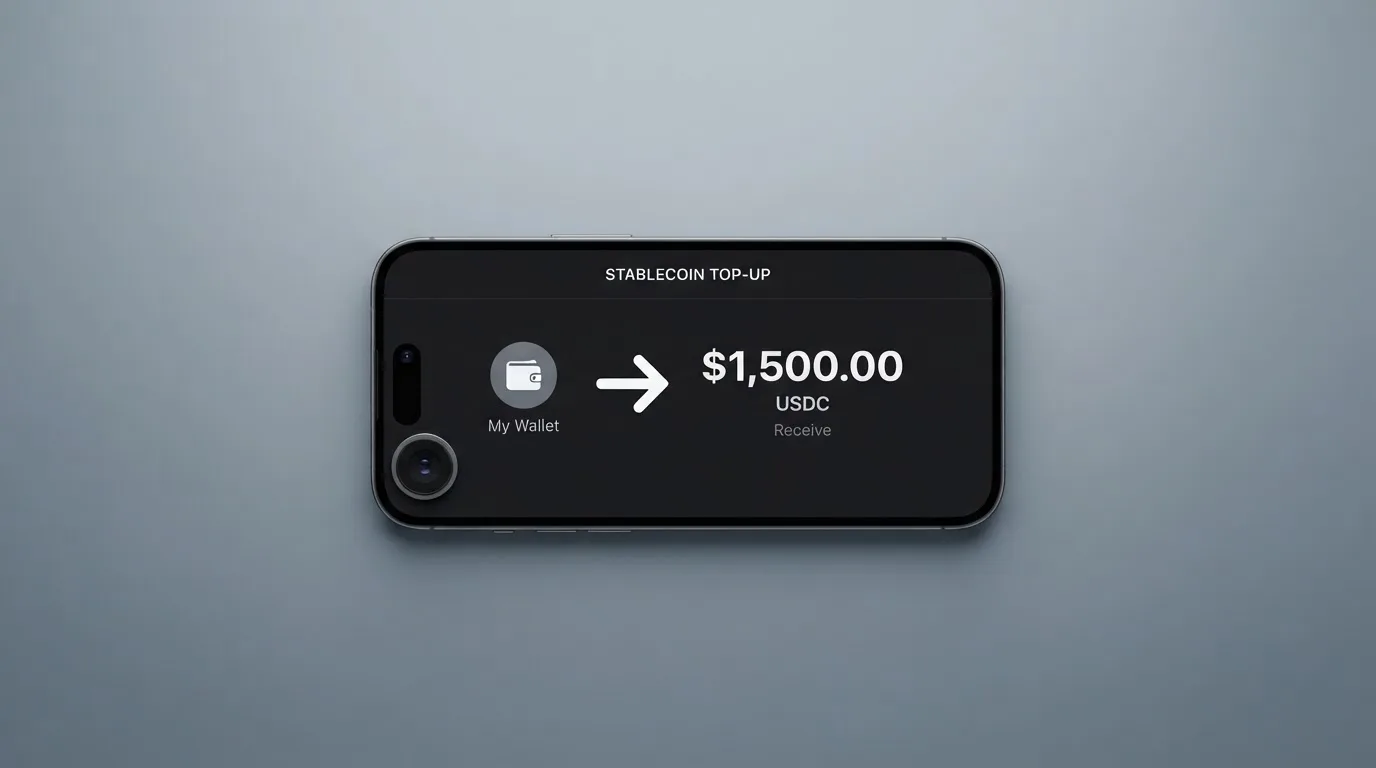
The one network detail that is documented: the card’s collateral is held in stablecoins on Ethereum, Polygon, Optimism and Arbitrum. That is the collateral structure, not necessarily the deposit routes, and I would read it that way.
There is one money-management decision the card makes for you, and you should know about it. The issuer may suspend or cancel your account “with or without cause”, and what happens to your balance in that case is not stated. That is a real consideration when the balance is your own money rather than an exchange float.
Withdrawing works the other way: the wallet supports sending crypto out to an external wallet, with a linked help article covering it and fees not read.
Paying with it every day
Day-to-day, the digital card works the way you would hope. It is instant, it sits in Apple Pay and Google Pay, and you can freeze and unfreeze it any time from the app — which is the single most useful control on a card like this, because it turns a lost phone into a two-tap problem rather than a phone call to a bank.
The app is on Google Play and the Apple App Store. I did not read the ratings, so I am not going to tell you what users think of it.
Rewards are not stated. Cashback is not mentioned anywhere in the card’s material, which usually means there is none rather than that it is hidden — but treat it as no rewards until you see it in writing.
If a payment goes wrong, the route the card documents is: take it up with the merchant first, then start a Chargeback in your account. The window is 60 days from the posting date. After that, disputes go to AAA arbitration, and you waive the right to a class action — a standard US-style clause, but it does remove one avenue if you are dealing with a systematic problem rather than a single bad purchase.
What can go wrong
The obvious worry with a card like this is that the company vanishes. On that, the picture is unusually clean. I found no complaints — not thin complaints, none, and no Trustpilot page to read either. The company behind it is MAAAR PAY FZCO, in DMCC, Dubai, licence DMCC-981512, registration DMCC202616, with a subsidiary MAAAR CIRCLE PAYMENTS LTD. in British Columbia, Canada (BC1585437). The issuing institution is named as Third National, under a Visa licence, and BANEX MICROFINANCE BANK LIMITED is named for Nigerian users.
That structure deserves one sentence of interpretation, because it cuts both ways. A named issuer under a network licence means somebody with a banking licence is accountable for the card programme, and card networks can and do pull programmes — Visa ended its agreements with FTX on 13 November 2022, and WaveCrest, a card issuer that supplied several crypto brands, was suspended by Visa in Europe in 2018. If a programme is wound down, the usual sequence is a notice period, then loading and spending stop, then you are asked to withdraw what is left.
The other risk is the one every crypto product carries: the chain does not reverse transfers. Blockchain transfers are irreversible, so a deposit sent on a network the provider does not support, or to an address belonging to a different network, can be lost or need manual recovery with no guarantee. If you already hold USDT on Tron, note that Circle stopped supporting USDC on Tron in February 2024, so “USDC over TRC20” is not a native option anywhere in this category.
Two smaller risks. Tether says it disables tokens in wallets on the OFAC sanctions list and has frozen funds tied to illicit activity, so stablecoins are not censorship-proof and your balance can be frozen by an issuer at a level above the card. And declined payments can leave holds that linger — a declined authorisation may sit on your funds for several days, typically up to seven — which matters when your balance is the whole of your money for the week.
On the security claims, the card says “advanced security protections”, institutional-grade SaaS infrastructure, secure virtual card details, and two-factor authentication is not stated. Take the marketing at face value and set your own expectations from what is missing rather than what is said.
Support exists: a Help Center, FAQs, a Contact Us page, [email protected], a Telegram channel at t.me/Maaarpay_official, and a Reddit community at r/maaarpay. Languages and opening hours are not stated, and the FAQ interface shows “Eng”.
What to take instead
Three cards in the same category, all of which publish different subsets of the same information. None of them is dramatically better; the differences are in what they bother to tell you.
Cardex — scored 5.6 / 10. Claims “one crypto card, 200+ countries” with no exclusions listed, though its App Store listing is Naira-focused and pays in Naira. It is a debit card across VERVE, Visa, Mastercard and UnionPay, with virtual and physical cards. Its distinctive claim is an “AI-Powered Conversion Rate” that scans exchange rates and picks the best one when you spend — and it states no fee percentage at all. USDT, USDC and BTC wallets, networks not stated.
TakeCard — scored 5.5 / 10. The narrowest of the three: the physical card is “available only to Bolivian users for now”, and the help articles do not list countries. Virtual card immediately, physical for Bolivia, Visa network, issued in the United States, prepaid, paying USD 1:1 with other currencies at the official Visa rate of the day. This is the only one of the four that publishes a real price list: virtual card USD 5, physical in Bolivia USD 20 issuance plus USD 20 shipping — though another article in the same centre says USD 10 for physical in Bolivia, which conflicts. Commission is 1% per purchase. It top-ups from the Takenos balance rather than straight from a wallet, which is a different model.
OkiCard — scored 6.0 / 10. “150+ countries” on some pages and “200+” on others, “no geo-blocking based on your passport”, with a confirmation that you are not in a sanctioned jurisdiction. Virtual card, network listed only as “Visa/Mastercard”, currency pegged USD/EUR. The pricing page is the most transparent of the four but also self-contradicting: issuance $0, monthly $0, starting price $15, while the FAQ mentions a one-time issuance fee. Load fee 3%, USD transaction fee 0%, “no hidden exchange spreads”, FX fee not stated. Funding is the widest network list here — USDT on BSC, Ethereum, Tron and Solana, USDC “soon”, BTC and altcoins “coming soon” — with an initial deposit of 100 USDT.
| MaaarPay | Cardex | TakeCard | OkiCard | |
|---|---|---|---|---|
| Score | 6.7 / 10 | 5.6 / 10 | 5.5 / 10 | 6.0 / 10 |
| Country reach stated | 150+ | 200+ | Bolivia only for physical | 150–200+ |
| Physical card | Coming soon | Yes | Bolivia only | Mentioned, no detail |
| Published fees | FX up to 2%, cross-border up to 3% | None, claims best rate | 1% per purchase | Load 3%, USD transaction 0% |
| Issuance price | not stated | not stated | USD 5 virtual / USD 20+20 physical | $0–$15, pages disagree |
| Networks for funding | not stated | not stated | Takenos balance | BSC, Ethereum, Tron, Solana |
| Rewards | not stated | not stated | not stated | not stated |
The pattern worth noticing is not about any one card. Across all four, rewards are unstated. If you are choosing between them on cashback, you are choosing between four silence.
Who I would recommend it to
To someone who already holds USDT or USDC, cannot get a normal bank card where they live, and spends most of their money online or through a phone wallet. For them this is a Visa number that works in more places than their own banking system does, with a freeze button that makes it feel manageable, and a company structure that names its regulator and its issuer.
I would not build my recommendation around a physical card or cash, because neither exists yet. I would not build it around cost, because the two published fees have ceilings rather than rates and the conversion fee is simply absent from the pages. And if your wallet is your savings rather than your spending money, the suspension clause — the issuer may cancel “with or without cause”, balance treatment unstated — deserves more weight than the fee table does.
My own order of operations, if I were starting today: read the AML & KYC policy first so I know what documents to have ready, confirm with support which deposit network is live before sending anything, put in a small amount, and test a dollar-denominated payment before trusting it with rent.
Frequently asked questions
What is the MaaarPay card?
MaaarPay is a digital Visa payment card you load with cryptocurrency rather than a bank account. You top up an in-app wallet with USDT, USDC or another supported crypto — BTC is listed on the home page — and spend that balance in shops, online, or through Apple Pay and Google Pay. It is a spending tool, not a bank account, and the physical card is still marked “Coming soon”.
How does the MaaarPay card work?
Your crypto sits in an in-app wallet, and the card draws on a stored balance much like a prepaid card, so it cannot overdraw. When you pay in a currency other than dollars, the card association converts it to USD first, and a foreign exchange fee of up to 2% applies. The card is issued by a third-party licensed institution, with the issuer named as Third National under a Visa licence.
Is MaaarPay a bank?
No. MAAAR PAY FZCO describes itself as a “technology service provider” that “does not provide banking or money transmission services”. The company is registered in DMCC, Dubai, under licence DMCC-981512, with a Canadian subsidiary in British Columbia. The card itself is issued by a separately licensed institution, which is the normal arrangement for crypto cards but means the app’s name is not on the licence.
Who owns MaaarPay?
The card’s pages name MAAAR PAY FZCO, a Dubai free-zone company in the DMCC, licence DMCC-981512 and registration DMCC202616. Its subsidiary is MAAAR CIRCLE PAYMENTS LTD., registered in British Columbia, Canada. BANEX MICROFINANCE BANK LIMITED is named for Nigerian users. There is no public record of investors or parent ownership.
Which countries is the MaaarPay card available in?
The card says “available in 150+ countries” without publishing the list. One exclusion is explicit: users must attest they are “not a United States citizen”, and the terms refer to OFAC sanctions. Whether the test is citizenship or residence is not stated, so if you live outside the US but hold a US passport, ask support before applying.
How do I apply for the MaaarPay card?
Download the app from Google Play or the Apple App Store and sign up with the identity verification the flow prompts for. The card is issued digitally and instantly in the app. The card’s pages do not list which documents, proof of address or minimum age apply — read the AML & KYC Policy published at /aml-kyc-policy first so you have the right papers ready before you start.
Does the MaaarPay card require KYC?
Yes, sign-up includes what the card calls “secure identity verification”. This is normal for cards of this type: anti-money-laundering law requires regulated businesses to verify customers and screen them, and a separate published policy is set out at /aml-kyc-policy. The number of verification tiers and the documents required are not stated on the pages I read.
What are the fees on the MaaarPay card?
The published fees are a foreign exchange fee of up to 2% on non-USD payments and a “Cross Border Fee: up to 3%”. Late payment is up to $40 and a returned payment is listed as up to $29, though another section says $00.00 — the card’s own pages conflict. Issuance, monthly and crypto conversion fees are not stated, and interest is 0% APR for now.
Can I add the MaaarPay card to Apple Wallet?
Yes — the digital card is compatible with Apple Pay and Google Pay, which for most people is how they will actually use it. The card’s numbers are tokenised in the same way as any other card’s, so Apple Pay replaces the card number with a device-specific number rather than storing your actual card details on Apple’s servers. You can also freeze the card in the app at any time.
Is the MaaarPay card safe?
There is no single answer, so here is the honest version. I found no complaints and no Trustpilot page. The company is licensed in Dubai, the issuer is named, and you can freeze the card instantly. But balances are custodial, blockchain transfers are irreversible, and the issuer may cancel an account “with or without cause” with no stated treatment of the balance. Card programmes can also be wound down — Visa ended its FTX agreements in November 2022.
Highest-scored virtual cards – cryptocardbest.com
Content created by the «cryptocardbest.com» team