
A self-custody spending card with a $99 metal option and a 2% currency markup
 Available in US
The Prive card promises something quite specific: you keep your crypto in your own wallet, and a Visa card spends it. That is the pitch, and on paper the card delivers it — a virtual card for $10, a metal card for $99, spending from USDC, USDT, EURC or PYUSD held in a non-custodial wallet, plus ordinary fiat balances. My problem is not the idea. It is that almost nobody outside the company’s own pages will tell you what Prive actually is in regulatory terms, who the issuer is, and whether you are eligible at all. The public pages do not publish a country list. The terms say the content is intended exclusively for Hong Kong residents. A third-party catalogue says the opposite — that it is *not* available in Hong Kong. Those two statements cannot both be your situation, and the card does not settle the question.
Conditions are current as of October 28, 2026.
I gave the card 5.1 out of 10. That is not a rejection of the concept. It is a verdict on what a stranger can find out before handing over their documents and their money: the funding side is good, the everyday-use side is decent, the cost side is expensive, and the reliability side is a wall of silence.
The score in full
Before the details, here is how the number breaks down — one row per criterion, so you can disagree with a specific line rather than with the whole thing.
| Criterion | Mark | Why |
|---|---|---|
| Who can get it | 5 / 10 | No country list published; off-ramps to bank accounts in 80+ countries; site terms are written for Hong Kong residents; third-party sources disagree; unofficial: early access by invitation |
| Cost | 3 / 10 | Metal card $99.00, virtual $10.00 (shown discounted to $5.00); top-up 0.50% plus $0.05 network fee; FX markup 2.00%; ATM markup 1.00% |
| Top-up options | 7 / 10 | USDC, USDT, EURC, PYUSD from a non-custodial wallet, plus fiat via FPS, ACH, SEPA; networks not named |
| Reliability and complaints | 5 / 10 | Prive Technologies Limited, “not a bank”; issuer and FCA number not named; complaints of login failures after an update and slow support; App Store 4.3 from 20 ratings |
| Everyday use | 7 / 10 | Virtual and metal card, 1.00% ATM markup, a Google Pay terms page exists; unofficial: Apple Pay and Google Pay not supported |
Total: 5.1 / 10.
Who this suits, in one sentence: someone who already holds USDC or USDT in a wallet they control, spends in currencies those balances map onto cleanly, and can tolerate a 2.00% currency markup and a fee that can change with fifteen days’ notice.
Who it does not suit: anyone who needs a predictable monthly cost, anyone in a hurry to be approved, anyone who wants to know who their money is held by, and anyone for whom a 1.00% withdrawal markup at a cash machine is a normal thing rather than an emergency one.
Will they give you the card
The honest answer is: I cannot tell you from the public pages, and neither, apparently, can Prive.
There is no country list on the site. What is stated is that off-ramps go to bank accounts “in 80+ countries” — that is about where you can *send* money, not about where you can *hold* an account. Website Terms indicate the content is “intended exclusively for Hong Kong residents,” though other information suggests the card is not available in Hong Kong. Neither statement is the company’s own eligibility tool, which lives inside the app.
There is also an unofficial thread worth knowing about: early access by invitation, reported by that same catalogue in 2026, with the note that it was not available in Hong Kong. Treat all of that as unofficial — Prive’s public pages do not confirm it.
The practical consequence for you is this. You will not find out whether you qualify from the marketing site. You will find out during onboarding, and “during onboarding” is the worst possible moment to learn that your country is not on the list. If your situation depends on certainty — a fixed salary being paid somewhere, a residency you cannot afford to complicate — you should treat the eligibility question as unresolved rather than settled.
Membership itself is “subject to application and verification” at Prive’s discretion. That sentence is doing a lot of quiet work.
How to get it
You need to be 18 or the age of majority. Identity checks run through Sumsub and Bridge; the help centre carries eight KYC articles, though the documents themselves are not shown publicly. The sequence is: install the app, onboard and verify, order the virtual card, then request the metal card from inside the app.
What you will have to hand over is not fully specified on the public pages. A third-party catalogue lists email, phone and an identity document, and says proof of address and a selfie are not required. That is unofficial, and it is the kind of detail that changes without notice.
Two things here should make you pause.
The first is that the card itself is a Prive Visa Platinum, available as a virtual card or as a “premium metal” physical card. The currency the card is denominated in is *not stated* in the published schedule. The fiat balances you can hold are listed as GBP, USD, EUR, NGN, KES, MXN and BRL. That gap matters: if the card runs in a currency you do not hold, the 2.00% markup applies to what you spend.
The second is shipping. Metal card shipping costs $60.00 and is included in the $99.00 total; which countries it ships to and how long it takes are *not stated*. A lost, stolen or damaged metal card is replaced for $99.00.
And then there are the tiers. Verification tiers set your card limits. The tier names, what each tier unlocks, how long review takes, and the grounds for rejection are all *not stated*. One unofficial source names a single level, “ID Verification”, and mentions complaints about slow review.
The card currency, the shipping destinations, and the verification tiers are the three things I would ask support about in writing before I transferred anything.
Fees: what it really costs
The fee schedule is effective 12 April 2026. Here is every figure published on it.
| Fee or limit | Value |
|---|---|
| Metal card issuance | $99.00 total ($39.00 card fee + $60.00 shipping) |
| Virtual card | $10.00, shown discounted 50% to $5.00 |
| Monthly fee | None listed |
| Card closure | Free |
| Top-up fee | 0.50% ($0.50 minimum, $999,999 maximum) |
| Network fee | $0.05 on USDT and USDC |
| FX markup | 2.00% |
| Domestic transaction | No extra fee |
| Declined authorisation | $0.50, only if your decline rate exceeds 5% over 10 or more attempts |
| ATM withdrawal markup | 1.00% |
| Per-transaction ceiling | Up to $100,000 |
| Daily and monthly limits | Not stated; limits “depend on your verification tier” |
| Free ATM allowance | Not stated |
The $99 metal card is the number that decides this card for most people. Read it as what it is: $39 to make a piece of metal exist, $60 to ship it. There is no monthly fee, which is genuinely unusual in this category, but you pay that cost once, up front, in a currency of your choice, before you have spent anything.
Now let us run three ordinary days through it, because a fee schedule is only useful when you know which lines actually get touched.
A $30 lunch in your own city, in a currency you already hold. No FX markup applies, because the transaction is domestic and the card currency matches the balance. No extra fee. The only cost is the top-up fee you paid when you loaded the balance: 0.50% of $30 is $0.15, which is below the $0.50 minimum, so you paid $0.50 to load, plus the $0.05 network fee on the stablecoin transfer. That is roughly $0.55 on a $30 lunch, and nearly all of it fixed rather than proportional.
A $60 hotel in a currency you do not hold. This is where the 2.00% markup lands. Two dollars on sixty, before you have counted anything else. If you loaded the balance by topping up a stablecoin, the 0.50% top-up fee with its $0.50 floor is sitting on top of that, plus $0.05 for the network. So roughly $3.55 in cost on a $60 room. This is the single largest drag on daily use and it is invisible until you actually book something abroad.
$200 taken out of a cash machine. The 1.00% markup is $2.00. How much free allowance you get before that kicks in is *not stated*, so treat any cash withdrawal as fully marked up. Combined with whatever fee your own ATM adds, and possibly a decline if the balance is thin, this is the most expensive thing on the list. Cards of this type are better used for payments than for cash.
One thing to watch, quietly: declined authorisations cost $0.50, but only once your decline rate passes 5% over ten or more attempts. Before you cross that line, declines appear to be free — which is exactly the arrangement that can push a legitimate pattern of failed payments over a threshold.
One more thing about the schedule as a whole: fees may change with fifteen days’ notice. Your cost next year is not the cost on this page.
Top up: how the money gets in
This is the strongest part of the product, and it deserves to be said plainly.
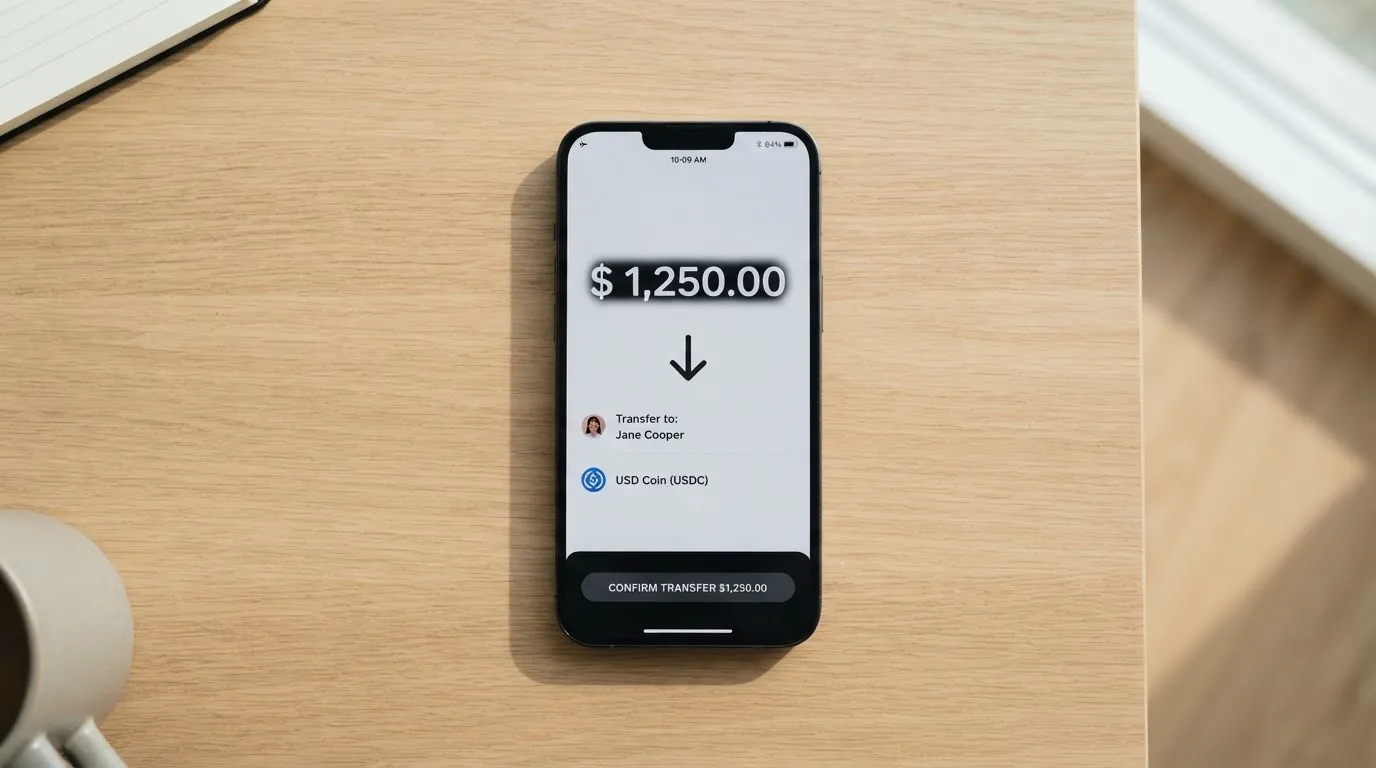
You hold USDC, USDT, EURC or PYUSD in a non-custodial wallet. Top-ups from that wallet balance to the card are instant. Fiat top-ups go through FPS, ACH or SEPA in GBP, USD, EUR, NGN, KES, MXN or BRL. The fee is the same 0.50% with a $0.50 minimum plus $0.05 for USDT and USDC; the minimum top-up is *not stated* apart from that fee minimum, and fiat top-up fees are *not stated* at all.
So far this sounds effortless. Here is where the gap bites: the networks are not named. Circle lists USDC as natively supported on 38 networks as of 16 September 2026 — Ethereum, Solana, Base, Polygon PoS, Avalanche, Arbitrum, Stellar among them — and Tether describes USDT as running on multiple blockchains including Ethereum, Tron, Solana, Polygon and Avalanche. Prive does not tell you which of those it accepts, or what address to send to.
This is not a detail. Blockchain transfers are irreversible. A deposit sent on a network the provider does not support, or to an address belonging to a different network, can be lost outright, or need manual support recovery with no guarantee of success. There is also a network-fee mechanics issue that bites repeatedly: on Ethereum, gas is paid only in ETH, so a wallet holding USDT and no ETH cannot send at all. On Tron, fees are paid through bandwidth and energy resources, often burning TRX. Circle stopped supporting USDC on Tron in February 2024, so “USDC over TRC20” is not a native option. And in the background, an ETH fee needs a small amount of a token whose price moves.
Before your first transfer, get the network and the address from the app itself, check them twice, and keep a little of the native gas token on hand. That is not cleverness; it is the difference between a working top-up and an expensive support ticket.
The other end of the flow is the off-ramp: withdrawal fee 0.00% with a $0.01 minimum, plus $0.05 for USDT and USDC, out to local bank accounts in 80+ countries. Note the Terms clause regarding termination — outstanding balances become due. There is an account-closure disclosure page, but the money must go back to a bank account, and that bank must accept it.
Paying with it every day
Virtual card, metal card, and the standard array of places a Visa card goes. The Google Pay terms page exists at /legal/prive-googletnc, which at minimum means the company has written terms for it.
Whether either mobile wallet actually works is where the sources collide again. A third-party catalogue says Apple Pay and Google Pay are both “not supported”, and that directly conflicts with the company’s own Google Pay terms page. Apple Pay is simply *not stated* by Prive. Test both before you need them — a wallet that refuses to enrol at the airport is a bad surprise.
Points are earned on top-ups, payments, withdrawals and referrals, and are usable only inside the app. No cashback is stated. Blocked merchant categories are *not stated*, which means you do not know what has been switched off — gambling (MCC 7995) is the category most issuers block on crypto cards, and the block list varies by issuer, so absence of a published list is absence of reassurance, not evidence of openness.
The app itself: 4.3 out of 5 on the iOS App Store from 20 ratings, read on 21 October 2026. Twenty ratings is a very small sample — it can be read as fine and it can be read as a rounding error, and I would not lean on it either way. A Google Play listing exists (life.prive) but its rating could not be read.
The disputes section is the weak point. The Terms point to arbitration in Hong Kong under HKIAC. The card chargeback process and time frames are not published — the Card Agreement page shows “content not yet available”. So: if a charge goes wrong, the published route is binding arbitration in Hong Kong, and the ordinary chargeback route that a cardholder would assume exists is undocumented. For a card aimed at people who cannot easily open a bank account elsewhere, that is worth pausing over.
For context on why foreign-issued cards sometimes get declined at the till: a card number starts with a 6- or 8-digit issuer identifier, and merchants can look it up to see the institution and issuing country. If that differs from your billing address they may apply extra scrutiny. Address verification, which compares the numeric parts of your billing address against issuer records, is mainly offered in the US, Canada and the UK and is generally unavailable for foreign-issued cards. Some merchants decline prepaid or foreign-issued numbers outright. None of this is Prive-specific — it is the category, and it is a reason to keep a backup payment method.
What can go wrong
The issuer is not named. Prive Technologies Limited describes itself as “not a bank”. Card services run through unnamed “licensed card programme partners”. The Terms are governed by Hong Kong law, no FCA authorisation number is stated, and the issuer is not identified. Identity checks run through Sumsub and Bridge.
That last cluster matters more than it first appears. A payment card sits inside a structure of three parties: the network (Visa) routes the messages and sets the rules, the issuer is the bank or e-money institution licensed to issue under that network’s licence, and the crypto brand is often only a programme manager and front end. If Prive is the front end, then the thing that actually holds your money when you tap is a partner you cannot name from the public pages. That is not automatically bad — plenty of legitimate programmes work exactly this way — but you should know it before you top up, not after.
Related: FSCS protection does not apply. That is stated on Prive’s FCA page. And in general, e-money balances are not the same as bank deposits. E-money institutions must safeguard customer funds by segregating them or insuring them, but that safeguarding is not a deposit guarantee scheme.
Self-custody cuts both ways. The card’s motto is “Your Wallet. Your Keys.” — the funds stay with you until the moment of payment. Good. But with self-custody, the sole responsibility for key loss, phishing, and clipboard-hijacking malware that silently replaces a copied address sits with you. Blockchain transfers are typically irreversible; a stolen private key has no recovery mechanism, because the network cannot freeze or return anything. A seed phrase — typically 12 to 24 words — is an unencrypted private key, and anyone who obtains it can restore the wallet and spend everything in it. And stablecoins are not censorship-proof: Tether says it disables tokens in wallets on the OFAC sanctions list and has frozen funds tied to illicit activity.
Complaints. I found no official incidents. What circulates is a third-party user report from 2026: login failures after an update, slow and vague support, and the note that payment links require the payer to register and complete KYC. A search of Reddit and Trustpilot returned only unrelated “Privé” shopping sites, and there is no Trustpilot page for Prive Money — which is itself information: it means the usual place you would check for a card’s reputation does not exist yet.
So the honest picture on reliability is: nothing confirmed wrong, and almost nothing available to check either.
Support. A Help Center and online support “24 hours a day, 7 days a week”, at [email protected]. The app is in English and ten other languages; Russian is *not confirmed*. An app that is a frontend for your own wallet is also, in practice, your first line of defence — if you lose access to it, nobody can rebuild your keys for you.
The clock. Fee schedule effective 12 April 2026, fees changeable on fifteen days’ notice, iOS app at v1.0.36 in October 2026. And the category’s own record: Visa terminated its global agreements with FTX on 13 November 2022 and the FTX US debit card was wound down by its issuer; WaveCrest, a Visa issuer that supplied several crypto card brands, was suspended by Visa in Europe in 2018, closing all WaveCrest-issued Visa programmes. Programme closures typically mean a notice period, then spending and loading stop, then you are asked to withdraw what is left. Your money moving instantly into a card balance is only good news if the programme is running next month.
What to take instead
I looked at three cards that a reader in this position might reasonably compare against. Here they are side by side, on what each publishes.
| BloFin Wallet Card | Decaf | SafePal | |
|---|---|---|---|
| Score | 6.9 / 10 | 6.2 / 10 | 6.2 / 10 |
| Card | BloFin Wallet Visa Platinum; virtual/physical not stated | Decaf Visa, virtual or physical (tracked delivery) | Virtual Mastercard debit; physical not stated |
| Availability | Country list not published; app says “select your country or region”; starting data lists 35 countries incl. US, Australia, Japan, UAE, Brazil, Mexico, Malaysia, New Zealand | Not issued in Belarus, China, North Korea, India, Iran, Iraq, Israel, Myanmar, Nepal, Russia, Syria, Turkey, Cuba, Ukraine, Venezuela, Vietnam, Nicaragua, Puerto Rico, Nigeria; restricted US states incl. Arizona, Delaware, Georgia, Idaho, Louisiana, Maryland, Montana, Ohio, Oregon, Rhode Island, Washington, Wisconsin | “Citizens of supported regions who live in supported areas”; the regions list was empty when fetched |
| Issuance / annual | $0.00 activation, annual, issuance, dormancy each | Virtual $5 worldwide; physical $10 (US only) or $90 (rest of world); no annual or monthly fee | No account or management fees; card issuance fee not stated |
| Spend fee | “1% or lower” by VIP tier: VIP 0 1.00%, VIP 1 0.90%, VIP 2 0.80%, VIP 3 0.50%, VIP 4 0.20%, VIP 5 0.00% | Not stated | Not stated |
| FX | Not stated | No fee added — “the FX is the one Visa offers” | Mastercard non-USD settlement 1% FX fee |
| Top-up | USDT and USDC on Arbitrum and Base | By card, bank transfer or USDC; app on Solana and Stellar; which coins and networks top up the card is not stated | Crypto from 40+ blockchains, converted to USDC (default) or fiat; transactions on Arbitrum |
| Rewards | No cashback; reduced spend rate instead | Not stated | No cashback; referral commissions up to 40% of referred top-up fees |
Three observations from that table, which are worth more than the scores.
BloFin is the cheapest on paper — zero issuance, and a spend fee that falls to zero at the top VIP tier — and it names its networks, which is the thing Prive does not. But 1.00% at the entry tier is *worse* than Prive’s domestic zero, and eligibility is as unpublished as Prive’s.
Decaf is the only one of the four with a real eligibility list, including explicit restricted US states — and the only one that states its FX position clearly, adding nothing on top of Visa’s rate. That is a real answer to the question Prive answers with “2.00%”. Its card funding route is the vaguer one, though.
SafePal carries the standard top-up fee of 0% and a 1% FX fee, and it also names its networks and counts them: 40+ blockchains. Note the pattern across all three alternatives: not one of them publishes a country list you can read before signing up. That is the category’s shared failing, not Prive’s alone.
If your decision is dominated by cost, look at Decaf or BloFin. If it is dominated by the right to spend from your own wallet with no custody question attached, Prive’s structure is sound and its fees are the price of that structure.
Who I would recommend it to
I would recommend the Prive card to someone who has already decided to hold stablecoins long-term, keeps them in a wallet they control, spends mostly in a currency they already hold balances in, and treats the card as one instrument among several rather than as their only way to pay. I would tell that person to test with the virtual card — $10, currently shown at $5 — before committing to the $99 metal version, and to check the Google Pay question in the app rather than trusting either source.
I would not recommend it to anyone who needs certainty about eligibility, who cannot absorb a fee schedule that moves on fifteen days’ notice, or who plans to lean on cash machines. And I would ask anyone considering it — including me, if I were you — to get two things in writing first: the network and address for the stablecoin you intend to send, and the name of the licensed partner holding the balance.
5.1 out of 10. The concept is right, the funding design is the best in its immediate comparison set, and the company is candid about being “not a bank”. What holds it back is silence where it matters most: the country list, the issuer, the networks, the chargeback process, and the tier rules. Card issuers get judged on what they publish when nothing has gone wrong. Prive has not yet published enough for me to give it the benefit of the doubt.
Frequently asked questions
What is the Prive card?
The Prive card is a Visa Platinum payment card, available as a virtual card or a physical “premium metal” card, that spends stablecoins and fiat balances held in a Prive account. You load it with USDC, USDT, EURC or PYUSD from a non-custodial wallet you control, or with fiat through FPS, ACH or SEPA. The crypto side is self-custody — “Your Wallet. Your Keys.” — while fiat balances are held with what Prive calls regulated partners. The card issuer is not named on the public pages.
Is Prive a bank?
No. Prive Technologies Limited describes itself explicitly as “not a bank”. Card services run through unnamed “licensed card programme partners”, and identity checks are handled by Sumsub and Bridge. The terms are governed by Hong Kong law and no FCA authorisation number is stated. That also means FSCS protection does not apply, and e-money safeguarding is not the same thing as a bank deposit guarantee.
Is the Prive card available in my country?
Honestly, you cannot tell from the public pages — there is no published country list. Prive’s own Terms say the content is “intended exclusively for Hong Kong residents”, while a third-party catalogue says the opposite, that it is not available in Hong Kong. Off-ramps to bank accounts are offered in 80+ countries, but that describes withdrawals, not eligibility. The card states its terms for Hong Kong residents and for readers in general.
How much does the Prive card cost?
The metal card is $99.00, made up of a $39.00 card fee plus $60.00 shipping, and a replacement for a lost, stolen or damaged card is $99.00. The virtual card is $10.00, currently shown discounted 50% to $5.00. No monthly fee is listed and closing the card is free. On top of that: 0.50% per top-up with a $0.50 minimum, $0.05 network fee on USDT and USDC, a 2.00% foreign exchange markup, and a 1.00% ATM withdrawal markup.
How do I top up the Prive card?
You send USDC, USDT, EURC or PYUSD from a non-custodial wallet to your Prive balance, and the top-up is instant. You can also add fiat in GBP, USD, EUR, NGN, KES, MXN or BRL through FPS, ACH or SEPA. The critical catch: Prive does not name the supported networks, and blockchain transfers are irreversible, so a transfer on the wrong network can be lost. Confirm the network and address in the app before your first send.
Is the Prive card safe?
The self-custody design is a genuine strength: the funds stay in your wallet until the moment of payment, and Prive reports biometric login, two-factor authentication and real-time fraud detection. But it also means sole responsibility for key loss, phishing and malware that swaps copied addresses, with no recovery possible once a transfer is out. The company itself is not a bank, the issuer is unnamed, FSCS protection does not apply, and there is no Trustpilot page for Prive Money to check.
Can I add the Prive card to Apple Pay or Google Pay?
The published pages are contradictory. Prive has a Google Pay terms page at /legal/prive-googletnc, which suggests the wallet is contemplated, but a third-party catalogue states that Apple Pay and Google Pay are both “not supported”. Apple Pay is not mentioned by Prive at all. I would test both inside the app before you travel, rather than discovering the answer at a checkout.
Where can I use the Prive card?
Anywhere a Visa card is accepted, subject to your verification tier and to ordinary card-network limits. The per-transaction ceiling is stated as up to $100,000, while daily and monthly limits are not stated and depend on your tier. Blocked merchant categories are not stated either — gambling (MCC 7995) is commonly blocked on cards of this kind, and each issuer decides its own list. Foreign-issued cards can also be declined at some merchants on BIN and address-verification grounds.
Is the Prive card worth it?
That depends on which costs you hit. Spend in a currency you already hold and the only cost is the fixed $0.50 minimum on your top-up. Spend abroad and the 2.00% FX markup dominates. Take money out and you pay 1.00% on top of your own ATM’s fee. Card and cash handling are what you actually pay for; the deciding question is how often you do each.
How do I close or delete my Prive account?
Closing the card is free, and there is a dedicated account-closure disclosure page. The clause to read first is the one on termination: outstanding balances become due. Plan the off-ramp to a bank account before you close anything, because balances do not simply disappear when the card goes.
Highest-scored wallet cards – cryptocardbest.com
Content created by the «cryptocardbest.com» team