
A prepaid card on top of self-custody, with a custody shutdown on the horizon
 Available in US
If you have normal access to a bank account, this card is a puzzle rather than a solution. If a bank card is hard to get — because of where you live, what documents you hold, or a banking history that has gone wrong — the Simple Crypto card is genuinely interesting: it spends a stablecoin balance through a virtual Mastercard, it asks for one round of identity documents, and it lists a very wide set of countries. But it is also a prepaid card with no monthly fee, a 2.5% charge on spending abroad, no physical card yet, and a published plan to shut its custodial wallet services on 30 June 2026. My score for it is 6.9 out of 10, and the shape of that number matters more than the number itself: the top-up side is excellent, the reach is excellent, and the parts around them are where the caution goes.
Conditions are current as of October 28, 2026.
The conditions described here are current as of 20 October 2026.
Verdict: 6.9 / 10, and the number is really five numbers
When I score a card I break it into the things a user actually decides on separately, because a single average hides the reason you might still want it. Simple Crypto scores very high on who can get it and on how you fund it, middling on everyday use, and lower on cost and on reliability — and those last two are not small reservations. They are the reasons to think twice before loading anything you cannot afford to move away.
| Criterion | Score | Why |
|---|---|---|
| Who can get it | 8 / 10 | Region list dated 24 January 2026 covers Europe, Asia-Pacific, Latin America, Middle East, Africa and the CIS, and the United States |
| Cost | 5 / 10 | Issue 0 EUR, servicing 0 per month; international card payment 2.5%; ATM: first 3 withdrawals per month free, then 2%; card replacement 20 EUR |
| Top-up options | 9 / 10 | USDT on Ethereum ERC20, Polygon, BNB Smart Chain, Arbitrum, Tron and USDC on Ethereum ERC20, Polygon, BNB Smart Chain, Arbitrum, Base — instantly |
| Reliability and complaints | 6 / 10 | Issued by Unlimit EU Limited (Cyprus), Central Bank of Cyprus licence 115.1.3.7; custodial wallet closing by 30 June 2026; reports of blocks and slow support, Trustpilot 4.2 out of 5 from 7,046 reviews |
| Everyday use | 7 / 10 | Virtual Mastercard only, physical in development; Apple Pay and Google Pay work; ATMs available with a limit of 500 USDC a day |
| Total | 6.9 / 10 | A strong reach and top-up story, held back by fees on foreign spend, no physical card, and an unresolved custody transition |
The audience this card fits, stated plainly, is someone who already holds USDC, wants to spend it through Apple Pay, and wants to keep the crypto in their own self-custody wallet rather than on someone’s balance sheet. For that person the everyday mechanics are close to ideal. Who it does not suit: anyone planning a trip with heavy foreign spending, since 2.5% adds up fast; anyone who wants a physical card in a postbox; and anyone whose plan depends on the custodial side of the platform continuing past mid-2026.
Will they give you the card?
Yes, across an unusually long list — and this is the single best thing about the card. The help centre carries a region list dated 24 January 2026 for the USDC Simplecard, and it is worth reading in full rather than skimming, because it is the difference between “probably” and “no”.
Europe is there in full, including Andorra, Austria, Belgium, Bulgaria, Croatia, Cyprus, Czech Republic, Denmark, Estonia, Finland, France, Germany, Gibraltar, Greece, Hungary, Iceland, Ireland, Italy, Latvia, Lithuania, Luxembourg, Malta, Monaco, Montenegro, Netherlands, Norway, Poland, Portugal, Romania, Slovakia, Slovenia, Spain, Sweden, Switzerland, United Kingdom and Ukraine. Asia-Pacific includes Australia, Hong Kong, Indonesia, Japan, Macao, Malaysia, Philippines, Singapore, South Korea, Taiwan, Thailand and Vietnam. Latin America includes Argentina, Brazil, Chile, Colombia, Ecuador, El Salvador, Mexico and Peru. A combined Middle East, Africa and CIS group covers Azerbaijan, Bahrain, Georgia, Ghana, Israel, Kazakhstan, Kenya, Moldova, Nigeria, Oman, Saudi Arabia, South Africa, Turkey, Uganda, UAE and Uzbekistan. Then there are Guernsey, Isle of Man and Jersey, and the United States.
Two things I could not resolve, and you should not assume either way. First, citizenship versus residence: the list does not address it, and that distinction bites in practice, because sanctions screening and issuer risk policy are often applied to citizenship and country of birth as well as to where you live. Second, the age requirement is not stated on the public pages; prepaid and debit cards are generally available to adults, and some issuers set higher limits, so treat adult status as the working assumption and confirm it in the app.
How to get it
The route is short, which is unusual for anything crypto. In the Cards section of the app you choose the virtual card, enter your phone number, and complete identity verification by uploading a Proof of Identity and a Proof of Address. The card’s own help pages say this “usually takes a few minutes but can take longer”.
Proof of address has to be dated within the last six months, and the accepted list is specific: a bank statement as PDF, an electricity, water or gas bill, an internet or landline bill, a tax bill or government letter, or a utility bill from a government agency. The help pages also name three reasons proof of address gets rejected, and all three are avoidable: uploading a passport or ID instead of a proof of address, a document older than six months, and a screenshot instead of a PDF or photo. That last one surprises people. If your bank only shows statements inside the app, get the PDF.
What you get is a virtual Mastercard. The card page is explicit: “Physical card is currently in development.” There is no delivery to wait for and no delivery fee to misread — but there is also no plastic. Card currency is EUR. Reissue, renewal or replacement costs 20 EUR. There are no tiers to climb and no KYC levels are stated; the process is a single proof-of-identity plus proof-of-address round.
Fees: what it really costs
The headline numbers are genuinely good, and then the fine print starts working. Issuance is 0 EUR, cardholder management is 0 per month, and maintaining a non-active card is 0 per month. That part is better than most neobank products. What follows is where the cost score of 5 comes from.
| Fee or limit | Value |
|---|---|
| Card issue | 0 EUR |
| Cardholder management | 0 per month |
| Non-active card maintenance | 0 per month |
| Reissue, renewal or replacement | 20 EUR |
| Card payment, domestic | 0 |
| Card payment, international | 2.5% |
| Cash withdrawal in a currency other than the card currency | 0 |
| ATM withdrawal, domestic | 0 for the first 3 withdrawals per month, then 2% |
| ATM withdrawal, international | 1.75 + 2.5% (EUR figures as listed) |
| ATM balance inquiry | 0 |
| Card payments | 30 000 USDC daily (max 15 purchases), 30 000 USDC monthly, 75 000 USDC per 3 months, 100 000 USDC per 6 months |
| ATM | 500 USDC daily (max 5 withdrawals), 5 000 USDC monthly |
“Domestic” here means the EU Member States, Iceland, Liechtenstein and Norway. That is narrower than you might expect — it excludes the UK, Switzerland, the US and essentially everywhere else on the region list, so most spending for this card’s target user counts as international.
Two details deserve a second look. There is no separate conversion line in the fee schedule; the crypto conversion rate is shown on screen at the top-up step instead, which means the rate you get is the rate you saw, not one decided later. And the currency line reads 0 for “cash withdrawal in a currency other than card currency” — that is a withdrawal fee, not a promise of a good exchange rate. Card payments made abroad carry 2.5% on top of whatever the network’s conversion produces.
Three everyday payments, and which fees apply:
- A coffee in your own country. No card payment fee, no conversion charge, no ATM involved. This is the free case, and it covers most local spending.
- A week of hotels and restaurants abroad. 2.5% on every card payment. On a large trip this is the line that decides whether the card was worth opening, and it is charged per payment, so splitting the total into several transactions does not reduce it.
- Withdrawing local currency from an ATM abroad. 1.75 plus 2.5%, capped at 500 USDC a day and five withdrawals, and free only for the first three domestic withdrawals each month. Card-not-present risk aside, ATMs are the most expensive way to use this card and the easiest to avoid: pay by card where you can.
Two charges that are not about spending at all, because they are large. A chargeback is 40 EUR, and a review of an unjustified claim is 40 EUR. Time frames are not stated. That combination — 40 EUR to dispute, and no published deadline — means disputing a small transaction may cost more than the transaction. Nobody should treat that as a reason to accept a bad charge, but do know the number before it surprises you.
Top up: the strongest part of the product
Here the card earns its 9 out of 10, and if any single thing makes it worth your attention, this is it. You can fund with USDT on Ethereum ERC20, Polygon, BNB Smart Chain, Arbitrum and Tron, and with USDC on Ethereum ERC20, Polygon, BNB Smart Chain, Arbitrum and Base. The card is “Linked directly to your crypto balance”, and the top-up is instant — the balance updates immediately, with conversion details shown on screen as you do it.
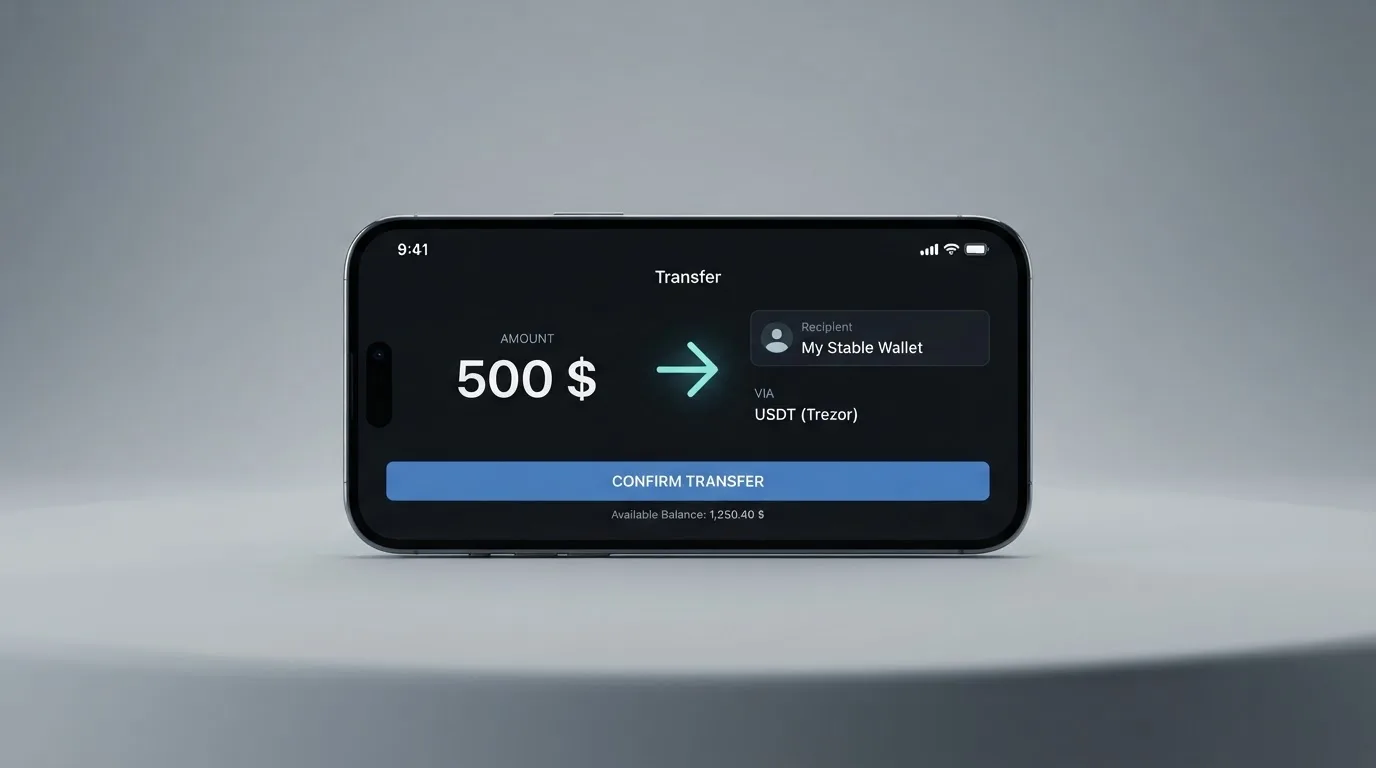
That combination of networks is the practical win. Both major dollar stablecoins, on the chains you are most likely to already use, at no stated deposit fee. If your USDC sits on Base or Arbitrum you are not forced into a bridge; if your USDT sits on Tron, the most common home for it, it is supported natively.
What is not stated, and what I would want to see before sending a large amount: the minimum top-up, who pays the blockchain network fee, and the deposit fee in any specific currency. On-chain network fees for your deposit are charged by the blockchain, not by the card provider, so a wallet holding USDT but no ETH cannot send on Ethereum — gas is paid only in ETH.
One practical warning that costs people real money: pick the network and the address to match exactly what the app shows you. Blockchain transfers are irreversible, so a deposit sent on a network the provider does not support, or to an address belonging to a different network, can be lost or need manual recovery with no guarantee. Note also the asymmetry between the two tokens: Circle stopped supporting USDC on Tron in February 2024, so “USDC over TRC20” is not a native option here — Tron appears for USDT only.
If you hold no crypto at all, the app also lets you buy crypto “using your bank card or account within the app”, which routes you straight back through the banking system you were trying to avoid. It is a convenience, not a workaround.
Withdrawing out works from the card dashboard: a withdraw button sends funds to your Custody Wallet or your Self-custody Wallet, and the withdrawal is executed in cryptocurrency. Fee amounts are not given in the fee schedule — they are visible in your Card Transaction History — and timing and minimum closure balance are not stated.
Paying with it every day
Day to day this behaves like a prepaid card. A prepaid card draws on a stored balance, while a standard debit card asks your bank for money at the moment of purchase; many crypto cards work the first way, and Simple Crypto does too. The practical consequence is reassuring: the card spends only the balance you loaded, so it cannot overdraw, and a bad surprise cannot become a negative balance.
Apple Pay and Google Pay both work, and with no physical card in the post they are not a nicety — they are the primary way you pay. A tokenised phone wallet replaces the card number with a device-specific number held in the device’s secure element, with a one-time code per payment, which reduces the damage a leaked card number can do. Blocked merchant categories are not stated, so you cannot tell in advance whether a given category will decline.
The card’s own site claims 4.8 out of 5 on the App Store and 4.9 out of 5 on Google Play. Those are marketing claims, the number of ratings behind them is not shown, and I would read them as “nobody has publicly hammered the app interface” rather than as evidence of quality.
No cashback or rewards are mentioned anywhere in the card material. With spending abroad at 2.5% and no rebate, there is nothing to offset the fee — worth being blunt about if you were hoping for a rewards card.
What can go wrong
This is the section where I lose the most sleep on this card, and I want to lay out three separate problems rather than one vague worry.
The custody closure. The help centre carries an urgent notice: “Mandatory Closure of Custodial Wallet Services by June 30, 2026”, with articles on the cessation of custodial services, a general public announcement, and a separate piece on moving your wallet to the new engine. A card is a payment service regulated separately from the crypto side, and under EU rules an electronic money institution must safeguard customer funds, usually by segregating them or insuring them; such funds are not bank deposits and may not sit under a deposit guarantee scheme. The point for you is not the legal detail; it is that a closure timetable exists for one half of the product, and you should know which half your money is in before you need to. Programme shutdowns in this category tend to follow a pattern: a notice period, then loading and spending stop, then a request to withdraw remaining balances.
Blocks and slow support. On Trustpilot, simple.app shows 4.2 out of 5 from 7,046 reviews, of which 24 were in the last twelve months, and the company does not reply to negative reviews. The themes users report are blocked or suspended accounts with funds stuck (reviews from January 2025 to June 2026), verification requests that keep growing, slow or silent support (January 2025 to September 2026), failed card top-ups and transfers (August 2026), scam allegations and an unexpected charge (April 2025, September 2026), and complaints about fees and rates (January and April 2026). I am reporting these as user reports, not verified findings — but the pattern is the one that matters: funds stuck behind a block, with support that does not answer, is exactly the scenario in which a prepaid balance becomes inaccessible.
The usual category risks. Under EU customer due diligence, if the checks cannot be completed, the institution is required to hold off on the transaction or relationship and, where necessary, end it — which is why accounts close or freeze pending documents. In the US the customer identification programme requires name, date of birth, address and an identification number, and electronic systems validate proof-of-address documents against records. And structurally, custodial platforms have a history: Mt. Gox (about US$350 million reported stolen, 2011–2014), Coincheck (about US$400 million, 2018), Ronin Network (US$625 million, 2022). A prepaid card is not a bank deposit, and the balance behind it is not the same thing as money in an account with a guarantee scheme behind it.
What the card does well on the safety side is real and worth saying. The self-custody wallet is non-custodial, meaning your private key never sits with the provider; you can set spending limits; official support is by email only; and Simple states it never asks for passwords, codes or seed phrases. An in-app freeze is not stated. Given that what you control is the crypto, the seed phrase is the whole risk — anyone who obtains those 12 to 24 words can restore the wallet and spend the funds, and because blockchain transfers are irreversible, the network cannot freeze or return them. That is why a proper offline copy of the phrase matters more here than any in-app switch.
What to take instead
Three alternatives, with the same honesty applied.
BloFin Wallet Card — 6.9 / 10. The one competitor with the same score. A Visa Platinum wallet card with zero activation, annual, issuance and dormancy fees and no cancellation fee, so its cost profile is at least as good. But its spend fee is “1% or lower” by VIP tier, from 1.00% at VIP 0 down to 0.00% at VIP 5, charged at payment — meaning the headline saving on foreign spend depends on a tier you may never reach. There is no cashback, only the tier rate. Top-ups are USDT and USDC on Arbitrum and Base, a narrower set of networks than Simple Crypto’s. Its country list is not published on the card page — you select your region in the app — though starting data lists 35 countries including the US, Australia, Japan, UAE, Brazil, Mexico, Malaysia and New Zealand. Card currency and virtual-versus-physical are not stated. Pick this if fee tiers matter more to you than network choice.
Decaf — 6.2 / 10. A Visa card, virtual or physical with tracked delivery, and its currency handling is the cleanest of the three: Decaf adds no FX fee, “the FX is the one Visa offers”. The catch is who it will not serve. It is not issued in Belarus, China, North Korea (DPRK), India, Iran, Iraq, Israel, Myanmar, Nepal, Russia, Syria, Turkey, Cuba, Ukraine, Venezuela, Vietnam, Nicaragua, Puerto Rico or Nigeria, and a list of US states are restricted: Arizona, Delaware, Georgia, Idaho, Louisiana, Maryland, Montana, Ohio, Oregon, Rhode Island, Washington and Wisconsin. Activation costs $5 for a virtual card worldwide, $10 for physical in the US or $90 elsewhere, with no annual or monthly fee. Payments can be made by card, bank transfer or USDC, and the app runs on Solana and Stellar, but which coins and networks top up the card itself is not stated, and no rewards are mentioned.
SafePal — 6.2 / 10. A virtual Mastercard debit with no account creation or management fees, though the card issuance fee is not stated. Its fee picture is more tangled than Simple Crypto’s: standard top-up 0%, a 1% FX fee on Mastercard non-USD settlement, a refund processing fee of 1 USD/EUR/CHF/7 CNH, and swaps that include an unquantified spread — with the bank page elsewhere advertising crypto top-up “as low as 0.4%” on the top tier. Top-ups come from 40+ blockchains, converted to USDC (the default) or fiat, with transactions on Arbitrum. No cashback, but referral commissions up to 40% of referred top-up fees. The real problem is transparency: its region list at the bank page was empty when I fetched it, and it describes eligibility as “citizens of supported regions who live in supported areas” — which is not something you can check before applying.
| Alternative | Score | Fees | Networks for top-up | The catch |
|---|---|---|---|---|
| BloFin Wallet Card | 6.9 / 10 | Activation, annual, issuance, dormancy all $0.00; spend 1% or lower by VIP tier; FX fee not stated | USDT and USDC on Arbitrum and Base | Country list not published; card currency not stated |
| Decaf | 6.2 / 10 | No FX fee beyond Visa’s; virtual activation $5 worldwide, physical $10 US or $90 elsewhere; no annual fee | Card payments by card, bank transfer or USDC; app on Solana and Stellar; card top-up coins not stated | Long restricted-country and restricted-US-state lists |
| SafePal | 6.2 / 10 | No account or management fees; 1% FX on Mastercard non-USD settlement; top-up 0% standard, swaps include a spread | 40+ blockchains, converted to USDC, transactions on Arbitrum | Region list empty when fetched; issuance fee not stated |
Two warnings about all three, from the category rather than from any one company. First, stablecoins can depeg: TerraUSD collapsed in May 2022, and USDC temporarily lost its peg in March 2023 during the US banking crisis. Second, none of these cards escapes the merchant side. Some shops decline prepaid or foreign-issued cards because the BIN lookup reveals the card type and the issuing country, and address verification services are generally unavailable for foreign-issued cards, which can cause declines. There is regulatory movement worth knowing about too: MiCA, the EU’s markets-in-crypto-assets regulation, took legal effect in June 2023, its rules on asset-referenced tokens and e-money tokens applied from 30 June 2024 and the remaining provisions, including crypto-asset service provider rules, applied from 30 December 2024, with a transitional period letting providers already operating under national law continue only until 1 July 2026 or until they are authorised or refused, whichever comes first. E-money tokens may be issued only by a credit institution or an electronic money institution. In the US, FinCEN guidance treats administrators and exchangers of convertible virtual currency as money transmitters, while people merely buying goods or services are not.
Who I would recommend it to
I would recommend this card to someone specific rather than to the reader in general. If you hold USDC, want to spend it from your own wallet with Apple Pay, and your country is on the long list — especially if your USDC already sits on Base, Arbitrum, Polygon, BNB Smart Chain or Ethereum, or your USDT on Tron — you get an instant, fee-free way to spend it, with no monthly charge and a reach most competing cards cannot match. That is a genuinely good deal, and the 9 out of 10 on top-ups is not politeness.
I would not recommend it as your only card, in three situations. If you spend abroad regularly, 2.5% per transaction is a standing tax on ordinary life. If you need physical plastic, it does not exist yet. And if you intend to sit on a custodial balance through the middle of 2026, you are holding funds with a published end date and a complaints history that includes stuck money — I would keep the balance in the self-custody wallet and use the card as a thin layer on top.
Before you load anything, three checks in order: confirm your country on the dated list, and check whether it is residence or citizenship that matters; decide which network your funds will move on and get that exactly right, because a wrong-network transfer is unrecoverable; and read the closure notice so you know whether your money is in the wallet that survives 30 June 2026 or the one that does not.
Frequently asked questions
What is the Simple Crypto card?
It is a prepaid Mastercard that spends a stablecoin balance instead of a bank account, issued in EUR and currently virtual only. You load it with USDT or USDC from a set of named blockchain networks, and the balance converts and updates immediately. It is best understood as crypto loaded into card form, not as a bank account with crypto attached.
Is Simple Crypto a bank?
No — and that distinction is the one to hold on to. The Simple Account and Mastercard are provided by Unlimit EU Limited in Cyprus, licensed and regulated by the Central Bank of Cyprus as an Electronic Money Institution, licence number 115.1.3.7. Entities behind the service include Simple Europe UAB in Lithuania for self-custody services and Stored Assets Ltd in Bulgaria for custody services. E-money funds are safeguarded rather than bank deposits.
Who owns Simple Crypto?
Two named companies operate it for different purposes: Simple Europe UAB handles self-custody services from Lithuania, and Stored Assets Ltd handles custody services from Bulgaria, registered with the National Revenue Agency under wallet provider number BB-292. The card programme itself is issued by Unlimit EU Limited in Cyprus. The brand, the custody arm and the card issuer are separate legal entities.
Is the Simple Crypto card available in my country?
Very likely, if you are in Europe, Asia-Pacific, Latin America, the Middle East, Africa, the CIS, the UK, the US, Guernsey, Isle of Man or Jersey, based on the help-centre list dated 24 January 2026. What that list does not say is whether it turns on citizenship or residence, and that is the question to ask before you apply. Each country group is enumerated on the card’s region list page.
Does the Simple Crypto card require KYC?
Yes — one Proof of Identity plus a Proof of Address dated within the last six months, after which the card pages say it usually takes a few minutes but can take longer. Accepted address documents include a bank statement PDF, an electricity, water or gas bill, an internet or landline bill, a tax bill or government letter, or a government agency utility bill. The three named rejection reasons are ID uploaded instead of an address document, a document older than six months, and a screenshot instead of a PDF or photo.
How much does the Simple Crypto card cost to use?
Issuance, monthly servicing and non-active card maintenance are all 0 EUR, and a domestic card payment is 0. The charges that matter are elsewhere: 2.5% on international card payments, ATM withdrawals at 0 for the first three each month then 2% domestically and 1.75 + 2.5% internationally, and 20 EUR to replace the card. There is no separate conversion line; the crypto rate appears on screen at top-up.
Is the Simple Crypto card safe?
It depends which wallet you use. The self-custody wallet is non-custodial, so your key never reaches the provider, and you can set spending limits; Simple states it never asks for passwords, codes or seed phrases, and support is email only. Against that, Trustpilot shows 4.2 out of 5 from 7,046 reviews, with user reports of blocked accounts, stuck funds and slow support, and custodial wallet services are closing by 30 June 2026. Treat the self-custody side as the safer half.
Can I use Simple Crypto card with Apple Pay and Google Pay?
Yes, both are supported, and with no physical card in the post they are the main way you would pay. The number is tokenised into your device rather than shared with each merchant, with a fresh security code per payment. Blocked merchant categories are not stated, so specific shops or gambling categories may decline the card, and a foreign-issued BIN is something some merchants refuse.
What are the limits on the Simple Crypto card?
Card payments are capped at 30 000 USDC daily with a maximum of 15 purchases, 30 000 USDC monthly, 75 000 USDC per three months and 100 000 USDC per six months. ATM withdrawals are 500 USDC daily with a maximum of five withdrawals, and 5 000 USDC monthly. Limits are expressed in USDC even though the card currency is EUR, and limits by KYC level are not stated.
Is the Simple Crypto card worth it?
Worth it if you already hold USDC, want to spend it through your own wallet, and will mostly pay domestically or in nearby countries, since the top-up side is instant, network-generous and free of any stated deposit fee. Not worth it if you spend abroad heavily, need a physical card, or want to park a balance on the custodial side, which has a published closure date of 30 June 2026. On my scoring it lands at 6.9 out of 10.
Highest-scored wallet cards – cryptocardbest.com
Content created by the «cryptocardbest.com» team