
Trocador review: a prepaid crypto card sold without published numbers
 Available in US
Trocador sells prepaid Visa and Mastercard cards that you buy with cryptocurrency. That is the whole product in one sentence, and almost everything interesting about it follows from that: the card is loaded before you use it, the price of the card is set at the moment you pay, and the pages that would normally tell you the fee, the limits and the support hours are largely silent. I have gone through what the card states publicly, what third-party sources say, and what is simply not stated, and I set out below which is which. The score I give is 5.4 out of 10, and the reason for it is not that the card is a scam or a fraud — I found no official incident to point to — it is that the terms you would need in order to decide are the terms the card does not publish.
The conditions described here are current as of October 28, 2026.
Verdict: 5.4 out of 10, and the reasons are mostly missing information
Trocador is aimed at privacy-minded users who want to buy a prepaid card with crypto. If that is you, and you are comfortable verifying each provider’s terms yourself before you commit money, the arrangement makes sense in principle. If you are comparing this with a regulated card from a bank or a licensed electronic money provider where the fees and the complaint route are printed on the website, Trocador will lose on paper, because those pages are not there to print.
Here is the breakdown by criterion, with the numbers as I scored them.
| Criterion | Mark | Why |
|---|---|---|
| Who can get it | 8 / 10 | Country restrictions vary by provider; unofficial sources say available in 164 countries and closed in 11; the Reward and MyPrepaidCenter cards are US only |
| Cost | 3 / 10 | Not disclosed officially; unofficial figures are a Trocador fee of 3% of the nominal value plus $2, Obsidian at $0.60 per purchase and $5 a month after the second month, and 2.75% on payments not in USD |
| Top-up options | 7 / 10 | Cards are bought with crypto; starting data mentions BTC, XMR, LTC, stablecoins and others via AnonPay, exact list unconfirmed; unofficial reports describe a wide choice including Monero, with a possible envelope conversion fee |
| Reliability and complaints | 5 / 10 | Operated by Reta Development Assets LLC, cards delivered by Reward, MyPrepaidCenter and Obsidian, issuing bank not named; complaints about MyPrepaidCenter cover activation, declines and slow support; Trustpilot 4.8 from 267 reviews on the exchange |
| Everyday use | 4 / 10 | Virtual cards, Apple Pay, Google Pay and Samsung Pay “usually” work; not accepted where 3-D Secure is required; unofficial reports say no ATMs, no top-up and no plastic |
| Total | 5.4 / 10 | A workable idea, published as a set of arrangements rather than as a product with terms |
The single biggest thing to understand is the shape of the offer. Trocador looks like a card brand, but it is closer to a marketplace: it is operated by Reta Development Assets LLC, and the actual cards are delivered by Reward, MyPrepaidCenter and Obsidian. Which company issues your card, which country’s rules apply, what the fees are and who you complain to when the card is declined at a supermarket checkout all depend on which of those you ended up with. That is not a flaw in itself — plenty of card programmes work this way — but it means the phrase “the Trocador card” refers to several different products with several different sets of rules, and no single page sets them out together.
That is also why the marks sit where they do. Eligibility scores well because the audience is broad and the country question is answered, sort of, by each provider. Cost scores badly because the card does not publish a fee. Top-up scores respectably because crypto funding is the actual point of the product. Reliability lands in the middle because the exchange has a good review record while the card side has none that I could verify officially. Everyday use is the weakest line, and it is weak for a structural reason rather than a moral one: a prepaid card without 3-D Secure, without published limits and, per unofficial reporting, without ATM access is simply not a card that works everywhere.
Will they give you the card?
Broadly, yes, and that is the strongest part of the offer. The card’s own position is that country restrictions vary by provider — meaning there is no single country list, because there is no single card. Unofficial sources, which I have not been able to confirm against the card’s public pages, put availability at 164 countries with 11 closed, and say specifically that the Reward and MyPrepaidCenter cards are US only.
That last point matters more than the headline number. If you live outside the United States and you were planning on a Reward or MyPrepaidCenter card, that plan does not survive contact with the details. The Obsidian card is the one associated with the fee structure quoted in the cost section below, and Obsidian is also the provider named in the reliability complaints.
So the practical question is not “can I get a Trocador card in my country” but “which of the three providers issues cards to someone in my country, and what does that provider’s site say”. You will have to answer that from the provider, not from Trocador. Ask the provider directly, in writing, before you send any crypto, and keep the answer.
Two things the card does not tell you. It does not state what identity checks apply — no documentation list, no tiers, no indication of whether a different process applies to a small purchase and a large one. And it does not state how the card reaches you: whether it is delivered physically, issued as a virtual card, or both, and how long it takes. Those are the two questions I would put first, because both determine whether the card is usable on the day you need it.
How to get it
The process itself is short, and that is a point in the card’s favour. You choose a card, you pay for it in crypto, and the card arrives as a prepaid Visa or Mastercard from one of several providers. There is no application form described anywhere in the public material, and no waiting period, no credit check and no bank relationship — the card is bought, not applied for.
What you are missing is the paperwork around it. The card does not state what identification is required, and it does not describe any verification levels, so you cannot tell in advance whether you will need to send documents, how long a check might take, or what happens to your money while it runs. The same silence applies to delivery: no stated delivery time, no stated delivery method, no statement of whether a physical card is included in the price or sold separately.
That silence has a practical consequence, and it is worth being blunt about it. Because crypto transfers are typically irreversible, money you send before you know whether the card will be issued cannot simply be recalled. Blockchain transfers are irreversible as a matter of how the networks work, so a deposit sent to an address of the wrong kind, or on a network the provider does not support, can be lost or need manual support recovery with no guarantee of outcome.
My advice, which is a sequencing suggestion rather than a trick: find out which provider issues to your country, confirm the identity requirements with them, confirm how the card is delivered, and only then pay. If any of those answers is vague, treat the vagueness itself as the answer.
Fees and limits: the section the card does not publish
I want to open this with the honest finding rather than bury it. Trocador’s public pages do not state the card’s cost, its fees, its ATM arrangements, its daily or monthly limits, its tier structure, or the currencies it handles. Each of those is simply not stated. That is not the same as “there is no fee” — it means the fee exists and I cannot read it from the card.
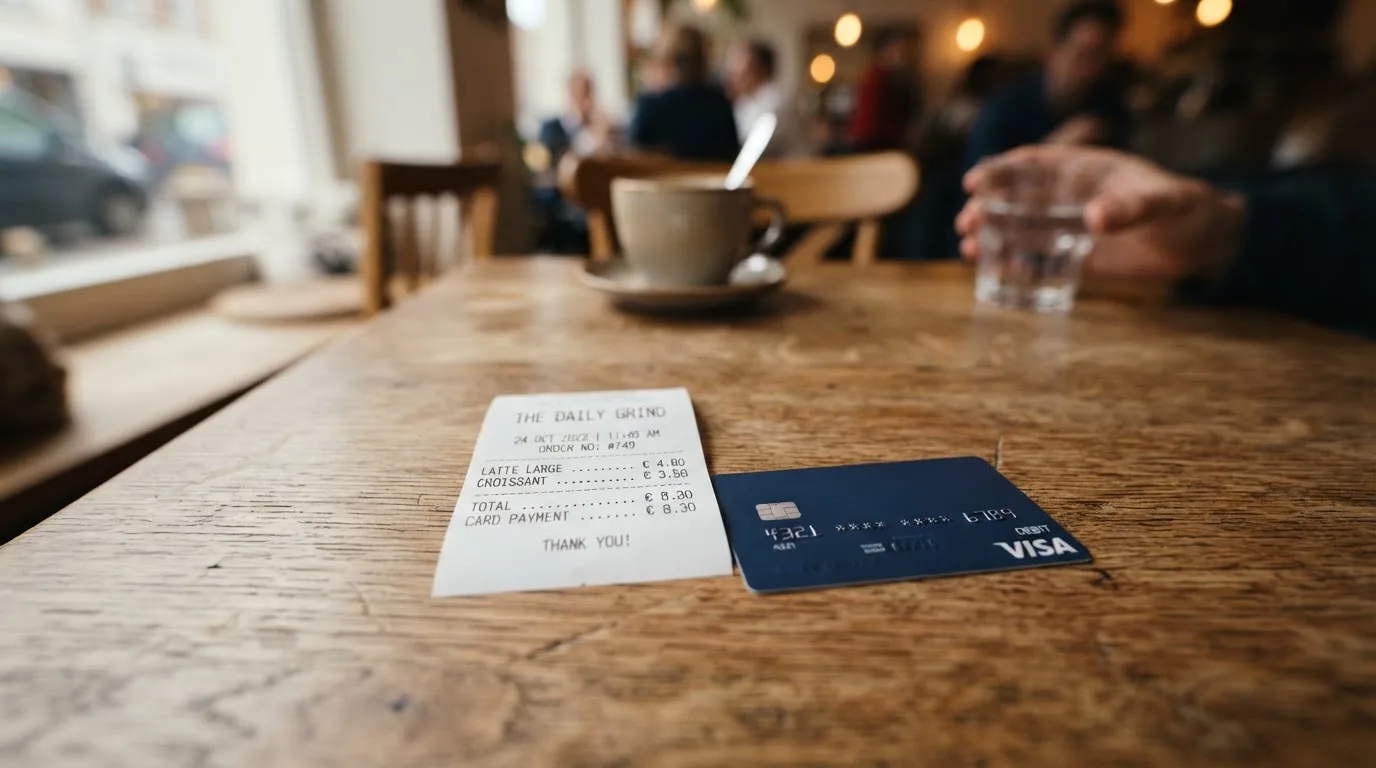
The figures below are therefore a mixture of two kinds of information, and I have labelled them. Where a line says unofficial, it comes from a third-party source rather than from the card, and the card does not confirm it.
| Fee or limit | What the card states | Unofficial figures |
|---|---|---|
| Issuance | not stated | Trocador fee of 3% of the nominal value plus $2; Obsidian $0.60 per purchase |
| Monthly fee | not stated | Obsidian $5 a month after the second month |
| Conversion | not stated | Possible envelope conversion fee when paying in crypto |
| FX | not stated | 2.75% on payments not in USD |
| ATM | not stated | No ATM reported |
| Daily and monthly limits | not stated | No figures published by any source I found |
| Tiers | not stated | No tier structure described |
Now, what does that mean when you actually spend money? Take three ordinary payments and see which of the above lines could touch them.
A coffee at a local café. You tap or insert the card, the amount is small, and if you hold a USD balance the FX line probably does not apply at all. The card’s own fee structure is not published, so I cannot tell you whether a per-transaction charge exists. What you can expect, from what users report, is that acceptance is not universal: merchants may refuse prepaid cards, and a foreign-issued card with a billing address that does not match the shop’s country can attract extra scrutiny at the till.
A weekly supermarket shop. Here the FX line bites if your balance is not in the shop’s currency, at an unofficial 2.75%. If you are paying in USD, it does not. The bigger risk is a decline: address verification compares the numeric parts of the billing address you entered with the issuer’s records, it is mainly offered in the US, Canada and the UK, and it is generally unavailable for foreign-issued cards — which is precisely the profile of a card bought with crypto and delivered from somewhere else. A declined authorisation may also leave a hold on your funds that can stay for several days, typically up to seven, even though you never completed the purchase.
A subscription or an online service. This is where the card is most likely to fail outright, and the reason is not the price. 3-D Secure adds an identity check to online card payments, and the card is not accepted where 3-D Secure is required. So are recurring payments, and anything with a strong fraud filter — travel, tickets, digital goods, anything that wants a one-time code. Visa’s brand is Visa Secure and Mastercard’s is Identity Check; under those systems the issuer either approves frictionlessly or challenges you. This card’s position is that it does not take part.
The 2.75% on non-USD payments and the $5 monthly fee after the second month are the two numbers I would hold onto, because they are the ones that turn a cheap card into an expensive one. A $5 monthly charge on a card you use twice a month is not a fee, it is a subscription. If you cannot find a published schedule, ask the provider for one in writing before you buy, and treat the Obsidian figures above as the working assumption until they tell you otherwise.
Top up: you are buying, not topping up
This is the part where Trocador is genuinely different from most crypto cards, and it explains a good deal of the score. The model is not “load funds as you go”. The card is bought with crypto, and the crypto is converted once, at the moment of purchase, into a card of fixed value. There is no later top-up step in the published material.
The funding route is crypto: starting data mentions BTC, XMR, LTC, stablecoins and others through AnonPay, though the exact coin list is not confirmed. Unofficial sources describe a wide choice including Monero and flag the possibility of a conversion fee at that point. So the funding experience in practice is: choose a coin, send it, receive a fixed-value prepaid card.
Three consequences follow, and each of them is a thing to check before you send anything.
The network. Deposits go to an address, and if you send on a network the provider does not support the result can be loss or a long support conversation with no guarantee. This is the most common way people lose money with cards like this, and it is entirely avoidable by confirming the exact network with the provider first. It is not a workaround or a trick — it is just the one question to ask before transferring.
The coin you hold may not be one you can send. ERC-20 is the Ethereum token standard, and gas on Ethereum is paid only in ETH, so a wallet holding USDT but no ETH cannot send it. Tron prices fees through bandwidth and energy, often burning TRX. If you are holding a token and cannot move it, that is the reason, and it is a wallet-level constraint rather than anything the card did.
The stablecoin may not be the one you think. USDT and USDC are US-dollar-pegged, and the BIS put about 90% of stablecoin market capitalisation in those two as of July 2025. But stablecoins are not stable by definition: TerraUSD collapsed in May 2022 and USDC temporarily lost its peg in March 2023. Circle also stopped supporting USDC on Tron in February 2024, so “USDC over TRC20” is not a native option. OkiCard, one of the alternatives below, illustrates the point neatly — its listed networks are USDT on BSC, Ethereum, Tron and Solana, with USDC “soon” and Bitcoin and altcoins “coming soon”.
One more thing that is not stated: whether you can withdraw money from the card. The card does not say, and a fixed-value prepaid card with no published withdrawal route is a one-way instrument as far as the public material goes.
Paying with it every day
The realistic picture is a virtual card, and it is a card that works on ordinary purchases and then fails on specific, identifiable ones.
Wallets: Samsung Pay, Google Pay and Apple Pay “usually” work, and I would treat “usually” as the operative word. Apple Pay replaces the card number with a device-specific number held in the Secure Element rather than on Apple’s servers, and each payment carries a one-time dynamic code — but the issuer can still restrict the tokenised number, for example blocking it for website or phone use. If adding the card to your wallet fails, that is the issuer declining the token, not a fault in your phone.
Acceptance: the card is not accepted where 3-D Secure is required, or where gift and prepaid cards are refused outright. There is no app — purchase happens on the web. There is no rewards programme stated, no cashback, nothing to offset the fees. Per unofficial reporting there is no plastic and no ATM.
That last point deserves a moment. No ATM means no cash, and cash is precisely the fallback you would want on the days the card declines. Combined with unpublished limits and a declined-payment hold of up to seven days, it means the failure mode of this card is not “slightly worse than a bank card” but “no money that day and no obvious way to get any”. That is why I score everyday use at 4 out of 10. It is not that the card is badly made; it is that it is narrow, and the narrowness is undocumented.
Where it does work, the mechanics are ordinary card mechanics. The card number starts with a six- or eight-digit issuer identification number that merchants can look up to see which institution and country issued the card — which is why a card issued in one country can look foreign to a shop in another. Merchants may apply extra scrutiny, and some decline prepaid or foreign-issued cards on the basis of that lookup alone.
What can go wrong
I found no official incident to report, and I want to be precise about that rather than implying a clean record. What follows is a mix of user reports and general category risks, labelled by source.
Reported card-side problems. Undated user reports, relayed by a third party in August 2026, describe MyPrepaidCenter cards with activation problems, billing-address validation issues, declines, locked access and slow support. That is the provider most associated with complaints in this set, and it is also reported as US-only, so the people most affected are likely the people with the fewest alternatives.
Reported service-side problems. Delayed swaps via partner exchanges in June and July 2026, long AML and KYC holds from March to May 2026, and complaints about the tone of support in September 2026. On the exchange side itself the picture is better: Trustpilot shows 4.8 out of 5 from 267 reviews, read on 2026-10-21, though that rating is mostly about the exchange service rather than the card.
The company. Operated by Reta Development Assets LLC per the starting data. The issuing institution is not named. Licences are not stated. If you were hoping to find a banking licence or an electronic money licence on the website, there is not one to find.
Why the silence itself is a risk. KYC is not optional for regulated businesses: rules require customer verification and risk assessment as part of anti-money-laundering law, with ongoing monitoring and suspicious-activity reporting. In the EU, due diligence covers name, address, date of birth, nationality, identity documentation, a sanctions check, the purpose of the relationship and politically-exposed-person status. If due diligence cannot be completed, the institution is required to refrain from the transaction. That is not sinister — it is the law working — but it means that any provider can freeze or close an account pending documents, and it means the holds people report are a known consequence of the process rather than a quirk of one support desk.
Structural category risks. Card programmes do close. Visa terminated its global agreements with FTX on 13 November 2022 and the FTX US debit card was wound down by its issuer. Visa also suspended WaveCrest in Europe in 2018, closing all WaveCrest-issued Visa programmes. Closures typically follow a pattern: notice, then spending and loading stop, then users are asked to withdraw remaining balances. That last step is the one to think about with a fixed-value prepaid card bought with crypto.
Rules you did not read. Gambling is classified under merchant category code 7995, and many issuers block it on specific cards by policy rather than by law, with the blocked list varying by issuer. Whether this card blocks it is not stated.
What you should do about it. Nothing clever, just ordinary prudence: keep small amounts on the card rather than your whole balance, withdraw the remainder if and when the option exists, and treat the card as a convenience instrument with a limited life rather than as a wallet.
What to take instead
Three alternatives, all of which publish more than Trocador does. I include them because the comparison is the useful part.
| Alternative | Score | Cost | Key limitation |
|---|---|---|---|
| OkiCard | 6.0 / 10 | $0 issuance, $0 monthly, starting price $15 for the virtual card; load fee 3%; USD transaction fee 0% | Pages disagree on the issuance fee; initial deposit 100 USDT |
| Cardex | 5.6 / 10 | Not stated; conversion at the moment of payment with no percentage published | App Store listing is Naira-focused |
| TakeCard | 5.5 / 10 | Virtual $5; physical in Bolivia $20 issuance plus $20 shipping, with another article saying $10 | Physical card Bolivia only; pages conflict on price |
OkiCard is the strongest of the three on paper and the closest to Trocador’s idea done more explicitly. It covers “150+ countries” on some pages and “200+” on others, says there is no geo-blocking based on your passport, and asks users to confirm they are not in a sanctioned jurisdiction. It is a virtual card, with a physical one mentioned without detail, on a Visa/Mastercard network that the page does not pin down, denominated in a USD/EUR peg. Its fee schedule is the clearest of any card here: issuance $0, monthly $0, starting price $15, load fee 3%, transaction fee 0% on USD and “no hidden exchange spreads”. Funding is USDT on BSC, Ethereum, Tron and Solana, with USDC “soon” and BTC and altcoins “coming soon”. No rewards stated. The pages contradict each other on whether there is a one-time issuance fee, which is exactly the kind of small inconsistency worth asking about.
Cardex markets itself as one crypto card for 200+ countries with no country list or exclusions, on the VERVE, VISA, Mastercard and UnionPay networks, virtual and physical. Its conversion story is the interesting part: it claims an “AI-Powered Conversion Rate” that scans global exchange rates and picks the best one at the moment you spend. No fee percentage is stated, which is why its cost line is empty — the mechanism is described, the price is not. Funding is USDT, USDC and BTC, networks not stated. Its App Store listing is Naira-focused, paying in Naira, which tells you more about its centre of gravity than the country count does.
TakeCard is the most transparent on fees and the most restricted on reach. It is a prepaid Visa card issued in the United States, in USD, paying 1:1 with no currency adjustment; other currencies convert at the official Visa rate of the day. The commission is 1% per purchase. The virtual card is $5 and available immediately; the physical card is Bolivia only, at $20 issuance plus $20 shipping, though another article in the same help centre says $10 — a conflict worth confirming. Countries are not listed in the help articles; the site says the wallet can receive payments from any country, and starting data lists virtual cards for Argentina, Bolivia, Peru, Chile, Paraguay, Colombia, Ecuador, the US, Spain and Italy, which I could not verify on a page I could read. Top-up is from the Takenos balance, with USDC and USDT via Polygon, BNB Chain, Tron or Ethereum in unverified starting data.
My honest comparison: if you are choosing on published information, OkiCard beats Trocador, and TakeCard beats both on fee clarity while losing on who can have one. If you are choosing on privacy, Trocador and OkiCard are closer than either is to a bank card, and neither of them tells you what happens to your identity documents.
Who I would recommend it to
I would recommend Trocador to someone who has already decided that an ordinary bank card is not available to them, who is comfortable buying from a marketplace of providers rather than from a named issuer, and who will spend the twenty minutes it takes to get written answers about fees, limits, identity checks and delivery before sending any crypto. That person will find the arrangement coherent: crypto in, fixed-value prepaid card out, no credit line, no relationship to end.
I would not recommend it to anyone whose income depends on this card being accepted everywhere, to anyone who needs cash as a backup, to anyone planning recurring online subscriptions, or to anyone who has to answer to an accountant and prefers documentation. If the card declines on a day you needed it, the fallback is thin: no ATM, no plastic, no published limit to reason about, no support hours.
And I would not recommend it to someone who is choosing a crypto card for privacy and expects that word to mean what it meant in the early days. Prepaid cards are checked. KYC is required of regulated businesses and applied in practice; address verification compares what you type with what the issuer holds; a foreign-issued card is visible to any merchant who looks at the issuer number. Nothing here is a way around any of that, and I am not going to describe one.
The 5.4 is not a verdict on the idea. It is a verdict on a product that asks you to buy without publishing what you are buying. That gap is closeable — ask the provider, in writing, before you pay — and if the answers are clear, the card may suit you. If they are vague, you have your answer.
Frequently asked questions
What is the Trocador card?
The Trocador card is a prepaid Visa or Mastercard bought with crypto. You pay in crypto, which is converted at purchase into a card of fixed value. It is not a debit card linked to a bank account, so it cannot overdraw. Cards are delivered by third-party providers — Reward, MyPrepaidCenter or Obsidian — meaning the rules and support depend on which provider issues your card.
How does the Trocador card work day to day?
You spend the stored balance in shops, online and via mobile wallets like Apple Pay, Google Pay and Samsung Pay, which usually work. The card is not accepted where 3-D Secure is required, and merchants may refuse prepaid cards. With no plastic or ATM access, this is a virtual, fixed-balance card, with no cash fallback.
Is Trocador a bank?
No. The operator is Reta Development Assets LLC, and I could not find a banking or e-money licence on its public pages. The card networks themselves do not issue these cards directly; they license third-party issuers. The licence that protects your funds would sit with the provider that issues your card, not with Trocador itself.
Who owns Trocador?
The operating company is Reta Development Assets LLC. However, the cards are delivered by independent third-party providers — Reward, MyPrepaidCenter and Obsidian — so the card you receive may have no relationship with the entity that sells it. This structure is common for card marketplaces, but it separates the purchase from the issuance and the rules.
Does the Trocador card require KYC?
The card does not state its identity requirements, but KYC is mandatory for regulated businesses and typically required in practice. Ask your specific provider what identification they require before you pay. Crypto transfers are irreversible, so money sent before verification cannot be recalled if your documents are not accepted by the provider.
How much does a Trocador card cost?
The card does not publish its fees. Unofficial figures suggest a Trocador fee of 3% plus $2, Obsidian charging $0.60 per purchase and $5 a month after the second month, and 2.75% on non-USD payments. Treat these as unconfirmed assumptions; always ask the specific provider for their official schedule in writing before buying.
What are the limits on a Trocador card?
Limits and ATM availability are not stated publicly, and third-party sources provide no reliable figures. This is a practical reason to buy small: with no published ceiling, you cannot know if a payment will clear, and a declined purchase can leave a hold on your funds for up to seven days, effectively locking your balance.
Is the Trocador card safe?
I found no official incident to report. However, user reports from August 2026 mention activation problems, declines and slow support for MyPrepaidCenter cards. Crypto card programmes like FTX in 2022 or WaveCrest in 2018 have closed abruptly, stopping spending. Treat this card as a convenience instrument with a limited life, not a wallet.
Is the Trocador card worth it?
It is worth it if a bank card is unavailable and you are comfortable buying from a provider marketplace. It is not worth it if you need universal acceptance, cash withdrawals, or official documentation. OkiCard is a better alternative, publishing a $15 price, $0 monthly fee, 3% load fee and 0% USD transaction fee.
Can I use the Trocador card in my country?
Probably, but there is no single list because card restrictions vary by provider. Unofficial sources say 164 countries are covered, with 11 closed, and that the Reward and MyPrepaidCenter cards are US-only. Ask your specific provider which is issuing for your country before sending crypto, and confirm if they accept residents rather than only citizens.
Highest-scored virtual cards – cryptocardbest.com
Content created by the «cryptocardbest.com» team