
The Shakepay card, read closely: a Canadian Visa prepaid card that spends your balance and pays you back in bitcoin
 Available in US
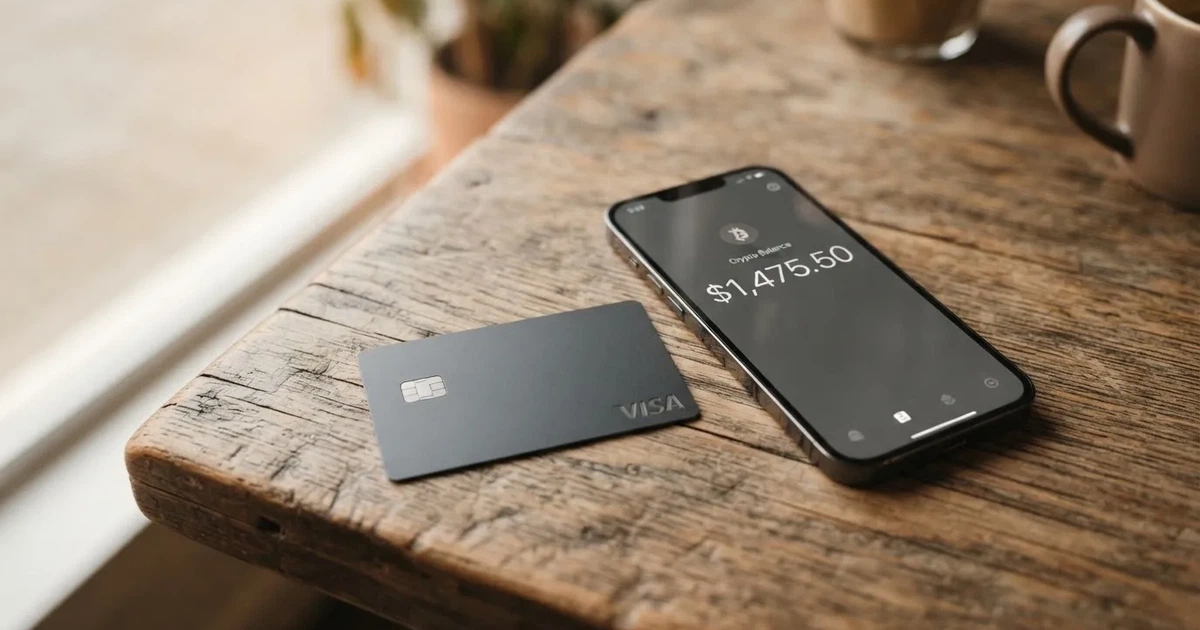
The Shakepay card is a physical Visa Prepaid Card that spends a Canadian dollar balance held in a Shakepay account, and pays up to 1.5% of eligible purchases back in bitcoin. It is issued by Peoples Trust Company, it is only for customers in Canada, and its honest appeal is narrow and real: if you are a Canadian resident who already holds crypto with Shakepay and wants a card that spends that balance and rewards you in bitcoin, few alternatives do it this simply. If you are anywhere else, or you need a bank account in a currency Shakepay does not hold, the short answer is that this is not the card for you, and no reward rate changes that.
The conditions described here are current as of October 28, 2026.
Verdict: 4.3 out of 10
I scored this card 4.3 / 10 overall. That number is not a verdict on Shakepay the company, which is a long-running Canadian crypto platform registered with FINTRAC (#M17065696) and a member of CIRO. It is a verdict on the card, weighed against the specific thing many people are looking for: an ordinary, everyday payment card that works widely, costs little and does not make you anxious.
The shape of the problem is this. Shakepay’s card is solid where it is strong: physical Visa, Apple Pay and Google Pay, a real ATM allowance, no annual fee, and bitcoin cashback that credits automatically. That is why it scores highest of all on everyday use. It is weak on reach (Canada only), on top-up flexibility (the card spends a fiat balance, and the crypto routes for it are not stated), and on the thing that damages confidence more than any fee: Trustpilot at 2.3 out of 5, with reviews about account freezes, closed accounts and delayed withdrawals.
| Criterion | Mark | Why |
|---|---|---|
| Who can get it | 2 / 10 | Available to Shakepay customers in all 13 Canadian provinces and territories; Canada only |
| Cost | 5 / 10 | No annual fee; foreign conversion 3% at Base, 1.5% at Bright, 0% at Blue; issuance fee not disclosed; card free for fully verified accounts |
| Top-up options | 3 / 10 | The card spends the Canadian dollar balance; Interac e-Transfer free, $5 minimum, $10,000 maximum; crypto top-up for the card not disclosed |
| Reliability and complaints | 5 / 10 | Issued by Peoples Trust Company, FINTRAC registration #M17065696, funds not CDIC-insured; Trustpilot 2.3 out of 5, complaints about freezes, account closures and withdrawal delays |
| Everyday use | 7 / 10 | Physical Visa Prepaid, Apple Pay and Google Pay, ATM withdrawal of $500 per transaction; virtual card not disclosed |
| Total | 4.3 / 10 |
Who this suits: Canadian residents who want bitcoin cashback on what they already spend, and who are comfortable holding a balance with a custodial platform. Who it does not suit: anyone outside Canada, anyone who needs a multi-currency balance, anyone who plans around a virtual card for online subscriptions, and anyone whose income arrives in a currency other than Canadian dollars and who is sensitive to a 3% foreign exchange charge.
Who will they give you the card to
Answer: Shakepay customers in all 13 Canadian provinces and territories. That is the whole eligibility statement on the card page, and it is Canada only.
One thing worth reading carefully, because it is easy to over-read in either direction: the cardholder agreement does not explicitly require Canadian residency, and the card arrives “regardless of where you live in Canada”. Other countries are simply not listed at all. That is silence, not permission. If you are outside Canada, do not plan around it — the honest reading is that the card is a Canadian product, and both the country restriction and the address-verification behaviour described further down work against cards used from elsewhere. If you have a specific non-Canadian address in mind, the only reliable answer comes from Shakepay itself: the card support email is [email protected].
Some merchants also restrict prepaid cards, which is a property of the category rather than of this card. More on that in the section on what can go wrong.
How to get it
Answer: you order the physical card in the app, set your PIN during the ordering, and it arrives within 21 days by regular Canada Post mail.
There is no credit check, and setup takes minutes. What documents you need, what proof of address is required, and any age requirement beyond the usual: not stated on the public pages. What is stated is that a fully verified account is required, that you must be of the age of majority in your province or territory, that it is one card per person, and that there is an eligibility questionnaire inside the app. Verification tiers, how long verification actually takes, and the reasons a verification can be refused: not stated in the pages I read. That gap is worth holding onto, because it is exactly the information a cautious applicant wants.
What arrives in the post:
- A physical Shakepay Visa Prepaid Card drawing on a Canadian dollar balance. Whether a virtual or metal version exists: not stated.
- Delivery by Canada Post regular mail, within 21 days, untracked.
- Ordering moved to a general order flow (help article 16221106).
If something goes wrong with the card itself:
- A damaged card keeps its number, expiry and CVV.
- A lost or stolen card gets new details.
- Replacement is handled through “Replace card” in the app.
- The replacement fee: not stated.
- Reissue within 30 days after you report the loss.
- Your PIN cannot be changed once set — a new PIN means replacing the card.
One unofficial note, since it affects whether you can simply order one: CryptoCardHub reported on 11 August 2026 that the physical card rollout opened gradually by waitlist rank, after an announcement on 21 May 2026. The official help article I read does not mention a waitlist at all. Treat the waitlist story as third-party reporting, not something the card confirms.
Fees and what your money actually leaves for
Answer: there is no annual fee and the card is free for fully verified accounts, but outside Canada the foreign exchange charge is the number that decides whether the card is worth having — 3% at Base, 1.5% at Bright, and 0% at Blue.
| Item | What it costs |
|---|---|
| Annual fee | None |
| Issuance fee | Not stated; card free for fully verified accounts |
| Conversion / crypto conversion fee | Not stated |
| Foreign exchange charge | 3% (Base), 1.5% (Bright), 0% (Blue); the cardholder agreement’s fee table lists only the 3% FX charge |
| ATM withdrawal | $500 per transaction, $1,000 per day at PLUS-logo ATMs; operator fees may apply; no cash or cheque deposits |
| Per-transaction limit | CAD $5,000 |
| Daily limit | CAD $5,000 |
| Monthly limit | CAD $50,000 |
| Apple Pay / Google Pay tap limit | $250 |
| Limits increaseable | No (help article updated 21 April 2026) |
Three everyday payments, and what applies:
- Groceries in Toronto, on Base. No foreign exchange charge, because the transaction is in Canadian dollars. The cashback applies: 1% at Base, credited automatically in bitcoin. This is the case the card is actually good at.
- A hotel in Lisbon, on Base. The bill arrives in euros, so Visa converts it at its rate and the card adds the 3% foreign exchange charge on top. On Blue the same purchase converts at 0%, which is a real difference and the single strongest argument for reaching Blue.
- Coffee on Apple Pay, on Bright. The $250 tap limit applies, so a large restaurant bill on the phone will need the physical card. Cashback is 1% at Bright, and the FX charge is 1.5% if the transaction is not in Canadian dollars.
One detail that costs real money to learn the hard way: a foreign refund comes back at the rate you paid to Visa minus the charge, so it is usually smaller than what you paid. And the card holds a Canadian dollar balance — whether it can hold more than one currency is not stated.
The reward statuses are set per calendar month, which is worth understanding, because they are what drive the FX rate:
| Status | How you get there | Cashback | FX charge | Notes |
|---|---|---|---|---|
| Base | Default | 1% card cashback | 3% | Where everyone starts |
| Bright | Exchange $100+ or $200+ in eligible direct deposits | 1% cashback | 1.5% | Monthly |
| Blue | Exchange $1,000+ or $2,000+ direct deposits | 1.5% cashback | 0% | Priority support |
| Business | Automatic | — | — | Monthly |
| Metal card | — | — | — | None stated |
How to top it up
Answer: by funding the Shakepay account — most simply with Interac e-Transfer — and the card spends the Canadian dollar balance.
- Interac e-Transfer in: free, arrives in minutes, $5 minimum, $10,000 maximum.
- Wire in: free, 1–2 working days, $10,000 minimum.
- No activation fee, no minimum balance.
- Which coins and networks can be used to top up the card specifically: not stated.
That last line is the honest weak spot in this section, and it is why the card scored 3 / 10 on top-up options. The card is funded from a CAD balance, and there is no direct crypto-to-card route. If your money is in bitcoin and your spending is in groceries, something has to convert in between, and the terms of that conversion are not published here. Ask before you commit.
Two more things worth knowing:
- Closing the card leaves your Shakepay Wallet balance accessible, and the funds do not expire with the card.
- Withdrawal fees from the wallet are not disclosed.
If you were planning to deposit a stablecoin straight to the card, stop and read this: blockchain transfers are irreversible, and a deposit sent on a network the provider does not support, or to an address belonging to a different network, can be lost or need manual support recovery with no guarantee.
Paying with it every day
Answer: it is a physical Visa Prepaid that works wherever Visa is accepted, with Apple Pay and Google Pay supported “where available”, and up to 1.5% cashback in bitcoin on eligible purchases at eligible merchants worldwide.
What works well:
- The physical card, plus Apple Pay and Google Pay, and $500 per ATM transaction at PLUS-logo ATMs (no bitcoin rewards on ATM transactions).
- Cashback up to 1.5% in bitcoin, credited automatically to your BTC balance and withdrawable to your own wallet. At Base that is 1%.
- The Shakepay Mobile App handles disputes, card settings and support chat. Its store ratings and number of ratings: not obtained.
- Freezing the card instantly in the app, and two-factor authentication.
What you may hit:
- Virtual card use: not stated. If you subscribe to a pile of services and want a disposable card number for each, this is not that card.
- Blocked merchant categories: not stated, so you cannot tell from the public pages whether gambling or anything else is switched off.
- $250 tap limit on Apple and Google Pay, and limits that cannot be increased.
- Address verification. AVS compares the numeric parts of the billing address you type against issuer records; it is mainly offered in the US, Canada and the UK and is generally unavailable for foreign-issued cards, which can cause declines. A Canadian card used on a non-Canadian billing address is exactly the shape of transaction that gets declined. If a decline happens, a hold on the funds can stay for several days, typically up to seven.
What can go wrong
Answer: the mechanical risks are ordinary and manageable — freezes, limits, declines. The reputational risk is not ordinary, and it is the reason this card does not score higher.
The company and the money:
- Shakepay is registered with FINTRAC, #M17065696, is a CIRO member and an Investment Dealer registered with the AMF and provincial regulators.
- The card is issued by Peoples Trust Company under licence from Visa International.
- The funds are not CDIC-insured. If you are used to bank deposits, this is the single most important line on this page. You are holding money with a platform, not in a deposit.
- The wallet is custodial: Shakepay holds the credentials, so you must trust them completely. A seed phrase of 12 to 24 words is the unencrypted form of the private key — anyone who gets it can restore the wallet and spend the funds, and blockchain transfers are typically irreversible with no built-in recovery.
What people actually report. I read the Trustpilot page on 20 October 2026: 2.3 out of 5 across 22 reviews, of which one was in the last 12 months. Only one review mentions the card at all — a positive one from December 2021. The recurring themes:
- Account freezes and closures without a stated reason (2021 to February 2022, and July 2025).
- Support unresponsive for days (2021, December 2023, July 2025).
- Delayed or blocked withdrawals and wires (2022–2023).
- Funds not returned, including a $250 bill payment never received (September 2026).
- Questions about the source of funds (November 2022).
A caveat I will not skip: these are individual accounts on one review platform, not a measured rate. But they line up with something structural. If due diligence cannot be completed, anti-money-laundering rules require the institution to hold off, and where necessary end the relationship — which is why accounts get closed or frozen pending documents. Nationality is screened separately from residence, because sanctions screening and issuer risk policy are often applied to citizenship and country of birth, not just to your address. CryptoCardHub cited Trustpilot at about 1.5 out of 5 on 11 August 2026, which disagrees with the 2.3 I read; neither is an official figure.
There is a category-level risk that sits underneath all of this. Visa and Mastercard do not issue crypto cards to consumers themselves — they license issuers, and they can suspend a programme. Visa terminated its global agreements with FTX on 13 November 2022 and the FTX US debit card was wound down by its issuer. WaveCrest, a Visa issuer that supplied several crypto card brands, was suspended by Visa in Europe in 2018, closing all WaveCrest-issued Visa programmes. Closures typically follow a pattern: a notice period, then spending and loading stop, then users are asked to withdraw what is left.
Disputes, if something goes wrong with a payment: notify Shakepay in writing within 60 days of the transaction through the dispute section of the app. The agreement also says a dispute must be received within 90 days, or the transaction is deemed accepted. Visa Zero Liability claims for unauthorised use can take up to 120 days after paperwork and may need a police investigation, and transactions before you reported the loss may be treated as yours. If a complaint is unresolved, the Ombudsman for Banking Services and Investments is 1-888-451-4519, and FCAC is 1-866-461-3222.
Contact details, all of them from the card’s own pages: [email protected], in-app Support Chat under Settings > Help, phone +1(438) 802-1221, and 1-855-574-2539 for lost or stolen, 24/7. Blue and Business status holders get priority live chat on weekdays 8am–10pm EST and weekends 9am–5pm EST. Note that your PIN may be disabled after three wrong entries.
What to take instead
Answer: if you are not a Canadian resident, look at a card that is actually built for where you are, and if you are a Canadian who wants the cashback without the country limits, a crypto credit card may suit you better. None of these is a recommendation — I am telling you what each one is, so you can weigh them against the Shakepay card yourself.
| Card | Score | What it is | Annual fee | Foreign transaction fees | Rewards | Top-up |
|---|---|---|---|---|---|---|
| Shakepay | 4.3 / 10 | Visa Prepaid, CAD balance, Canada only | None; issuance fee not stated | 3% / 1.5% / 0% by status | Up to 1.5% bitcoin cashback | Interac e-Transfer, wire |
| Gemini | 4.9 / 10 | Mastercard World Elite credit card | None; issuance fee not stated | None; crypto conversion not applicable (credit card) | 4% gas/EV/transit on first $300 per month, 3% dining, 2% groceries, 1% other; 10% Vault Rewards at some merchants (capped, vary) | Not prepaid — credit card paid off in fiat |
| Lava | 7.1 / 10 | “Lava Card”, 150 million merchants in 150+ countries | “no annual fees”; issuance fee not stated | “no FX fees, and no FX spread” | “up to 5% back in bitcoin on every purchase”; conditions not stated | Local currency or stablecoins; networks not stated |
| Trastra | 4.1 / 10 | Prepaid debit card accepted at Visa merchants worldwide | Not stated | Not stated | Not stated | Crypto, via the Mover wallet; coins and networks not named |
How to read that table. Gemini scores highest of the three alternatives but is a credit card, not a prepaid one — different product, different obligations, and the crypto is the reward rather than the funding. Lava scores best overall and its fee structure is the most attractive of anything here, but its eligibility is not stated on the card page, so I cannot tell you who gets one. Trastra has the clearest geographic statement of the four: available in 31 listed countries including Germany, France and the UK, promised for all residents of the EEA, and for non-European residents the page says “Not at the moment.” The rule appears to be residence-based rather than citizenship-based. Its cost, fee and reward details are simply not stated, which is itself information.
One thing all three alternatives do that Shakepay does not: they are not restricted to one country.
Who I would recommend it to
Three people. One person who lives in Canada, holds crypto with Shakepay already, and wants their ordinary spending to earn bitcoin without thinking about it — for them this card does exactly what it says, and the 0% foreign exchange charge at Blue status makes travel genuinely cheaper.
A second person is a Canadian resident with a genuine reason to earn bitcoin cashback, and who treats a custodial balance with the same wariness they would give any exchange account: not too much money, not the whole emergency fund, and CDIC insurance not assumed.
A third is a Canadian small business owner who can reach Business status and wants a simple prepaid card rather than a credit facility.
And here is who I would not recommend it to, plainly: anyone outside Canada. Anyone who needs a card for a country Shakepay does not serve. Anyone who needs a virtual card. Anyone who needs a multi-currency balance. Anyone whose priority is that the money is protected by deposit insurance — it is not CDIC-insured, and no cashback rate changes that. And anyone who has already read the Trustpilot reviews about freezes and unreturned funds and has decided that counterparty risk is not one they want to carry.
What I would check myself before applying, if I were the one deciding: whether my address will pass verification as a billing address abroad; what the direct crypto top-up route for the card actually is, since it is not stated; and whether the limits I need match CAD $5,000 per transaction, $5,000 per day and $50,000 per month, since they cannot be increased.
Frequently asked questions
What is the Shakepay card?
The Shakepay card is a physical Visa Prepaid Card that draws on the Canadian dollar balance in your Shakepay account rather than on a bank account. It is issued by Peoples Trust Company under licence from Visa International, works wherever Visa is accepted, and pays up to 1.5% cashback in bitcoin on eligible purchases at eligible merchants worldwide, credited automatically to your BTC balance. It is available to Shakepay customers in all 13 Canadian provinces and territories.
Is Shakepay a bank?
No. Shakepay is a registered crypto platform: FINTRAC #M17065696, a CIRO member and an Investment Dealer registered with the AMF and provincial regulators. The card itself is issued by Peoples Trust Company under licence from Visa International. Your balance is not a bank deposit and is not CDIC-insured, which is the distinction that matters most when you decide how much to leave there.
Who can get the Shakepay card?
Shakepay customers in all 13 Canadian provinces and territories — Canada only. You need a fully verified account, to be of the age of majority in your province or territory, one card per person, and to pass an eligibility questionnaire in the app. There is no credit check. The cardholder agreement does not explicitly require Canadian residency, but no other country is listed.
How much does the Shakepay card cost?
There is no annual fee, and the card is free for fully verified accounts; the issuance fee is not disclosed. The cost that decides it is the foreign exchange charge: 3% at Base status, 1.5% at Bright and 0% at Blue, applied to non-Canadian transactions converted at the Visa rate. Conversion fees and ATM fees are not stated on the public pages, though operator fees may apply at PLUS-logo ATMs.
How do I top up the Shakepay card?
You top up the Shakepay account and the card spends the Canadian dollar balance. Interac e-Transfer in is free, arrives in minutes, with a $5 minimum and $10,000 maximum. Wire in is free, takes 1–2 working days, and has a $10,000 minimum. There are no activation fees and no minimum balance. Which coins and networks can fund the card specifically is not stated.
Can I use the Shakepay card in another country?
Technically yes — it is a Visa card, so it is accepted wherever Visa is accepted, and it even gives 0% foreign exchange at Blue status. The catch is the address: AVS is generally unavailable for foreign-issued cards, so a Canadian billing address on a foreign purchase can be declined, and a hold can stay on the funds for up to seven days. If your address does not match, ask [email protected] before you rely on it.
Does the Shakepay card require KYC?
Yes, in the ordinary way: a fully verified account is required before you can order. Exactly which documents, what proof of address, how long verification takes and the reasons a verification can be refused are not stated on the pages I read. Verification tiers are also not published there. If your situation is not straightforward, ask in-app support chat before you order the card.
Is the Shakepay card safe?
Mechanically, it has the standard protections: instant freeze in the app, two-factor authentication, PIN entry, and Visa Zero Liability for unauthorised transactions, though claims can take up to 120 days after paperwork. What it does not have is deposit insurance — funds are not CDIC-insured — and the wallet is custodial, so Shakepay holds the credentials. Trustpilot showed 2.3 out of 5 across 22 reviews when I read it.
How do I add the Shakepay card to Apple Wallet?
The card supports Apple Pay and Google Pay “where available”, so you add it from the Shakepay app rather than by typing the number anywhere. Two practical things to know: the tap limit on Apple Pay and Google Pay is $250, which is low for a restaurant bill, and the tokenised number is stored in your device’s Secure Element rather than on Apple’s servers. If you set a PIN you cannot change it later without replacing the card.
Can I get a virtual Shakepay card?
That is not something I could confirm. Whether a virtual or metal version exists is not stated on the pages I read, and only the physical Visa Prepaid is described. If a virtual card is the reason you are considering this, write to [email protected] and get an answer before you apply. Same question if you care about getting a new card number for online subscriptions — the physical card does not do that job.
Highest-scored credit and cashback cards – cryptocardbest.com
Content created by the «cryptocardbest.com» team