
A virtual Visa (or is it Mastercard?) for existing EMCD users who already hold USDT
 Available in US
The EMCD card is a payment card connected to the Coinhold Wallet, a custodial crypto wallet run by the same company. You fund it with USDT, convert that to a US-dollar balance on the card, and spend wherever Visa or Mastercard is accepted. On paper, that sounds straightforward. In practice, the card comes with thin official information: the issuer is never named, the network is described as “Visa” on one page and “Mastercard” on another, and the help centre quietly lists thirteen countries where the card will not work, including Russia and Ukraine. The fees are steep for a card that promises “0%” on the Active tier, and the everyday experience is virtual-only with no 3-D Secure and no cash access.

I went through EMCD’s own pages, the Coinhold help centre, Trustpilot reviews and what is publicly available about the company. The picture that emerges is a card that works for a narrow audience: people who already keep USDT in a Coinhold account, who spend in US dollars, who do not need a physical card, and who are willing to accept the small print about limits, blocked merchant categories and a non-existent dispute process. If that is not you, the cost-to-flexibility ratio is poor compared to alternatives.
Conditions are current as of October 28, 2026.
Verdict
EMCD scores 4.9 out of 10. It is not a card for someone shopping around the crypto-card market; it is closer to a feature bolted onto the Coinhold wallet, useful only if you already live inside that ecosystem.
| Criterion | Score | Why |
|---|---|---|
| Who can get it | 9 / 10 | Works wherever Mastercard is accepted, with a short list of excluded countries |
| Cost | 2 / 10 | $19–$25 to issue, $5/month, 1.5% top-up, 1.5% + $0.50 per purchase, 3% non-USD conversion |
| Top-up options | 4 / 10 | USDT only, from the main Coinhold account, network not disclosed |
| Reliability and complaints | 4 / 10 | Issuer and legal entity are not named; Visa/Mastercard conflict; Trustpilot shows KYC blocks and slow support |
| Everyday use | 5 / 10 | Virtual only; Apple Pay and Google Pay flagged as “coming soon”; no 3-D Secure; no ATM |
Who the card suits: existing EMCD users who hold USDT in their Coinhold wallet, spend primarily in US dollars, and want a quick way to convert that balance to card payments without going through an exchange. The lower Active tier exists but I could not find an official way to obtain it; only Plus ($19) and Premium ($25) appear in the public fee schedule.
Who the card does not suit: anyone who needs a physical card, anyone who wants to withdraw cash, anyone who spends in non-USD currencies (the 3% conversion fee is steep), anyone who needs 3-D Secure for online shopping, and anyone who is a resident of one of the thirteen excluded countries (Afghanistan, Belarus, Cuba, Iran, North Korea, Syria, Venezuela, Russia, Myanmar, Somalia, Ukraine, Yemen and China).
Who they will give you the card
EMCD says the card works “worldwide” wherever Mastercard is accepted, but a notice on the card page says some EMCD services are unavailable in certain jurisdictions without naming them. The help centre is more specific: payments are not available in thirteen countries, listed as Afghanistan, Belarus, Cuba, Iran, North Korea, Syria, Venezuela, Russia, Myanmar, Somalia, Ukraine, Yemen and China. That is a significant restriction, especially because Russia and Ukraine are absent rather than just the sanctioned jurisdictions. Treat the help-centre list as the more reliable of the two, since the marketing page is vaguer than the operational reality.
Age and residency requirements are not stated in the official card materials. The general EMCD identity verification process asks for a government ID and “about 5 minutes” to complete, and a proof-of-address requirement is implied by the standard KYC flow but not spelled out for the card specifically. Nationality is checked as part of KYC, which means a citizen of one of the excluded countries is likely to be blocked even if they live elsewhere.
If you live in a country that is not on the excluded list and you can complete the standard EMCD verification, you are in the eligible pool. The card is then a function of funding, not geography, because the application is inside the wallet you already have.
How to get it
The card lives inside the EMCD app. There is no separate application form on a website; you open the app, complete or confirm identity verification, and order the card from the card section. Standard EMCD identity verification is required, with a valid government ID and “about 5 minutes” of process. A first top-up of at least $15 is needed to open the order, and that $15 stays in your card balance as a starting reserve.
After the first top-up, identity verification becomes mandatory. The help centre says verification usually takes “a few minutes” and that the card activates automatically. If it fails, you are told to retry with a different document. I could not find an official statement on which documents are accepted or on tiered KYC levels; the help centre is silent on those details. No proof of address is mentioned for the card specifically.
The card you receive is virtual only. The Coinhold help centre is direct: “Currently, we only offer virtual cards.” There is no delivery step, no shipping address, and no physical card to wait for. Cards are valid for two years; at expiry a new card with a new number is opened automatically. You can hold up to two active cards at a time.
Here is the practical order of operations:
- Open or sign in to the EMCD app.
- Complete identity verification with a government ID.
- Fund the main Coinhold account with USDT.
- Transfer at least $20 to the card balance ($15 of which is held as a reserve until total card spending exceeds $2,500).
- The card appears in the app, ready to use for online and contactless payments.
Fees
The cost picture is messy because the card page and the help centre disagree. The card page says the Active tier has “0% fees” on standard purchases. The help-centre article gives concrete numbers for Plus and Premium: a 1.5% top-up fee, a 1.5% + $0.50 purchase fee, a $1.50 declined-transaction fee, a $0.50 refund fee, a $2.00 reversal fee and a $35 chargeback fee. An unofficial third-party source puts the top-up/conversion at 2.5% with no monthly or annual fee, which contradicts the help centre on both counts. I treat the help-centre numbers as the more reliable, but the disagreement is itself a cost: you do not have one clean fee table to plan around.

| Fee or limit | Plus | Premium | Notes |
|---|---|---|---|
| Issuance | $19 | $25 | Whether one-off or recurring is not stated |
| Monthly maintenance | $5 | $5 | Unofficial source says no monthly fee |
| Top-up (USDT to USD balance) | 1.5% | 1.5% | Unofficial source says 2.5% |
| Purchase in USD | 1.5% + $0.50 | 1.5% + $0.50 | Active tier is described as “0%” |
| Non-USD purchase | up to 3% bank conversion | up to 3% bank conversion | Charged by the issuing bank, not EMCD |
| ATM cash withdrawal | not supported | not supported | Will “be” available with a physical card |
| Per-transaction limit | $1,000 | $10,000 | |
| Daily limit | $3,000 | $50,000 | |
| Monthly limit | $10,000 | $400,000 | |
| Closure fee | $15 | $15 | |
| Declined transaction | $1.50 | $1.50 | |
| Refund | $0.50 | $0.50 | |
| Reversal | $2.00 | $2.00 | |
| Chargeback | $35 | $35 |
Three everyday payments to make the table concrete:
- A $50 grocery run in the US: 1.5% + $0.50 = $1.25 on top of the purchase. The Active tier would in theory be $0, but I could not find a path to obtain the Active card from the public flow; only Plus and Premium are visible. If you have the Active card, the cost is zero. If you have Plus or Premium, the cost is $1.25.
- A $100 online subscription paid in euros: 1.5% + $0.50 = $2.00 EMCD fee, plus up to 3% ($3.00) charged by the issuing bank for the euro-to-dollar conversion. That is $5.00 on a $100 charge, or 5%. Most of that is not EMCD’s doing, but the total cost is what hits your balance.
- A $30 in-app purchase on a US store: 1.5% + $0.50 = $0.95, plus the $0.50 fixed fee hurts on small purchases.
The numbers above are the help-centre figures. The card page’s “0% on standard purchases” for Active is in tension with the same company’s published fee schedule, and that tension is the kind of thing you would want resolved before you commit $19 or $25 plus a $5 monthly fee.
Top up
Top-up is the one part of the flow that is fully internal to EMCD, and it is the simplest. You start with USDT in the Main account of your Coinhold wallet, then transfer to the card. The minimum first top-up is $20, and the fee is 1.5%. Top-ups usually land within 3 to 5 minutes, though the help centre warns that terms depend on the card plan and may change.
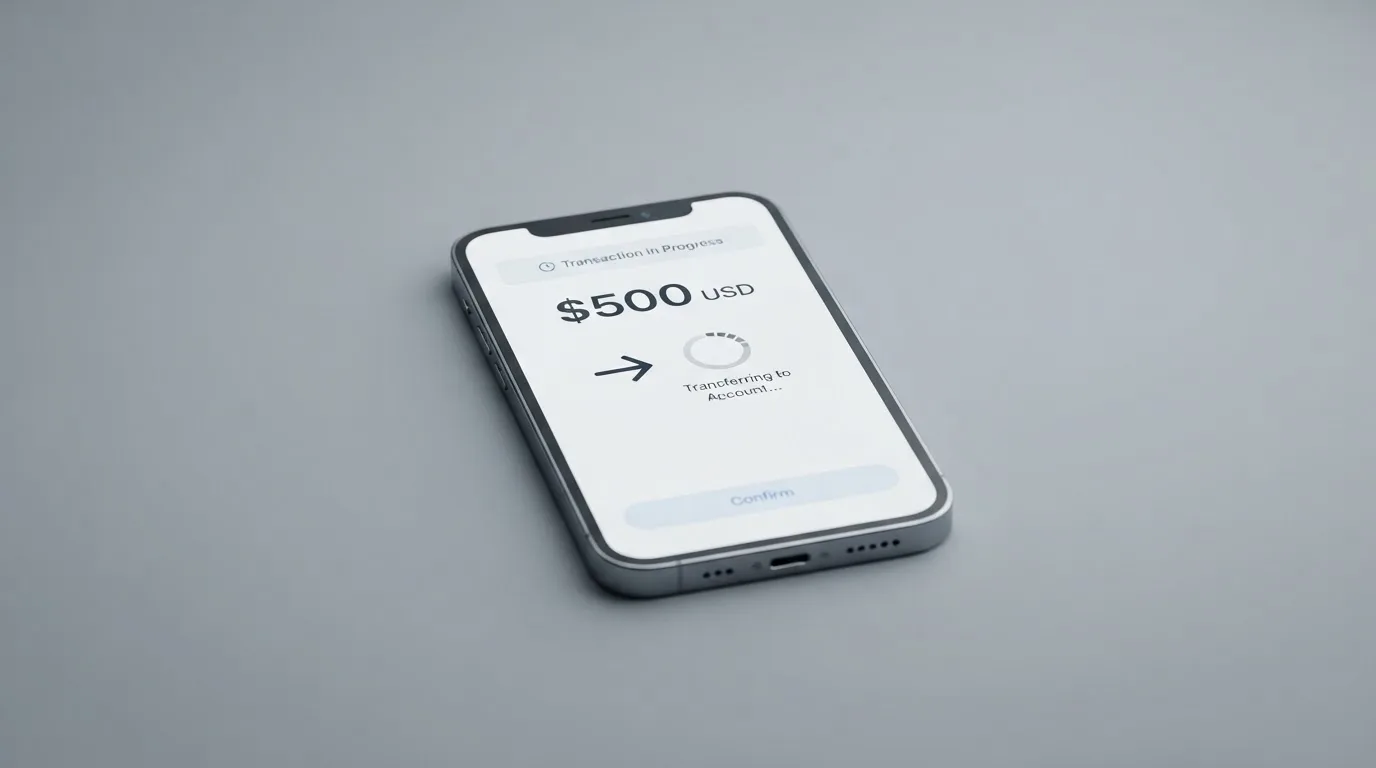
A few mechanics are worth knowing:
- Network is not disclosed. The official page says “USDT” without naming a chain. USDT exists on Ethereum (ERC-20), Tron (TRC-20), Solana, Polygon, Avalanche and others. The Coinhold help centre does not say which network the in-app transfer uses, and because the transfer happens inside the same platform you do not pick one. The lack of a stated network is unusual; most cards either pin to one chain or let you choose.
- $15 of your first top-up is held as a reserve. It returns to your available balance only after total card spending exceeds $2,500. That is effectively a $15 float you cannot touch.
- You cannot top up by card number, only from your main EMCD account. There is no way to load the card from an external bank card.
- Who pays the network (gas) fee is not stated. Because the transfer is internal, it may be zero, but it is not documented either way.
- A free transfer back from the card to the Main account is not supported. If you want to “unload” the card, the only path is to spend it down, or close the card and have the balance converted to USDT (with a $15 closure fee).
- The issuing bank can close the card if the balance drops to $20 or less and there is no activity for 30 days. Small or dormant balances are at risk.
An unofficial third-party source claims top-up is 2.5%, not 1.5%. If you are budgeting, plan for the higher figure and treat the lower one as best case.
Paying with it every day
The card is virtual, so every payment is either online (card number entered at checkout), in-app, or contactless through a mobile wallet. The EMCD app shows the card number, expiry and CVV; you can copy them into any checkout form. There is no physical tap-to-pay card and no PIN-based terminal use.
Apple Pay and Google Pay are mentioned in the FAQ as supported, but the feature list on the card page marks them as “Coming soon.” That is a conflict: one EMCD page says they work, another says they are not yet available. I would test the add-to-wallet flow inside the app before relying on it.
3-D Secure is not supported. Merchants that require 3-D Secure (most European banks now require it under PSD2’s strong customer authentication rules) will decline the card. That is a hard ceiling on where the card can be used online, especially for subscriptions and any EU retailer.
Blocked merchant categories are not listed on the official card page. The help-centre article, however, is specific: fuel, ride-hailing, AI subscriptions, money transfers, crypto exchanges, gambling, brokerage, and most entertainment except cinemas and theatres are blocked. That is a long list. If your spending pattern leans on any of these, the card will be declined at the merchant.
Cash is not an option. ATM withdrawals are not supported on the virtual card, and the FAQ says they “will be” available once a physical card launches. There is no timeline for that physical card. Until then, you cannot get physical money out of the card.
There is no cashback, no rewards programme and no points system described in the materials. Every payment costs you the fee; nothing comes back.
The card is managed in the EMCD app: freeze and unfreeze, set spending limits, view transactions, and report loss for reissue. App store ratings were not read for this review.
What can go wrong
Several things, and the way to think about them is in layers: company-level risk, card-specific risk, and operational risk.
Company-level. The legal entity behind EMCD and Coinhold is not stated on the card page, and the card issuer is not named. An unofficial third-party listing names the platform as EMCD and the card as running on Mastercard, but the issuer field is empty. That is a yellow flag. The Coinhold help centre lists languages as English, Portuguese, Russian and Spanish, which is consistent with an Eastern European or CIS-region operator, but I could not confirm that. The card page on the Coinhold website describes the card as “Visa Platinum,” while the help centre calls it “Mastercard.” The same product, two networks. One of them is wrong, and EMCD has not corrected it publicly.
Trustpilot reviews for the EMCD company (not the card specifically) are mixed. The score is hidden because of a “breach of guidelines” notice, but reading the reviews: 83% are five-star, 11% are one-star. The themes that come up repeatedly are:
- Accounts blocked or banned after KYC/AML review between November 2025 and April 2026.
- Slow or missing responses from support between November 2025 and March 2026.
- Welcome or referral bonuses unpaid because the KYC was not completed in time.
- US users blocked since 1 May 2025.
I could not find reviews specific to the EMCD card itself, and no Reddit threads about the card. The closest analogue is the wallet’s wider reputation.
Card-specific. The card is custodial: EMCD holds the USDT and the USD balance, and the card draws on what EMCD says is there. If EMCD has a custody failure of the kind that has hit other crypto platforms, the card balance is at risk. There is no insurance, safeguarding or segregation scheme described in the materials, and there is no indication that the card balance would be treated as client funds subject to any specific protection.
3-D Secure is not supported, so any online merchant that requires it will decline the card. This is more than an inconvenience; it means a meaningful share of European online retailers will not work. Address Verification System (AVS), which compares numeric parts of the billing address, is generally unavailable for foreign-issued cards and can cause declines at US merchants.
Disputes are a weak point. The fee schedule lists refund ($0.50), reversal ($2.00) and chargeback ($35), but the actual dispute procedure, time frames and outcomes are not described. If a merchant charges you for goods you did not receive, the path forward is unclear and the cost of invoking a chargeback is $35 up front.
Operational. Identity verification is mandatory after the first top-up, and the help centre says you should retry with a different document if it fails. There is no escalation path or SLA documented. Support is described as “24/7” in the help menu, but the contact email in the footer is obscured. Several Trustpilot reviewers said they did not get replies at all. That matches a pattern of slow support during the November 2025 to March 2026 window.
The card does not support 3-D Secure, which is worth repeating. If you want a card for European online shopping, this is not it.
What to take instead
If the EMCD card does not fit, three alternatives cover most of the same ground with different trade-offs.
Bybit Card (6.0 / 10) is the most established of the three. It supports both virtual and physical cards, runs on Mastercard or Visa depending on the region, and has a tiered cashback system that can reach 10% for top-tier users. The catch is geography: Bybit’s card is available in a specific list of countries (Argentina, AIFC/Kazakhstan, Georgia, Kazakhstan, Australia, Mexico, Brazil, Peru, and Asia Pacific), and EEA customers are explicitly excluded. Fees vary by region, but the crypto conversion fee is 0.9% over the One-Click Sell rate for most regions, which is lower than EMCD’s 1.5%. FX is 2% on top of the network rate for most regions. If you live in a supported country and you want a card with real rewards, Bybit is the stronger pick.
MSX (6.4 / 10) is the highest-scoring of the three on paper, but the public materials are thin. I could not find official statements on who can get the card, what it costs, how it is funded, or what rewards it offers. Treat the score as a placeholder until the company publishes more.
MEXC (5.6 / 10) is virtual-only like EMCD, funded with USDT through a Fiat account, and has a tiered cashback system: 4% for Standard users, 6% for Premier, 10% for Elite, paid by the 15th of the next month. The service fee is listed as 0%, but issuance is 20 USD (or 0 USD on a discount that is not clearly explained). If you are already a MEXC user, it is a closer fit than EMCD, with the same virtual-only limitation.
The honest summary: Bybit is the strongest of the three for users in its supported regions, MEXC is the closest alternative if you want virtual-only and USDT funding, and MSX needs more public information before it can be compared properly. None of them solves the “physical card with low fees and broad acceptance” problem that the best bank cards do.
Who I would recommend it to
A narrow audience.
I would recommend the EMCD card to existing EMCD and Coinhold users who already hold USDT in their main account, who spend primarily in US dollars at merchants that do not require 3-D Secure, who do not need cash, and who are willing to accept a $19 to $25 issuance fee plus a $5 monthly fee plus a 1.5% purchase fee. For that person, the card is a convenient bridge from a stablecoin balance to a card payment, and the 1.5% is the cost of not having to on-ramp through an exchange.
I would not recommend the EMCD card to anyone who lives outside the EMCD ecosystem and is choosing a crypto card for the first time. The fees are high, the issuer is not disclosed, the network description is internally inconsistent, the card is virtual-only, 3-D Secure is absent, and the merchant block list is long. Bybit and MEXC both offer more for less, even with their own regional limits.
I would also not recommend it to anyone who spends in non-USD currencies, because the 3% bank conversion fee is paid on top of EMCD’s 1.5% + $0.50, and the total cost of a euro or pound purchase is hard to justify when a dedicated multi-currency card exists.
If you are already inside the EMCD ecosystem, the card is a useful feature at a fair price. If you are choosing a crypto card, look elsewhere.
Frequently asked questions
What is the EMCD card?
The EMCD card is a virtual payment card connected to the EMCD Coinhold Wallet. You fund it with USDT from your main account, the USDT is converted to a US-dollar balance, and the card spends that balance wherever Visa or Mastercard is accepted. The card is currently virtual only, with a physical version not yet available.
How does the EMCD card work?
You complete EMCD’s identity verification, transfer USDT from your main Coinhold account to the card, and the USDT is converted to USD at a 1.5% fee. The card then behaves like a prepaid Visa or Mastercard, drawing on the converted balance for each purchase. There is no overdraft and no credit line; what is on the card is what you can spend.
Is EMCD a bank?
No. EMCD is a crypto platform that runs the Coinhold Wallet and the card. The card issuer, which would normally be a bank or e-money institution, is not named on the card page, and no banking or e-money licence is referenced. Treat EMCD as a programme manager, not a bank.
Who owns EMCD?
The owner of EMCD is not stated on the card or company pages reviewed here. The legal entity, registration country and licences are also not disclosed. This is a meaningful gap; most regulated card programmes name the issuer up front.
Is the EMCD card available in my country?
The card works wherever Mastercard is accepted, except in thirteen countries: Afghanistan, Belarus, Cuba, Iran, North Korea, Syria, Venezuela, Russia, Myanmar, Somalia, Ukraine, Yemen and China. If you are not in one of those, the next check is whether you can complete EMCD’s identity verification from your country of residence, which depends on the documents you can provide.
How do I get the EMCD card?
Open the EMCD app, complete identity verification, fund the main Coinhold account with USDT, and order the card from the card section. The minimum first top-up is $20, of which $15 is held as a reserve until your total card spending exceeds $2,500.
Does the EMCD card require KYC?
Yes. Identity verification is mandatory after the first top-up, with a government ID and the standard EMCD flow that usually takes a few minutes. The card activates automatically once verification clears. If verification fails, the help centre says to retry with a different document.
Can I use the EMCD card with Apple Pay or Google Pay?
The help-centre FAQ says yes, but the feature list on the card page marks both as “Coming soon.” The two statements conflict. Test the add-to-wallet flow inside the app before relying on it for a specific purchase.
How do I top up the EMCD card?
Transfer USDT from your main Coinhold account to the card balance in the app. The minimum is $20, the fee is 1.5% (an unofficial source says 2.5%), and the transfer usually lands in 3 to 5 minutes. The blockchain network used for the transfer is not stated.
How do I withdraw money from the EMCD card?
You cannot withdraw cash from an ATM; the card is virtual and ATM withdrawals are not supported. You also cannot transfer the card balance back to the main account for free. The only way to “cash out” the balance is to spend it, or close the card and have the remaining USD converted to USDT and credited to your EMCD account (with a $15 closure fee).
Is the EMCD card free?
The Active tier is described as “0% fees” on the card page, but only Plus ($19 to issue) and Premium ($25) are visible in the public fee schedule. Plus and Premium also carry a $5 monthly maintenance fee, a 1.5% top-up fee, and a 1.5% + $0.50 purchase fee. An unofficial third-party source claims there is no monthly or annual fee, which contradicts the help-centre figures.
Is the EMCD card safe?
The card is custodial: EMCD holds the balance and the issuer is not publicly named, so the safeguards that usually apply to regulated card programmes are not documented. There is no insurance or fund-segregation scheme described. 3-D Secure is not supported, which means some online merchants will decline the card, and the dispute process is unclear beyond the published fee schedule. Treat the card as a feature of the EMCD platform rather than a stand-alone regulated product.
Highest-scored exchange cards – cryptocardbest.com
Content created by the «cryptocardbest.com» team