
Deblock gives you a euro Visa card and a self-custody crypto wallet — but the fine print, the ATM limits and the recent account complaints deserve a careful read first.
 Available in US
Deblock is one of those crypto cards that promises the everyday thing rather than the flashy thing: a euro Visa debit card, a crypto wallet that keeps its keys on your own device, and an app you load with euros or swap your coins into. On paper it suits people living in the EEA who want a euro account that speaks crypto. In practice it carries a middling score — good for the mechanics of spending, more awkward around fees, eligibility and, lately, account closures. Whether it is right for you depends less on the marketing than on three questions: where you live, how you plan to load it, and how much you care about the possibility of an account freeze. I have gone through the card’s own pages line by line, and I will tell you both what it does well and where the edges are.
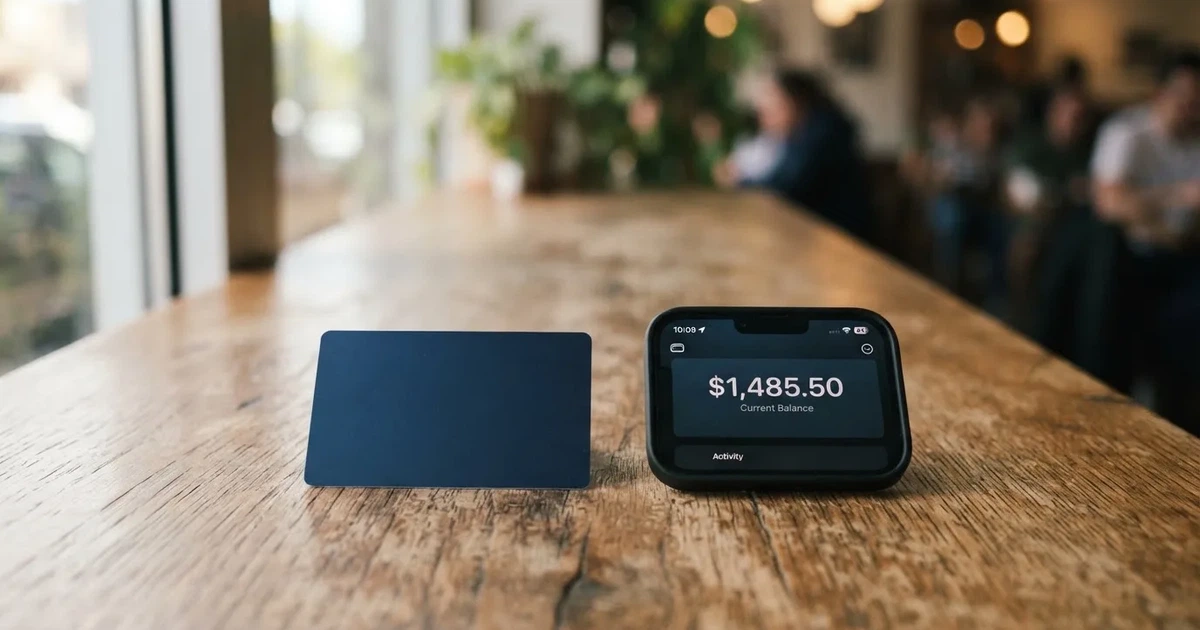
The conditions described here are current as of October 28, 2026.
Verdict: a solid euro crypto card with real caveats — 6.4 out of 10
My score for Deblock is 6.4 out of 10. That is not a condemnation; it is a card that does the basic job competently while leaving a handful of things unsaid or awkward. Here is how the score breaks down, criterion by criterion.
| Criterion | Score | Why, in short |
|---|---|---|
| Who can get it | 5 / 10 | Age and EEA residence are widely reported, not confirmed on the pages I could read; the US is restricted, the UK and Switzerland are out |
| Cost | 7 / 10 | Standard is free and crypto fees are 1.99%; non-euro card payments are free only up to a monthly euro allowance, then a percentage fee kicks in |
| Top-up options | 6 / 10 | SEPA, card and PayPal are listed; which crypto coins and networks can be sold is not stated in the documents I could read |
| Reliability and complaints | 5 / 10 | Licensed and a direct Visa member, but recent Trustpilot reports describe account blocks and held funds |
| Everyday use | 10 / 10 | Virtual cards in seconds, physical cards, Apple Pay and Google Pay from day one, and ATMs |
That table is the honest picture. The “everyday use” score is the highest one here and, I think, the reason the card is worth a look: virtual cards are created in seconds, Apple Pay and Google Pay work from the first day on both virtual and physical cards, and you can use ATMs. If your problem is “I need a card that just works at the till and in apps,” Deblock genuinely delivers. The weaker scores are about eligibility and stability — the boring parts, but the parts that decide whether you get your money when you want it.
Who it suits: EEA residents who want a euro account with a crypto wallet attached, are comfortable with crypto being sold into euros before they spend, and can live with reading a fee table. Who it does not suit: anyone in the UK or Switzerland, anyone in the US outside the restricted arrangement, anyone who wants to hold a balance of fiat inside a bank-deposit guarantee scheme, and anyone for whom an account freeze would be a serious problem. There is no promise of safety or anonymity here — this is a regulated e-money product with KYC, and I would not treat it as anything else.
Will they give you the card?
Short answer: probably yes if you are an adult living in the EEA, but the card’s own public pages do not actually spell that out, so you are relying on third-party reporting for the eligibility rules. That distinction matters, so let me be precise about what is confirmed and what is not.
On the official pages I could read, the eligibility criteria are not stated — there is no clear “who can apply” list in the documents available to me. The details below come from an unofficial source (CryptoCardHub, 2026), so treat them as a strong indication rather than a guarantee.
- Age and residence: applicants must be 18 or older and legally resident in the EEA.
- Countries: 30 countries are listed, including Austria, Belgium, Bulgaria, Croatia, Cyprus, Czechia, Denmark, Estonia, Finland, France, Germany, Greece, Hungary, Iceland, Ireland, Italy, Latvia, Liechtenstein, Lithuania, Luxembourg, Malta, Netherlands, Norway, Poland, Portugal, Romania, Slovakia, Slovenia, Spain and Sweden.
- United States: restricted.
- UK and Switzerland: not eligible.
- Basis: the rule is residence-based, not citizenship-based.
If you live in one of those 30 countries and are over 18, you are in the intended audience. If you are in the UK, Switzerland, or most of the US, this card is not for you and no amount of good intentions will change that. One more thing worth knowing generally: nationality is recorded and screened separately from residence, because sanctions screening is often applied to citizenship and country of birth as well as to your address. So a UK citizen living in France might pass the residence test but still be screened on nationality.
How to get it
Applying is a normal sign-up-and-verify flow, but the exact identity steps are not stated on the official pages I could read. From an unofficial source (CryptoCardHub, 2026), the verification asks for:
- E-mail and phone number verification
- An identity document and a video selfie
- Your residential address and occupation
- The purpose of the account, your citizenship, and the source of your funds
That last part — source of funds — is worth bracing for. Regulated businesses are required to verify customers and assess risk as part of anti-money-laundering law, and they may ask for more information later, not just at sign-up. In the EU, customer due diligence normally covers your name, address, date of birth, nationality and ID documentation, a sanctions check, the purpose of the relationship, and whether you are a politically exposed person. If the checks cannot be completed, EU rules require the institution to hold back from the transaction or relationship, and where necessary end it. This is not a Deblock quirk; it is how regulated finance works, and it is the single biggest reason accounts like this get closed.
Once you are verified, what you get is a Visa debit card, and Deblock states it is “a direct VISA member” — it issues the card itself rather than piggybacking on another bank. There are several card types:
- Standard (free)
- Premium Metal (21 g stainless steel)
- LED Metal
- Artist cards
All of them are tied to the current account denominated in euros. You also get virtual cards created in seconds and single-use “one-off” cards. On delivery, the card’s own wording is that “delivery fees may apply” for the debit card; the specific countries, delivery time, cost and replacement price are not stated in the documents I read, so budget for the possibility of a delivery charge and check at checkout. The verification tiers and how limits scale with them are not stated either.
Fees: what it really costs
This is where Deblock is more careful than most, and also where your monthly bill quietly changes shape. The headline is good — the Standard plan is free, the debit card is free to provision, and virtual cards are free — but the way fees attach depends on what you are doing: buying crypto, paying in a non-euro currency, or using an ATM.
The fee schedule as I read it:
- Standard plan: free.
- Premium: 14.99 euros per month, or 120 euros per year.
- Native: free, “provided you have owned a Deblock NFT … for at least 30 days”.
- Debit card provision: free, though “delivery fees may apply”.
- Virtual debit cards: free (Standard: 1, Premium: 10, Native: 10).
- Single-use cards: free (Standard: 3).
Here is the fuller picture in one place, mixing the plan fees with the transaction fees you are most likely to hit:
| Fee or limit | What it is | Value |
|---|---|---|
| Standard plan | Monthly subscription | Free |
| Premium plan | Monthly subscription | 14.99 euros per month (or 120 euros per year) |
| Native plan | Monthly subscription | Free if a Deblock NFT held for at least 30 days |
| Debit card provision | One-off on issue | Free; “delivery fees may apply” |
| Virtual cards | Included per plan | Standard 1, Premium 10, Native 10 |
| Single-use cards | Included per plan | Standard 3 |
| Crypto buy, sell, swap | Fee on converting between or within chains | 1.99% (Standard), 0.49% (Premium), free (Native) |
| Non-EUR card payments (Standard) | Free allowance, then a fee | Free up to 1,000 euros per calendar month, then 0.5% on weekdays and 1% at weekends |
| Extra fee on certain merchant categories | Applies on all plans | 0.5% on financial services, money transfers, funding of prepaid accounts, crypto and quasi-cash, gambling and lotteries, precious metals and jewelry |
| FX fee on card payments abroad | Stated by the cards page | “Deblock doesn’t charge any FX fee on card payments abroad”; in-app currency exchange 0% |
| ATM (euro-zone, another bank) | Per rolling month | Standard free up to 1 withdrawal or 100 euros, then 1% (min 1 euro); Premium and Native free up to 3 withdrawals or 1,000 euros, then 1% (min 1 euro) |
| ATM withdrawal abroad | FX on the withdrawal | 0% FX, limit “Plan-dependent” |
Three everyday payments, and what actually applies to each:
- A coffee in Paris, in euros, paid by card. No crypto conversion happens at the point of sale — the card simply draws down your euro balance. No FX fee, no extra merchant-category fee for a café. This is the cleanest case and costs you nothing beyond whatever the merchant charges.
- A subscription bought online in dollars on the Standard plan. This is where the free allowance runs out. Non-EUR card payments on Standard are free up to 1,000 euros per calendar month, then 0.5% on weekdays and 1% at weekends. So your first 1,000 euros of foreign-currency spending each month is clean; after that, every dollar subscription quietly costs you a percentage. (One unofficial source, Milesopedia 2026, reports that this 1,000-euro monthly free allowance ends on 11 November 2026 — a single-source claim, so I would verify it in the app rather than rely on it.)
- Withdrawing euros from a euro-zone ATM that belongs to another bank. On Standard, your first withdrawal (or 100 euros) in a rolling month is free, and after that it is 1% with a 1-euro minimum. If you take out more than a few hundred euros a month in cash, this is the fee that will actually show up — and on Standard it comes fast.
A note on the apparent contradiction in the FX line: the cards page says Deblock charges no FX fee on card payments abroad, while the fee schedule says non-EUR payments on Standard are free only up to a monthly euro allowance and then charge a percentage. I would read those as two different things — a currency-conversion markup (none) and a fee on certain foreign-currency transactions (yes, above the allowance) — but it is a fair question to put to support before you rely on it.
The bigger picture: crypto buy, sell, and swap (including swapping between chains and on the same chain) is charged at 1.99% on Standard. If you are frequently converting crypto to euros to spend, that 1.99% is the number that matters most, and it is exactly what the Native tier removes — if you are willing to hold a Deblock NFT for at least 30 days.
Top up: getting euros and crypto onto the card
The card spends the euro current account balance. So the practical question is how money gets into that balance. The fee schedule lists card top-up and PayPal top-up (in eligible regions), SEPA and instant SEPA transfers, receiving transfers, and peer-to-peer transfers. Which specific coins and networks can be sold into euros is not stated in the documents I read — so if your holding is an obscure token on an unusual chain, check before you assume.
From an unofficial source (CryptoCardHub, 2026), the fuller picture is:
- Crypto: BTC, ETH, SOL, USDC and others are sold from the self-custodial wallet into euro e-money before you spend. In other words, the crypto is not spent directly — it is converted to euros and then the card draws on the euros.
- SEPA to a personal IBAN.
- An external card in your own name, from an EU or UK issuer.
- PayPal.
- Deblock-to-Deblock transfers.
The cost of loading:
- External card top-up and PayPal top-up: free up to 2,000 euros per calendar month, then 0.5%.
- Account-funding transactions (loading another account): Standard free up to 1 transaction or 1,000 euros per rolling month, then 1 euro + 2%; Premium then 1 euro + 1%; Native then 1 euro + 1%.
- SEPA and instant SEPA transfers: free.
- Minimum top-up: not stated.
One practical warning that belongs here even though it is not a Deblock rule: a blockchain transfer sent on the wrong network, or to an address belonging to a different network, can be lost or need manual support recovery with no guarantee, because blockchain transfers are irreversible. Get the network right. Related: on-chain network fees for your deposit are charged by the blockchain, not by Deblock.
Getting money back out: from your euro balance, SEPA transfers, instant SEPA and direct debit are free on Standard; ATM withdrawals follow the limits above; and selling crypto into euros carries the conversion fee. What happens to a leftover balance if you close your account is not stated officially — though Trustpilot reviewers have said fiat funds were held for a period after closure (see the risks section).
Paying with it every day
This is the card’s strongest suit, and the section where it earns its 10. Once funded, the daily mechanics are good:
- Apple Pay and Google Pay are free on all plans, “from day 1”, for both virtual and physical cards.
- Virtual cards are created in seconds, which is genuinely useful for one-off online subscriptions where you do not want a reusable number.
- Single-use “one-off” card numbers “auto-expire after first use” — a nice safety property if a merchant stores your number.
- Cashback on card payments: Standard not included; Premium and Native “up to 1%”. The payout currency and the conditions are not stated, so I would not build a rewards strategy around the 1%.
- Apps: on the iOS App Store (Polish storefront, “Deblock – Banking App”) the app sits at 4.5 out of 5 from 22 ratings. Unofficial figures for Google Play are 4.7 from about 29,000 reviews and 500,000+ downloads (CryptoCardHub, 2026). The iOS rating count is small, so treat the app’s visible reputation as still forming.
One category caveat for daily use: the same merchant categories that carry the extra 0.5% fee — financial services, money transfers, funding of prepaid accounts, crypto and quasi-cash, gambling and lotteries, precious metals and jewelry — are worth keeping in mind if any of your regular spending falls into them. Blocked merchant categories are not stated in the pages I read; the listed categories carry a fee rather than being blocked. And how disputes and chargebacks work on this card is not stated — a gap worth raising with support, because a card you cannot easily dispute is a card you use more cautiously.
For general context on why card payments sometimes decline: a merchant can look up the card’s issuing country and card type, and some merchants treat prepaid or foreign-issued cards with extra caution. That is a property of how card networks and merchants work, not something Deblock does.
What can go wrong
This is the section I would not skip, because it is where the 6.4 shows its weight. The complaints are recent and specific.
The company and its licences. Deblock SAS is based in Lille, France. It is a crypto-asset service provider licensed by the AMF under number A2025-001 and an electronic money institution licensed by the ACPR, bank code (CIB) 17748. It is “a direct VISA member”, meaning it issues the cards itself. In the EU, an electronic money institution can issue e-money, payment cards and wallets but cannot lend, and it must safeguard customer funds in segregated accounts or insure them — but such funds are not the same as bank deposits and may not be covered by a deposit guarantee scheme. So your euro balance here is safeguarded e-money, not a bank deposit. I would not describe holding it as “as safe as a bank account”, because that is precisely the distinction the law draws.
Complaints and their themes. On Trustpilot, a user-reported source read in October 2026, the TrustScore is 4.4 out of 9,393 reviews (7,133 of them in the last 12 months), with 12% one-star, and the company replies to 25% of negative reviews. Recurring themes in those reviews include:
- Accounts blocked or closed with funds held, and a return date moved (October 2026).
- Accounts terminated without a stated reason (14 October 2026).
- A 10-euro transfer shown as successful but not credited (8 October 2026).
- Requests for clearer fees (14 October 2026).
- Balance and transfer discrepancies, and support taking about a week (October 2026).
Deblock’s own replies to these reviews cite regulatory safety measures — that is, the company attributes closures to compliance obligations. That is consistent with how EU rules work (if due diligence cannot be completed, the institution must hold back or end the relationship), but from your side of it, a held balance with a moved return date is still a real cost. This is the single biggest reason I do not push the score higher.
Reversed plans. Unofficial reporting (CryptoCardHub) says that on 11 March 2026 Deblock cancelled indefinitely a planned BLOCK token, an airdrop, staking levels, fee discounts, and card cashback of up to 10%. It is worth knowing this happened: it is a reminder that crypto “roadmap” perks are not guarantees, and a card’s advertised future is not a feature you should pay for today.
Limits and their ambiguity. The Standard card’s spending cap is stated as “No spending cap” on the cards page. However, an unofficial French review site (Milesopedia, 2026) cites 10,000 euros per card payment and 15,000 euros per month for Standard ATM withdrawals — which conflicts with “no spending cap”. Per-KYC-level limits are not stated. So do not assume unlimited spending; treat the “no cap” wording as a marketing simplification until you have seen your own limits in the app.
Security: what is and is not confirmed. The euro e-money balance is held with Deblock and, unofficial reporting says, safeguarded in segregated accounts — not under a bank-deposit guarantee. The crypto wallet side is self-custodial, meaning the seed phrase is exportable and you hold the keys; the euro balance is custodial with Deblock. Single-use card numbers auto-expire after first use. Beyond that, freeze-in-app, spending controls, custody details and two-factor authentication are not stated on the pages I read (the site navigation does list a “Self-custody” page). As a general principle, standard safeguards on cards like this include app-based 2FA, instant card freeze, spending limits, 3-D Secure confirmation and tokenised mobile wallets — but I can only confirm which of these Deblock offers by what its pages say, and on several of them the pages are silent.
Support. There are contact and FAQ pages, a public status page at status.deblock.com, and e-mail [email protected]. The site is available in English, French, German, Spanish, Italian and Portuguese. A week-long support turnaround shows up in the complaint themes, so factor that into how urgently you need help.
Fees just changed, and may change again. The fee schedule applies from 5 July 2026 to all clients regardless of when you joined. And one single-source, unofficial item to watch: Milesopedia reports the 1,000-euro monthly free allowance for non-euro payments ends on 11 November 2026. If your spending relies on that allowance, confirm it in the app.
What to take instead
If Deblock does not fit — because of where you live, because you want a card with published limits and a cleaner support record, or because you would rather not hold crypto in a custodial euro balance — there are alternatives in this category worth weighing. I have pulled their published figures; where a detail is not stated on the official pages, I say so rather than filling the gap.
Whop Cards (score 5.2 / 10). A US-focused option. For consumers it covers 31 US states (Alabama, Alaska, Arkansas, California, Colorado, Connecticut, Florida, Hawaii, Illinois, Indiana, Iowa, Kansas, Kentucky, Massachusetts, Michigan, Minnesota, Montana, Nebraska, New Hampshire, New Jersey, New York, North Carolina, Oklahoma, Pennsylvania, South Carolina, Texas, Utah, Virginia, West Virginia, Wyoming); for businesses, 41 states. Unsupported consumer countries include Belarus, China (Mainland), Cuba, Hong Kong, India, Iran, Iraq, Israel, Myanmar, Nepal, Nicaragua, North Korea, Russia, Syria, Turkey, Ukraine, Venezuela and Vietnam; unsupported corporate countries include Russia and Belarus. The basis (citizenship versus residence) is not stated. It is a Visa card that works anywhere Visa is accepted online and in stores; the virtual-versus-physical type and the card currency are not stated, and cards can also be issued to team members. On cost, the page says “No extra fees” but lists no issuance or monthly amounts, and conversion and FX fee amounts are not stated. It spends from a Whop balance, with pending balance usable as soon as a payment arrives and standard withdrawals using settled funds; the starting data says it is backed by stablecoin collateral from a linked wallet, with coins and networks not stated. It offers 5% cashback at select merchants, currently Uber, with more planned; the payout currency and conditions are not stated. If you are in the US, this is more likely to accept you than Deblock — but its euro-ness, which is Deblock’s whole appeal, is not there.
Stella (score 6.5 / 10). Offers virtual and physical VISA cards that work at “over 40 million VISA merchants globally”. On the official site the countries are not stated; its terms bar users under economic sanctions programmes and route US and European users through affiliates. Fees are not stated officially — the terms say they are “described under this User Agreement and/or on the App”. It works by custodial design: you deposit crypto into the account, which automatically tops up the card, using an in-app custodial wallet. The official card page states no cashback (the Earn product is separate yield). If you want a crypto card that is explicitly custodial and self-topping rather than self-custody-plus-euros, Stella is the cleaner conceptual fit, at the cost of the published-fee transparency Deblock offers.
UniFi Card (score 4.7 / 10). A “Prepaid Debit Visa Card” issued by Lead Bank, spending from a USD balance, with Apple Pay support in the app. Eligibility is not confirmed from official pages; the App Store lists send-money routes to the Philippines (PHP), Mexico (MXN), the eurozone (EUR) and recent release notes mention Colombia, Brazil (PIX) and the UK (GBP). Fees are not stated (“Fees may apply. See UniFi website for more details.”), as are conversion and FX fees. You fund it by receiving funds via ACH, wire, SEPA (IBAN) or SPEI (CLABE), or by getting paid to a USDC wallet; coins and networks beyond USDC are not stated on the listing. The listing claims “3% rewards on balances”; card cashback is not stated.
Placing them side by side, the honest summary is this:
| Option | Score | Card | Where it fits | What is not stated |
|---|---|---|---|---|
| Deblock | 6.4 / 10 | Visa debit, euro account, self-custody crypto | EEA residents wanting a euro account with a crypto wallet | Eligibility criteria, coins/networks, delivery cost |
| Whop Cards | 5.2 / 10 | Visa, US states | US consumers and businesses | Basis of eligibility, card currency, fee amounts |
| Stella | 6.5 / 10 | Virtual and physical Visa | A custodial, auto-topping model | Countries, all fee amounts |
| UniFi Card | 4.7 / 10 | Prepaid Visa debit (Lead Bank), USD | US-centric, USD balance | Eligibility, all fees, networks beyond USDC |
If you are in the EEA and want euros, Deblock remains the strongest of these on published-fee transparency and everyday convenience. If you are in the US, Whop or UniFi may simply be the only ones that will have you.
Who I would recommend it to
I would recommend Deblock to a specific person, and I want to be concrete rather than diplomatic. That person lives in one of the eligible EEA countries, is over 18, already has some crypto or plans to acquire a little, and their real need is “a euro card and account that links to my crypto, works with Apple Pay and Google Pay immediately, and does not charge me a subscription.” They are comfortable that their euro balance is safeguarded e-money rather than a bank deposit, they will read the fee table before spending heavily in non-euro currencies, and they can tolerate the small but real possibility that an account is reviewed and temporarily frozen — and that if it is, support may take about a week to answer.
I would not recommend it to someone whose income or savings sit for long periods in the card’s euro balance and who cannot absorb a delayed return of those funds; to anyone who needs published, generous spending or ATM limits and would be frustrated by the ambiguity between “no spending cap” and unofficial per-payment caps; to a resident of the UK, Switzerland, or most of the US; or to anyone looking for a bank, a deposit guarantee, or discretion about who knows what they are doing. It is an e-money product with a crypto wallet attached, and it should be chosen on that understanding.
If that is you, apply and read the fee table carefully. If it is not, one of the alternatives above — or a plain euro bank account — is likely the better fit.
Frequently asked questions
What is the Deblock card?
Deblock is a euro-based financial app that pairs a crypto wallet with a Visa debit card. You get a euro current account and a card that spends directly from its euro balance; separately, crypto in a self-custodial wallet can be sold into euros before you spend. Card types include Standard (free), Premium Metal, LED Metal and Artist cards, plus virtual and single-use cards. It is a payment product with crypto attached, not a bank.
How does the Deblock card work?
The card spends the euro balance in your current account. When you pay, it simply draws down that balance — so a euro purchase costs no conversion. If you hold crypto, you first sell it into euro e-money, and the card then spends the euros; crypto is never spent directly at the till. Crypto buy, sell and swap is charged at 1.99% on Standard, 0.49% on Premium and free on Native.
Is Deblock a bank?
No — it is an electronic money institution, not a bank. Deblock SAS (Lille, France) is licensed by the ACPR as an EMI, bank code (CIB) 17748, and licensed by the AMF as a crypto-asset service provider under number A2025-001. EMIs can issue e-money, cards and wallets but cannot lend, and they must safeguard customer funds in segregated accounts or insure them. Those funds are not bank deposits and are not covered by a deposit guarantee scheme.
Who owns Deblock?
Deblock is a French company, Deblock SAS, based in Lille. It is “a direct VISA member”, meaning it issues the Visa cards itself rather than relying on a third-party issuer. It holds both an AMF crypto-asset service licence (A2025-001) and an ACPR electronic money institution licence (CIB 17748). The company did not appear to have been acquired by a larger payments firm as of the information available.
Is Deblock card available in my country?
That depends on where you live. Unofficial reporting (CryptoCardHub, 2026) lists 30 eligible EEA countries including France, Germany, Spain, Italy, the Netherlands, Ireland, Austria, Poland, Sweden, Norway and others, requires you to be 18+ and legally resident in the EEA, restricts the United States, and excludes the UK and Switzerland. The card’s own readable public pages do not state the eligibility list, so check in the app before relying on this.
Can I use the Deblock card abroad?
Yes — the card works abroad and the cards page states “Deblock doesn’t charge any FX fee on card payments abroad”, with in-app currency exchange at 0%. But on Standard, non-EUR card payments are free only up to 1,000 euros per calendar month, after which 0.5% applies on weekdays and 1% at weekends. So free foreign spending is an allowance, not an unlimited state. ATM withdrawals abroad are charged at 0% FX with a plan-dependent limit.
How do I get a Deblock card?
Apply in the app and complete identity verification. Unofficial reporting (CryptoCardHub, 2026) describes e-mail and phone verification, an identity document and video selfie, residential address, occupation, account purpose, citizenship and source of funds, with the possibility of more information being requested later. Once approved, virtual cards are created in seconds and physical cards can be ordered; Apple Pay and Google Pay work “from day 1”.
Does Deblock require KYC?
Yes. Deblock is a regulated e-money and crypto-asset business, so it verifies customers as part of anti-money-laundering law. The exact Deblock steps are not stated on the official pages I could read, but third-party reporting describes document and video-selfie checks, address, occupation, citizenship and source-of-funds questions. EU rules also require a sanctions check and a politically-exposed-person assessment, and they permit accounts to be frozen or closed when due diligence cannot be completed.
How do I top up the Deblock card?
Several ways. The fee schedule lists card top-up and PayPal top-up (in eligible regions), SEPA and instant SEPA transfers, receiving transfers and peer-to-peer transfers. Unofficial reporting adds crypto (BTC, ETH, SOL, USDC and others) sold from the self-custodial wallet into euros, SEPA to a personal IBAN, an external card in your own name (EU or UK issuer), PayPal, and Deblock-to-Deblock transfers. Card and PayPal top-up are free up to 2,000 euros per calendar month, then 0.5%; SEPA is free.
Is Deblock card safe and worth it?
Safety is not a yes-or-no question. The company is properly licensed (AMF A2025-001, ACPR CIB 17748) and the crypto wallet is self-custodial, but the euro balance is safeguarded e-money, not a bank deposit, and Trustpilot (a user-reported source) shows a 4.4 score from 9,393 reviews with recent reports of accounts closed and funds held. Worth it if you want a euro card with crypto attached; less so if you need deposit-guaranteed funds or cannot tolerate a possible account freeze.
Highest-scored app and neobank cards – cryptocardbest.com
Content created by the «cryptocardbest.com» team