
Trade Republic card review: what a crypto-funded Visa from a German broker actually costs
 Available in US
The Trade Republic card turns the crypto sitting in your broker account into something you can spend at any Visa terminal, without selling first, waiting for a bank transfer, or paying a monthly fee. That is the basic idea, and it is what makes this card interesting if you already hold crypto with Trade Republic and want to use it in the real world. It is less interesting if you do not, because almost everything that makes it cheap or convenient depends on the broker relationship underneath.
Conditions are current as of October 28, 2026.

I spent time going through Trade Republic’s official pages, the press release announcing crypto spending, the help center, third-party reviews in German and Italian, and Trustpilot to see how the card actually behaves day to day. The picture that came back is a card with a genuinely low cost structure and a strong reputation, held back mostly by who can actually get one and by how little Trade Republic publishes about the card on its own site.
This review is current as of October 2026.
Verdict: 7.2 out of 10
The card scores 7.2 out of 10. It is one of the cheaper ways to spend crypto from an EU broker account, and the company behind it has a 4.6 out of 5 Trustpilot rating across more than 67,000 reviews, which is unusually high for a finance app. The score is pulled down by two real limits: eligibility is unclear beyond “EU resident” and the card’s own pages do not publish a country list, and the everyday numbers (fees, limits, supported coins) are mostly only available through unofficial sources.
| Criterion | Score | Why it scores there |
|---|---|---|
| Who can get it | 5 / 10 | Germany/EU based; the official pages do not publish a full country list |
| Cost | 8 / 10 | No monthly or annual fee; the numbers come from third-party reviews because the card page does not state them |
| Top-up options | 5 / 10 | Crypto held at Trade Republic can be spent directly, but the list of supported coins is not published |
| Reliability and complaints | 9 / 10 | Issued by Trade Republic Bank GmbH in Berlin; 4.6/5 on Trustpilot across 67,608 reviews, no card-specific complaint theme |
| Everyday use | 9 / 10 | Virtual, Classic and Mirror versions, Apple Pay and Google Pay, free ATM withdrawals from €100 |
If you are an EU resident holding crypto on Trade Republic and you want a low-friction way to spend it, this card fits. If you are outside the EU, or you want a card you can fund from any wallet, or you want fees and limits printed on the card’s own page in black and white, you will be happier elsewhere.
Will they give you the card
Trade Republic is a German broker with a banking licence, and the card is issued by Trade Republic Bank GmbH, which is registered at Brunnenstrasse 19-21, 10119 Berlin. The product is built around the EU market: the official site runs in German, Dutch and English, and everything from the company address to the press release language points to a German-and-Dutch-speaking core audience.
Beyond that, the official pages do not say who can apply. The country list, the minimum age, and the documents you need to send are not stated in the readable parts of the site. What is publicly stated is that the issuer is a Berlin-based bank and that the card is part of the Trade Republic account, so the eligibility question is really the same as opening a Trade Republic account. That is a useful framing: if you can open a Trade Republic account and fund it, you can in principle get the card.
In practice this means the card is a reasonable bet for EU residents, especially in Germany and the Netherlands where the broker is best known, and it is harder to judge for everyone else. If you are not in the EU and you are reading this, the only honest answer is to try opening an account and see what Trade Republic says. The product is not positioned as a global card, and the official pages do not promise one.
A separate but related point: the card is not advertised as anonymous, and it is not positioned for people who want to avoid identity checks. As a card from a German bank under EU rules, it sits inside the standard KYC and sanctions regime that applies to any EU-regulated payment product. If that is what you wanted, this is the wrong card to be looking at.
How to get it
The signup path is the same as opening a Trade Republic account, because the card lives inside the account rather than as a standalone product. The official pages do not walk through the steps in detail, and they do not list the documents you need to upload, the time the verification takes, or the delivery time for a physical card. That information is genuinely missing from the public site, not buried.
What third-party reviews say is that the virtual card is usable immediately after the account is opened, and that the physical cards (Classic and Mirror) are sent out once the account is in good standing. The cost to replace a lost, stolen or expired card is the same as buying a new one: €5 for Classic and €50 for Mirror, per German third-party reviews. The official pages do not confirm those replacement fees, so treat them as unofficial until Trade Republic publishes them.
Two things to know before you start. First, the verification step is not described in detail on the official site, but it follows the standard EU customer due diligence flow: identity document, proof of address, a sanctions check, and a politically exposed person check. The bank can refuse the relationship if it cannot complete that flow. Second, the card is not a separate product you can order without an account, so any friction in opening the account is friction in getting the card.
There is no sign-up bonus, no promo code, and no referral scheme mentioned on the official pages. If a site is offering you a code to get the card, it is not from Trade Republic.
Fees: what it really costs
The headline is good: the card is free to hold. There is no monthly fee and no annual fee. Crypto trading on Trade Republic is commission-free apart from a €1 third-party cost per trade, and card spending is treated as a sale of the underlying crypto for tax purposes. The card itself does not add a card-specific fee on top of that, per the press release.
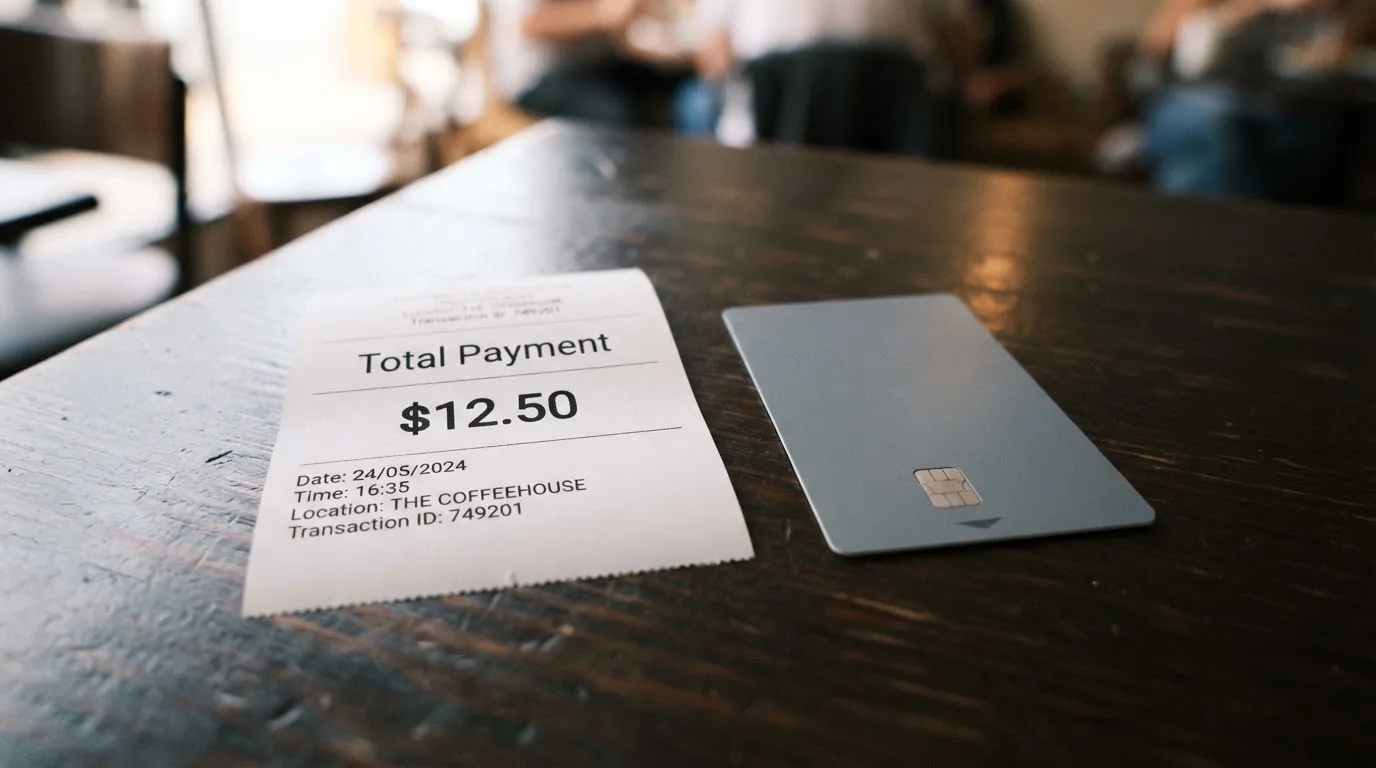
Beyond that, the numbers you actually care about (issuance, ATM, conversion, FX) are not published on the official card page. The table below uses the unofficial numbers from German and Italian third-party reviews, and I have marked each one clearly so you can see where the official site is silent. Treat the unofficial numbers as a reasonable guide, not as a quote.
| Fee or limit | Amount | Source |
|---|---|---|
| Virtual card issuance | €0 | Unofficial (third-party reviews) |
| Classic card issuance | €5 one-time | Unofficial (third-party reviews) |
| Mirror (metal) card issuance | €50 one-time | Unofficial (third-party reviews) |
| Monthly or annual fee | None | Unofficial (third-party reviews) |
| Foreign-currency surcharge | None (official Visa rate used) | Unofficial (third-party reviews) |
| ATM withdrawal, €100 or more | Free worldwide | Official card page |
| ATM withdrawal, under €100 | €1 fee | Unofficial (third-party reviews) |
| ATM operator’s own fee | May apply | Unofficial (third-party reviews) |
| Top-up by SEPA bank transfer | Free | Unofficial (third-party reviews) |
| Top-up by card, Apple Pay or Google Pay | 1% of the amount | Unofficial (third-party reviews) |
| Daily spending limit | €1,500 | Unofficial (third-party reviews) |
| Weekly spending limit | €6,000 | Unofficial (third-party reviews) |
Three everyday payments to make this concrete.
Paying for groceries in euros. You tap your card or your phone. The crypto you hold is converted to euros at the rate Trade Republic uses, and the merchant receives euros. There is no foreign-currency fee, no card fee, and no monthly fee, so the cost is just the spread between the crypto market price and the rate Trade Republic applies. That spread is not published, and it is the part most likely to bite you on a large payment. Reviews do not complain about it being punitive, but they also do not have a number to point at.
Paying for a hotel in US dollars abroad. The Visa network converts dollars to euros and charges Trade Republic a cross-border fee; Trade Republic does not add its own surcharge, so you pay the official Visa rate. Some reviews note that this is favourable compared to most bank cards, which typically add 1% to 3% on top. The €1,500 daily limit applies, and a hotel hold plus the final bill can sometimes cross that line, which can lead to a decline or a hold that lingers.
Withdrawing cash from an ATM in a non-euro country. Withdrawals of €100 or more are free, which is unusually generous for a crypto card. Withdrawals under €100 cost €1, and the ATM operator may add its own fee on top. The €1,500 daily limit and €6,000 weekly limit apply, and there is no separate cap on the number or size of withdrawals, per one third-party review.
A note on conversions and spreads: the official pages do not state the spread on crypto-to-fiat conversion, and they do not list the coins you can spend directly. Third-party reviews mention that the card advertises no conversion markup, but they also do not give a number, and past reporting on Trade Republic has mentioned high crypto spreads as a general complaint. If you plan to use the card for large payments, the cost of the spread is the thing to test with a small payment first.
Top up: how to fund the card
The card is unusual in that you do not really “top it up” in the way you would a prepaid card. You hold crypto in your Trade Republic account, and when you pay with the card the broker sells the crypto and pays the merchant in fiat. The marketing language is “spend your crypto directly,” and the press release confirms that customers can use crypto held with Trade Republic for card payments.
What is not published is the list of supported coins. The card page and the press release do not say which cryptocurrencies can be spent, and they do not say whether the conversion happens at the moment of payment or whether you can pre-convert into a euro balance. Third-party reviews imply that you can choose to spend from a euro balance or directly from crypto, but that detail is not on the official page.
Funding the underlying Trade Republic account is more standard. You can move money in by SEPA bank transfer, which is free per third-party reviews, or by card, Apple Pay or Google Pay, which costs 1% of the amount. Withdrawals from Trade Republic are not described in detail on the official site either; the help center covers the topic in general terms but does not give a step-by-step for card-related cash-outs.
A few practical points that come up in user reports. Some users have complained that Trade Republic’s crypto deposit addresses do not always warn about the network, which has led to at least one public complaint in mid-2026 about a deposit going to the wrong chain. The general rule with crypto still applies: blockchain transfers are irreversible, and sending on a network the broker does not support can mean losing the funds or waiting on support to recover them with no guarantee. If you are funding from an external wallet, double-check the network and the address before you send.
Paying with it every day
In daily use the card behaves like any other Visa debit card. You can add it to Apple Pay and Google Pay from inside the Trade Republic app, and you can use it online and in stores wherever Visa is accepted. The card is available in three versions, per third-party reviews: a virtual card, a Classic plastic card, and a Mirror metal card. Mirror differs from Classic only in the metal casing; the fees and limits are the same.
The 2% Crypto Saveback is the headline reward. Trade Republic’s press release says card spending earns 2% back, paid into a savings plan, up to a monthly spend cap of €1,500. The card page itself advertises 1% Saveback on card payments. The two are not necessarily contradictory: the 1% figure is the base rate and the 2% applies to crypto-funded payments, per third-party reviews. One review notes that a 2% rate with a €30 monthly cap was introduced at the end of 2025. Either way, the cashback is paid into a savings plan of at least €50 per month, not as spendable cash.
The 1% Saveback is not paid on transfers, ATM withdrawals, investments, top-ups, PayPal, gambling, or quasi-cash transactions, per German third-party reviews. The merchant category codes that are excluded are not published, so the only way to know is to test or to check the app after a payment. If you are spending heavily on the card, the excluded categories are where the cashback disappears.
A few things that the official site does not state but matter in practice. The card is not stated to be available in every country where Trade Republic operates, and the country list is not published. There is no public statement on 3-D Secure, dispute resolution, or the maximum number of cards per account. Reviews on Trustpilot mention that the card “works worldwide,” but that is a single user, not a guarantee.
The app is where you manage the card, freeze it, and add it to a mobile wallet. The app store listings were not read for this review, so I cannot tell you the rating or the languages supported. What I can tell you is that the Trustpilot reviews of the app in general are very positive, and the volume of reviews (over 67,000) suggests an active user base.
What can go wrong
The card sits inside a broader Trade Republic account, which means most of the risks are account-level rather than card-level.
The first is support. The most common complaint across Trade Republic’s reviews is that customer support is slow or hard to reach, especially for account issues. That is a problem for any product on the platform, including the card, because a frozen card or a stuck payment is handled by the same support queue. The official site does not list support hours, languages or channels, which makes it harder to set expectations.
The second is account blocks. Reviews mention that accounts have been blocked pending documents, and EU rules require the institution to refuse the relationship if it cannot complete customer due diligence. That is the regulator’s rule, not Trade Republic’s choice, and it can leave you without access to the card and the funds behind it while you provide what is asked for. The press and BaFin complaint volume has been rising on this point, though the date of those reports is not always clear.
The third is the spread on crypto conversion. Reviews complain that the spread on crypto trades is high, and that complaint is general rather than card-specific. Because the card spends by selling your crypto, the spread is effectively the cost of using the card. The official site does not publish the spread, so you have to discover it by paying.
The fourth is the gap between official and unofficial information. Most of the practical numbers (issuance fees, ATM fees, limits, saveback details) come from third-party reviews rather than from Trade Republic’s own pages. That is not the same as those numbers being wrong, but it does mean the card issuer has chosen not to publish them, and you have to take the unofficial source on trust.
The fifth is the regulatory environment. MiCA, the EU’s crypto regulation, has been phasing in since June 2023, with the stablecoin rules live since June 2024 and the wider crypto-asset service provider rules live since December 2024. A grandfathering period runs until 1 July 2026 or until a provider receives or is refused MiCA authorisation. Trade Republic Bank GmbH is a German bank, so it operates under that framework, but the card sits on top of crypto-asset and e-money regulation at the same time, and changes in either can change the product.
On the positive side, the issuer is a Berlin-based bank, the Trustpilot score is 4.6 out of 5 across 67,608 reviews (read 20 October 2026), and the latest review at that date was from the same day. Eleven per cent of reviews are one star, which is low for a finance app, and the visible themes are mostly about the investment side of the product rather than the card. There is no card-specific complaint theme visible in Trustpilot, and one review explicitly says the card “works worldwide.” The headline risk for the card itself is the same as the headline risk for the broker: the account around it.
What to take instead
If the Trade Republic card does not fit, there are three other cards that solve similar problems differently. None of them is a direct replacement: each makes a different trade-off on country coverage, custody, and reward.
Whop Cards scores 5.2 out of 10. It is available to consumers in 31 US states (Alabama, Alaska, Arkansas, California, Colorado, Connecticut, Florida, Hawaii, Illinois, Indiana, Iowa, Kansas, Kentucky, Maine, Massachusetts, Michigan, Minnesota, Montana, Nebraska, New Hampshire, New Jersey, New York, North Carolina, Oklahoma, Pennsylvania, South Carolina, Texas, Utah, Virginia, West Virginia, Wyoming) and to businesses in 41 states, with explicit country exclusions that include Belarus, China (mainland), Cuba, Hong Kong, India, Iran, Iraq, Israel, Myanmar, Nepal, Nicaragua, North Korea, Russia, Syria, Turkey, Ukraine, Venezuela and Vietnam. The card is a Visa that works anywhere Visa is taken, spends from a Whop balance (pending balance usable as soon as a payment arrives), and the company says there are “no extra fees” with no issuance or monthly amounts listed. The card offers 5% cashback at select merchants, currently Uber, with more planned. The basis for eligibility (citizenship versus residence) is not stated, and the coin and network list is not stated.
Stella scores 6.5 out of 10. The official site does not list the countries it serves, but the terms bar users under economic sanctions programmes and route US and European users through affiliates. The card is a Visa, virtual and physical, that works at more than 40 million Visa merchants. The fees are not stated on the official page; the user agreement and the app are where the numbers live. The card is funded by depositing crypto into the account, which automatically tops up the card from an in-app custodial wallet, and the official card page does not state a cashback rate (an Earn product for yield is separate).
UniFi Card scores 4.7 out of 10. Country availability is not confirmed from official pages; the app store listing shows send-money routes to the Philippines (PHP), Mexico (MXN), the eurozone (EUR) and recent release notes mention Colombia, Brazil (PIX) and the UK (GBP). The card is a prepaid Visa debit card issued by Lead Bank, denominated in USD, with Apple Pay support. Fees are not stated; the listing says “Fees may apply. See UniFi website for more details.” Funding is by ACH, wire, SEPA (IBAN) or SPEI (CLABE), and the app supports a USDC wallet. The listing claims 3% rewards on balances, with card cashback not stated.
In practice, if you are an EU resident already using Trade Republic, none of the three is a clear upgrade: Whop is US-focused, Stella’s country list is not public, and UniFi is a US-denominated card from a US issuer. If you are in the US and you want a card that spends from a balance backed by stablecoin collateral, Whop is the closest match.
Who I would recommend it to
I would recommend the Trade Republic card to an EU resident who already holds crypto in a Trade Republic account and wants a low-friction way to spend it. The no-monthly-fee structure, the free ATM withdrawals from €100, and the 1% to 2% Saveback into a savings plan make it one of the cheaper ways to use a broker balance in the real world, and the Trustpilot track record is strong.
I would not recommend it as your first crypto card if you are not already a Trade Republic customer, because almost every advantage of the card comes from the broker relationship underneath. I would not recommend it if you need every fee and limit printed on the card issuer’s own page, because most of the practical numbers are unofficial. And I would not recommend it if you are outside the EU, because the official pages do not state who is eligible and the product is positioned for the EU market.
If you do decide to apply, the practical order is: open a Trade Republic account first, complete the verification, fund the account by SEPA so you do not pay the 1% top-up fee, and start with the virtual card so you can test the spread and the Saveback on small payments before you commit to the €50 Mirror card or the €5 Classic.
Frequently asked questions
What is the Trade Republic card?
The Trade Republic card is a Visa debit card issued by Trade Republic Bank GmbH in Berlin, available in virtual, Classic and Mirror (metal) versions, that lets you spend crypto held in your Trade Republic broker account at any Visa-accepting merchant.
Is Trade Republic a bank?
Yes, in the sense that the card is issued by Trade Republic Bank GmbH, a Berlin-based company. Trade Republic operates as a broker with a banking licence in Germany and is regulated under the EU framework that includes MiCA.
How does the Trade Republic card work?
When you pay, Trade Republic sells the crypto in your account and pays the merchant in fiat. There is no need to convert manually, and the card behaves like a standard Visa debit card at the till or online.
How do I top up the Trade Republic card?
You do not top up the card in the usual sense; you hold crypto (or euros) in your Trade Republic account, and the card spends against that balance. Funding the account itself is by SEPA bank transfer (free) or by card, Apple Pay or Google Pay (1% fee), per third-party reviews.
Is the Trade Republic card free?
There is no monthly or annual fee. The virtual card is free, the Classic card costs €5 once, and the Mirror (metal) card costs €50 once, per third-party reviews. The official site does not publish those numbers.
Can I use the Trade Republic card abroad?
Yes. The card works anywhere Visa is accepted, and withdrawals of €100 or more are free worldwide, per the official card page. Withdrawals under €100 cost €1, and the ATM operator may charge its own fee.
How do I add the Trade Republic card to Apple Pay or Google Pay?
You add the card to Apple Pay or Google Pay from inside the Trade Republic app, per third-party reviews. The official site does not walk through the steps.
Is the Trade Republic card safe?
The card is issued by a German bank, the company holds a 4.6 out of 5 Trustpilot rating across 67,608 reviews, and the card is built into a regulated account. The main risks are account-level: support responsiveness, account blocks during KYC review, and the spread on crypto conversion, which is not published.
Does the Trade Republic card require KYC?
Yes. As a card from an EU-regulated bank, it sits inside the standard customer due diligence flow (identity document, proof of address, sanctions check, politically exposed person check), and the bank can refuse the relationship if it cannot complete that flow.
Is the Trade Republic card worth it?
For an EU resident already holding crypto at Trade Republic who wants a low-cost way to spend it, yes. For anyone outside that core case, the country eligibility is not published, the practical numbers come from third-party reviews, and a different card is likely to be a better fit.
Highest-scored app and neobank cards – cryptocardbest.com
Content created by the «cryptocardbest.com» team