
A Visa card for crypto dollars, with a low fee line and a thin layer of paperwork
 Available in US
Decaf is a crypto Visa card aimed at people whose income arrives in dollars and who want to keep their own keys while spending that money like an ordinary bank card. On paper it is a sensible shape: activate a virtual card for $5 or a physical one for $10 in the US, pay no monthly or annual fee, and spend with no foreign-exchange surcharge on top of Visa’s own rate. My score is 6.2 out of 10 — a card I would not be uncomfortable recommending, but one I would not build a financial routine around without reading the small print twice. The number is not a snob score; it is a measure of how much the card’s own pages tell you, and how much you have to accept on trust.
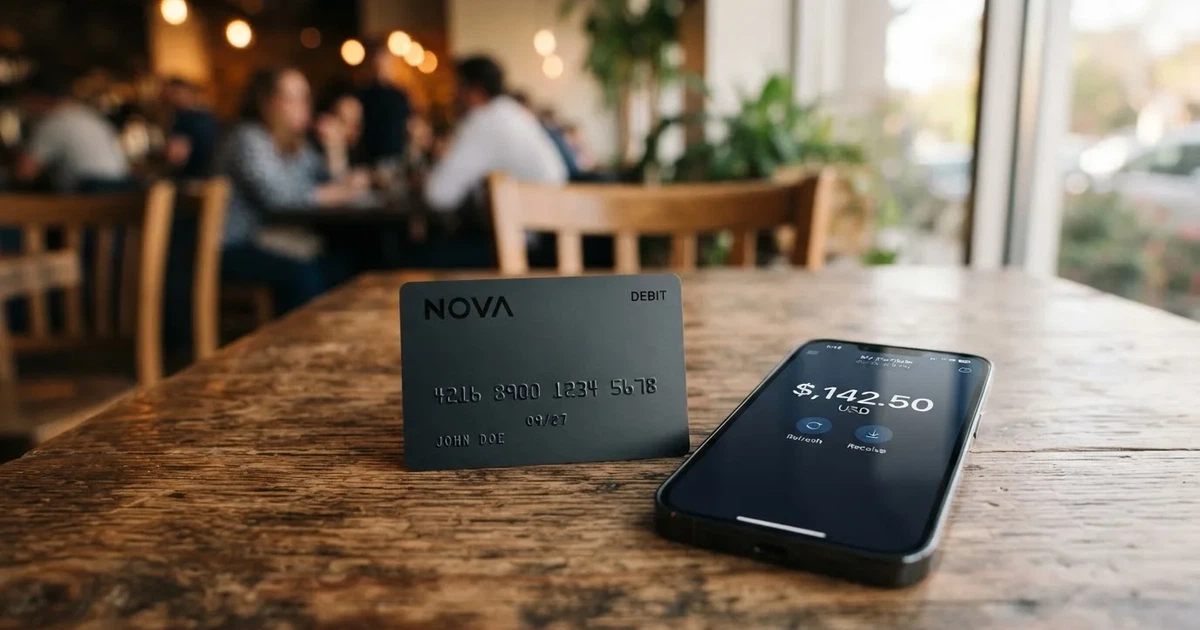
The conditions described on this page are current as of October 28, 2026.
Who this suits: freelancers and contractors paid in dollars who keep their own private keys, who travel or buy in currencies other than the dollar, and who want a card number in their wallet rather than an exchange account. Who it does not suit: anyone who needs a wide branch-and-ATM network, anyone in a restricted country or state, anyone who needs a banking relationship, and anyone for whom an unlisted issuer and an unnamed licensing structure is a dealbreaker.
The audience this card is built for, in one line: freelancers paid in dollars who keep their own keys.
Score card
| Criterion | Mark | Why |
|---|---|---|
| Who can get it | 8 / 10 | Not issued in 19 countries (Belarus, China, India, Iran, Russia, Turkey, Ukraine, Vietnam, Nigeria and others) and 12 US states |
| Cost | 7 / 10 | Virtual activation $5, physical $10 (US only) or $90 (rest of the world); no monthly or annual fee; FX at the Visa rate with no Decaf markup |
| Top-up options | 5 / 10 | Clients pay Decaf USDC; the app runs on Solana and Stellar; the coins and networks that top up the card itself are not named |
| Reliability and complaints | 4 / 10 | Decaf, Inc. (Delaware); issuer and licences not named; one Trustpilot review (1 star, Sep 23, 2026) about alleged fake support |
| Everyday use | 6 / 10 | Virtual and physical Visa; ATM $250 per transaction, up to 3 times a day; Apple Pay and Google Pay not indicated |
| Total | 6.2 / 10 | A workable card with a clean fee line and thin disclosure |
The two numbers that pulled the average down are top-up options and reliability. Everything a card does between “I want to pay for this coffee” and “the money arrived” is exactly where a crypto card earns its keep, and that is also where Decaf’s public pages are thinnest. The highest mark, who can get it, is largely earned by saying no: a long restricted list is easier to publish than a long permission list.
Who they will issue the card to
Here is the honest answer: to people outside a fairly long restricted list, and the card does not publish much beyond that. Decaf states it is not issued in these countries: Belarus, China, North Korea (DPRK), India, Iran, Iraq, Israel, Myanmar, Nepal, Russia, Syria, Turkey, Cuba, Ukraine, Venezuela, Vietnam, Nicaragua, Puerto Rico, Nigeria. Restricted US states are Arizona, Delaware, Georgia, Idaho, Louisiana, Maryland, Montana, Ohio, Oregon, Rhode Island, Washington, Wisconsin.
Read that list with care, because the way it is written matters to you. Russia and Belarus are both on it, but whether the rule is applied by citizenship or by residence is not stated. That single unanswered question is the one I would ask Decaf before anything else if I lived in one of those countries — and I am not going to guess on your behalf. The general rule in this industry is that nationality and country of birth are screened separately from where you live, because sanctions screening and issuer risk policy often follow citizenship rather than address. So if you are a citizen of a restricted country living elsewhere, the safe assumption is that you need to ask, not infer.
The twelve restricted US states are worth a second look too, because they are not the states people expect. A card that works in New York, Texas, Florida and California is not available in Delaware, Georgia, Idaho or Washington. For a reader who moves between US states, or who has a US address but a family in Arizona, that is a real constraint, not a technicality.
How to get one
The process the card describes is short: “sign up and verify your identity once.” Beyond that sentence, the public pages say very little. Which documents are accepted, whether proof of address is required, what the minimum age is, and whether verification tiers affect your limits — none of that is stated. I want to be plain about that rather than dress it up: this is not a card whose onboarding you can read end to end before you start.
What is stated about the card itself: it is a Decaf Visa card, available in a virtual or a physical form, with the physical card delivered by tracked delivery. The card currency is not stated, although the page headline reads “Earn in dollars” and the sample balance on the page is shown in USDC. So the honest picture is a dollar-oriented card where the working currency of the account is left to the app.
On the physical card, the delivery detail is real — tracked delivery — but the delivery time and the cost of a replacement card are not stated. The activation price for the physical card is $10 in the US and $90 in the rest of the world, which is a big gap and, for anyone outside the US, a real upfront cost to weigh against the ATM and fee savings later.
Fees and what a payment actually costs
The fee structure is the most attractive thing about Decaf, and I want to give it the credit it deserves. There is no monthly fee and no annual fee. The FX rate is the one Visa offers — Decaf adds no markup of its own. For a card aimed at people who spend in many currencies, that removes the single most common hidden cost in this category. The crypto conversion fee is not stated, which is the one gap in an otherwise clean line.
| Fee or limit | Value |
|---|---|
| Activation, virtual card | $5 (worldwide) |
| Activation, physical card | $10 (US only) or $90 (rest of the world) |
| Monthly fee | None |
| Annual fee | None |
| Foreign exchange | Visa’s rate; no Decaf markup |
| Crypto conversion fee | Not stated |
| ATM withdrawal fee added by Decaf | None |
| ATM limit | $250 per transaction, up to 3 times per day |
| Free ATM allowance | Not stated |
| Spending limits | Set by you in the limits section of the card screen |
| KYC-level limits | Not stated |
Two or three ordinary payments, so you can see which fees actually apply:
- An online subscription in your own currency. If you are spending dollars against a foreign-priced service, the FX line is the Visa rate with no Decaf markup, and that is the whole cost on this side. The crypto conversion fee is not stated, so I cannot tell you what the on-ramp cost is.
- A $60 purchase from a merchant in another currency. Same picture: no Decaf FX fee. What I would not promise you is that the payment goes through — a foreign-issued card can be declined by some merchants, and some shops apply extra scrutiny when the issuer country differs from your billing address.
- A $250 cash withdrawal at an ATM. Decaf adds no withdrawal fee, and the limit is $250 per transaction, up to three times a day. Whether the ATM operator charges its own surcharge is not something the card controls, and the free allowance is not stated.
If you want the general picture: prepaid cards draw on a stored balance, while a standard debit card asks the bank to withdraw from a linked account at the moment of purchase. Most crypto cards behave like prepaid cards — the crypto is converted and loaded as a balance, and the card spends only that balance, so it cannot overdraw. Decaf’s model looks like that: you load, then you spend.
Top up options
Topping up is where I have the most questions, and I would rather show you the gap than paper over it. Decaf states that clients can pay a Decaf payment link or account details by card, bank transfer or USDC. The app runs on Solana and Stellar, and the sample balance on the page is shown in USDC. Funds arrive as USDC into the Decaf balance and are moved to the card balance in the app.
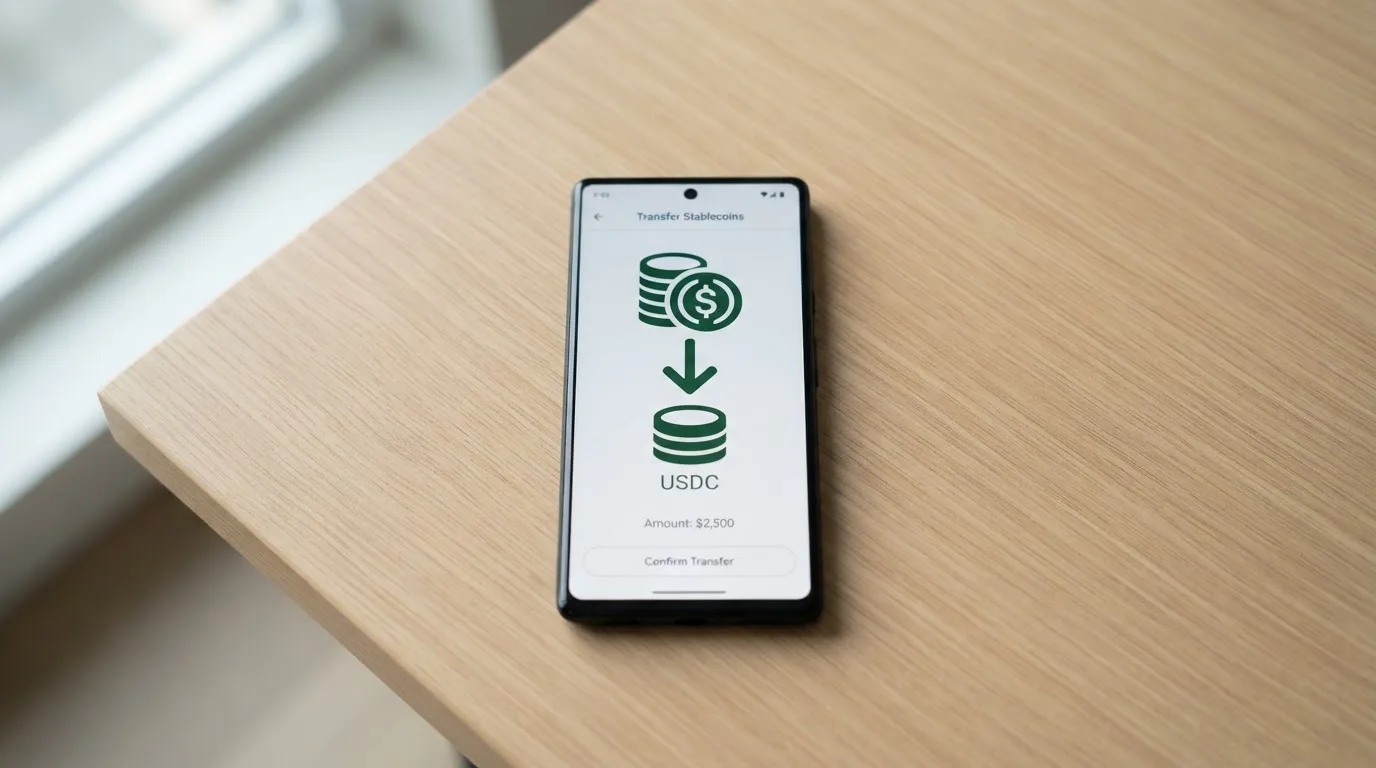
Here is what is not stated, and it is the part that bites: which coins and which networks actually top up the card itself. The deposit fee, the minimum top-up, and who pays the network fee are not stated either. In a category where sending on the wrong network can lose the money outright — blockchain transfers are irreversible, so a deposit sent on a network the provider does not support, or to an address of another network, can be lost or need manual support recovery with no guarantee — the absence of a published list is the first thing I would ask support about.
There is a related point worth understanding about the stablecoins involved. USDC is dollar-pegged; Circle says it is redeemable 1:1 for USD and fully backed by cash and cash equivalents, and it lists USDC as natively supported on 38 networks as of 16 September 2026, including Ethereum, Solana, Base, Polygon PoS, Avalanche, Arbitrum and Stellar. That network reach is reassuring in the abstract, but it is not the same thing as knowing which of them your card accepts today.
On getting money back out: bank withdrawals to accounts in “85+ markets” and cash pickup through MoneyGram in “180+ countries”. Moving the card balance back into crypto, and what happens to the balance if you close the account, are not stated.
Paying with it every day
Day to day, Decaf behaves like an ordinary Visa, which is the point. A card number starts with a 6- or 8-digit issuer identification number, and merchants can look it up to see which institution and which country issued it; some apply extra scrutiny when that issuer country differs from your billing address. That is the general reason a card issued in one country can look “foreign” to a shop in another, and it is worth keeping in mind rather than treating a decline as a fault.
Two things about daily use I would want to know and cannot: the card’s App Store listing is for iPhone, iPad and Apple Vision, rated 4.4 out of 5 from 113 ratings when I read it on 2026-10-21, and the Google Play listing was not read. Whether Apple Pay and Google Pay are supported, and which merchant categories are blocked, are not stated. That last one matters: many issuers block the gambling merchant category (MCC 7995) on specific cards by policy rather than by law, and the blocked list varies by issuer. Rewards are not stated either — there is no cashback rate to quote you.
A general note on why 3-D Secure will not show up in your normal card flow: it adds an identity check to online payments, with the issuer either approving frictionlessly or challenging you with a one-time code or biometric. Visa’s brand is Visa Secure. If a payment ever hangs at that step, it is the system working, not something going wrong.
The card screen lets you set your own spending limits, which is one of the standard safeguards in this category alongside app-based 2FA, instant card freeze and tokenised mobile wallets. An in-app freeze and 2FA are not stated for Decaf specifically.
What can go wrong
Nothing official. That is worth saying first, because it is what I found: no official incidents. Then the unofficial picture, which you should weigh accordingly. On Trustpilot, decaf.so has a TrustScore of 3.2 out of 5 from one review — a 1-star review dated Sep 23, 2026, on an unclaimed profile, titled “Scammers 2” and alleging fake support. That is a user report, not a finding. One review is far too few to establish a pattern, and I am not going to tell you it proves anything. What I can tell you is that the specific complaint — that support was not what it claimed to be — is the kind of complaint that, if it happened to you, would happen at the worst possible moment: when a deposit is stuck on the wrong network. A search for card reviews found no Reddit threads and no card-specific reviews, which cuts both ways — it means there is no body of user experience to learn from yet, and it means no corroboration of the one complaint that exists.
The bigger structural risks are not about complaints at all. They are about who is actually behind the card. Decaf, Inc. is described as a “financial technology company registered in Delaware, USA” that is “not a bank, exchange, or asset custodian”, and states that payment services are provided via licensed partners in each jurisdiction. The card issuer is not named, and no licences are named. Read that alongside how this category works: a card payment involves several parties — the network (Visa or Mastercard) routes messages and sets the rules, the issuer is the bank or e-money institution licensed under that network, and the crypto brand is often only a programme manager or front end that markets the card. So the absence of a named issuer is a real gap in the disclosure, not a technicality I can wave through.
There is history here worth knowing, because it is not hypothetical. In November 2022 Visa said it had “terminated our global agreements with FTX”, and the FTX US debit card programme was wound down by its issuer. WaveCrest, a Visa issuer that supplied crypto card brands, was suspended by Visa in Europe in 2018, closing all WaveCrest-issued Visa programmes. Programme closures tend to follow a pattern: a notice period, then spending and loading stop, then users are asked to withdraw remaining balances. One 2026 closure reported by a secondary source had new loads ending 8 July 2026 and spending stopping 8 August 2026 — a single unconfirmed source, so treat it as a shape rather than a date.
The other structural risk is custody, and here Decaf is on the stronger side. Its App Store listing describes a non-custodial app where “only you control your private keys”, and Decaf states it is not an asset custodian. That is a genuinely different posture from a custodial platform, and it is worth something: with a self-custody-linked card the funds stay in your own wallet until the moment of payment. The trade is that you bear sole responsibility for key loss, for phishing, and for clipboard-hijacking malware that swaps a copied address. A seed phrase is typically 12 to 24 words and is an unencrypted form of your private key — anyone who obtains it can restore the wallet and spend its funds, and because transfers are typically irreversible there is no built-in recovery. Custody has its own scar tissue, for what it is worth: Mt. Gox (about US$350 million reported stolen, 2011–2014), Coincheck (about US$400 million, 2018) and Ronin Network (US$625 million, 2022).
Support itself is thin: a Help Center on Intercom with collections for Business Accounts, Decaf wallet, DecafPay and Guidelines, no other channels or hours listed, and an English-only app — Russian is not supported. And on closing: how to delete your account, and what happens to any balance, is not something the pages answer.
If you are in the EU or UK, there is a register worth checking that goes beyond reading a card’s website: ESMA keeps an interim register of authorised crypto-asset service providers, white papers and non-compliant entities, and you can look a provider up there. Under MiCA, e-money tokens may be issued only by a credit institution or an electronic money institution. Note also that a card is a payment service regulated separately from the crypto side, so a crypto card often depends on two licences — which is another reason the unnamed issuer matters.
Alternatives worth comparing
I looked at three other cards in this category so you can see where Decaf sits rather than taking my word for it.
| Card | Score | Up-front and ongoing cost | Spend fee | Top-up |
|---|---|---|---|---|
| Decaf | 6.2 / 10 | $5 virtual; $10 (US) or $90 physical; no monthly or annual fee | FX at Visa rate, no Decaf markup; conversion fee not stated | Card, bank transfer or USDC; coins and networks for the card not stated |
| BloFin Wallet Card | 6.9 / 10 | Activation, annual, issuance and dormancy fees $0.00; no cancellation fee | 1% or lower by VIP tier (VIP 0 1.00% down to VIP 5 0.00%), charged at payment; FX not stated | USDT and USDC on Arbitrum and Base |
| SafePal | 6.2 / 10 | No account creation or management fees; card issuance fee not stated | Mastercard non-USD settlement 1% FX fee; refunds 1 USD/EUR/CHF/7 CNH; swaps include an unquantified spread | Crypto from 40+ blockchains to USDC (default) or fiat, on Arbitrum |
| Avici | 6.1 / 10 | “No Hidden Fee”, “No Gas Fee, No Interchange Fee”; no amounts | Not stated | Crypto deposit to Avici, then top up the card; coins and networks not listed |
Three contrasts stand out. BloFin scores higher and charges nothing to keep the account, but it takes a percentage on every payment — from 1.00% at the lowest tier down to zero at the top. That is the trade Decaf makes differently: nothing per payment, and an unquoted conversion fee. SafePal’s headline top-up fee is 0%, but a 1% Mastercard settlement fee on non-USD payments is the same idea as an FX markup wearing a different name, and its swaps carry a spread that is not quantified. Avici advertises no hidden fees and lists travel perks, but publishes no amounts at all — which, if you want to plan a budget, is the least useful kind of transparency.
Country availability is where none of them tell you much. BloFin does not publish a country list on the card page (the app asks you to “select your country or region”), though the starting data lists 35 countries including the US, Australia, Japan, the UAE, Brazil, Mexico, Malaysia and New Zealand; whether the test is citizenship or residence is not stated. SafePal says “citizens of supported regions who live in supported areas”, and its regions page was empty when I fetched it. Avici says nothing at all. On this axis Decaf is the most informative of the four, which is why it scores highest on who can get it — and also why I would still ask about citizenship rather than residence.
Who I would recommend it to
I would recommend Decaf to someone in this position: you earn in dollars, you hold your own keys, you spend in more than one currency, and you want a card that does not charge you to exist or to convert. For that person the fee line is genuinely better than most of the field, the card works as a plain Visa, and the non-custodial design means your money is not sitting behind someone else’s balance sheet.
I would not recommend it, without a conversation with support, to someone whose main worry is getting money in. If your income arrives as USDT on Tron and Decaf’s card does not list your network, you are one wrong transfer away from an irreversible loss with no published recovery promise. The page names Solana and Stellar for the app and USDC for client payments; it does not tell me what the card itself accepts.
And I would hold back anyone who needs a bank. Decaf says plainly that it is “not a bank, exchange, or asset custodian”. In the EU, e-money funds must be safeguarded — segregated in dedicated accounts or insured — but such funds are not bank deposits and may not sit under a deposit guarantee scheme. In the US, prepaid-card coverage varies and should not be assumed. Reversal rights differ too: US debit card rights come from Regulation E and credit card rights from Regulation Z, and a declined authorisation can leave a hold on funds for several days, typically up to seven. None of that makes Decaf a bad card. It makes it a card, and you should hold it as one.
My honest summary: good economics, thin paperwork. The 6.2 is not a verdict on the product. It is a verdict on how much I could confirm.
Frequently asked questions
What is the Decaf card?
Decaf is a Visa payment card, available in virtual and physical form, that lets you spend a balance funded from crypto. Clients pay a Decaf payment link or account details by card, bank transfer or USDC, funds arrive as USDC into the Decaf balance, and you move them to the card balance in the app. Decaf describes itself as a financial technology company registered in Delaware, USA.
Is Decaf a bank?
No — and the company says so itself. Decaf, Inc. is described as “not a bank, exchange, or asset custodian”, providing payment services through licensed partners in each jurisdiction. The card issuer is not named on the public pages and no licences are named either. If you need deposit-guarantee protection, treat that as a question to ask before you rely on the card.
Who can get the Decaf card?
Decaf is not issued in 19 listed countries — Belarus, China, North Korea, India, Iran, Iraq, Israel, Myanmar, Nepal, Russia, Syria, Turkey, Cuba, Ukraine, Venezuela, Vietnam, Nicaragua, Puerto Rico and Nigeria — and not in 12 US states: Arizona, Delaware, Georgia, Idaho, Louisiana, Maryland, Montana, Ohio, Oregon, Rhode Island, Washington and Wisconsin.
Does the Decaf card require KYC, and what documents?
The card states that you “sign up and verify your identity once”. Which documents are accepted, whether proof of address is required, what the minimum age is, and whether verification tiers change your limits are all not stated. That is a gap in the published onboarding, not a permission to assume it is light.
How much does the Decaf card cost?
Activation is $5 worldwide for the virtual card, and $10 (US only) or $90 (rest of the world) for the physical card. There is no monthly fee and no annual fee. Decaf adds no FX markup — “the FX is the one Visa offers” — while the crypto conversion fee is not stated.
How do I top up the Decaf card?
You can pay a Decaf payment link or account details by card, bank transfer or USDC; the app runs on Solana and Stellar, and the sample balance is shown in USDC. Which coins and networks top up the card itself, the deposit fee, the minimum top-up, and who pays the network fee are not stated — and on an unsupported network a transfer can be lost.
Can I use the Decaf card in my country, and where can I spend it?
The restricted-country and restricted-state lists above are the published answer on eligibility. On where the card spends, the pages do not give a merchant list, and Apple Pay, Google Pay and blocked merchant categories are not stated. A foreign-issued Visa can also be declined by some merchants, and declined payments may leave a hold on funds for several days.
Is the Decaf card safe?
Decaf’s app is non-custodial per its App Store listing — “only you control your private keys” — and the company says it is not an asset custodian, so your keys stay with you and key loss, phishing and wrong-address transfers are your responsibility. No official incidents were found. One unofficial Trustpilot review (1 star, Sep 23, 2026) alleged fake support; a single review cannot establish a pattern.
Is the Decaf card worth it?
For someone paid in dollars who keeps their own keys and spends in several currencies, the economics are the best part: no monthly or annual fee and no FX markup. Against that, the conversion fee is not stated, the card’s own issuer and licences are unnamed, top-up networks are unpublished, and support is an Intercom Help Center in English only. I scored it 6.2 out of 10.
How do I delete my Decaf account, and what happens to my balance?
The public pages do not say. How to close an account, and what happens to any remaining balance — including whether it can be moved back to crypto — is not stated. If you hold a balance you cannot afford to lose, ask support this before you close anything.
Highest-scored wallet cards – cryptocardbest.com
Content created by the «cryptocardbest.com» team